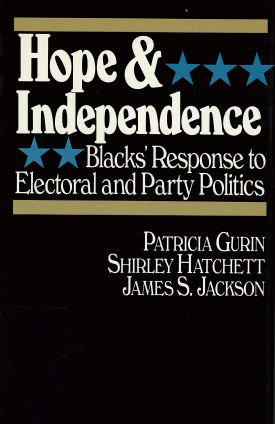
Cover image of the book Hope and Independence
Books

Hope and Independence

Blacks' Response to Electoral and Party Politics
Authors
Patricia Gurin
Shirley Hatchett
James S. Jackson
Hardcover
Add to Cart
Publication Date
6 in. × 9 in. 368 pages
ISBN
978-0-87154-374-5
Also Available From

About This Book

Over the past fifteen years, a New Black Politics has swept black candidates into office and registered black voters in numbers unimaginable since the days of Reconstruction. Based on interviews with a representative sample of nearly 1,000 voting-age black Americans, Hope and Independence explores blacks' attitudes toward electoral and party politics and toward Jesse Jackson's first presidential bid. Viewed in the light of black political history, the survey reveals enduring themes of hope (for eventual inclusion in traditional politics, despite repeated disappointments) and independence (a strategy of operating outside conventional political institutions in order to achieve incorporation).

The authors describe a black electorate that is less alienated than many have suggested. Blacks are more politically engaged than whites with comparable levels of education. And despite growing economic inequality in the black community, the authors find no serious class-based political cleavage. Underlying the widespread support for Jackson among blacks, a distinction emerges between "common fate" solidarity, which is pro-black, committed to internal criticism of the Democratic party, and conscious of commonality with other disadvantaged groups, and "exclusivist" solidarity, which is pro-black but also hostile to whites and less empathetic to other minorities. This second, more divisive type of solidarity expresses itself in the desire for a separate black party or a vote black strategy—but its proponents constitute a small minority of the black electorate and show surprisingly hopeful attitudes toward the Democratic party.

Hope and Independence will be welcomed by readers concerned with opinion research, the sociology of race, and the psychology of group consciousness. By probing the attitudes of individual blacks in the context of a watershed campaign, this book also makes a vital contribution to our grasp of current electoral politics.

PATRICIA GURIN is professor of psychology and faculty associate at the Institute for Social Research, University of Michigan.

SHIRLEY HATCHETT is research investigator at the Institute for Social Research.

JAMES A. JACKSON is professor of psychology and associate dean at the Rachkam School of Graduate Studies, University of Michigan, as well as research scientist at the Institute for Social Research.

RSF Journal
View Book Series
Sign Up For Our Mailing List
Apply For Funding
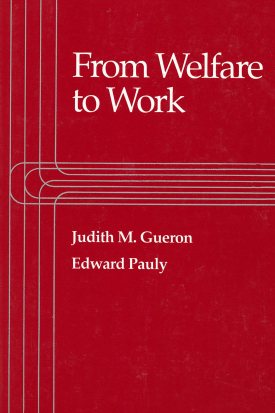
Cover image of the book From Welfare to Work
Books

From Welfare to Work

Authors
Judith M. Gueron
Edward Pauly
Paperback
Add to Cart
Publication Date
6 in. × 9 in. 336 pages
ISBN
978-0-87154-346-2
Also Available From

About This Book

"Above all others, Judy Gueron and her colleagues at MDRC did the research that led the Congress to pass the Family Support Act two years ago. As a result, we now have a historic opportunity to help welfare recipients become self-sufficient. But for that to happen, we must learn the lessons contained in From Welfare to Work, and make sure they are reflected in the reforms being implemented across the nation."
- SENATOR DANIEL PATRICK MOYNIHAN

"A truly exceptional achievement. This is the definitive book on welfare-to-work programs. It represents a triumph of reason and research in an arena swamped by anecdote and emotion. MDRC's studies have dominated the discussion about welfare reform because they are universally accepted as careful, thoughtful, and unbiased. Anyone who cares about welfare reform - academics and administrators, politicians and the press, policy analysts and the public - must read this book."
- DAVID T. ELLWOOD, Harvard University

"Required reading for anyone involved in efforts to boost employment among welfare recipients. A thorough review of what we know - and the large amount we have yet to learn- about what works effectively. And a good antidote for those who tend to overstate the impacts that welfare-to-work programs, by themselves, can have in reducing poverty."
- ROBERT GREENSTEIN, Center on Budget and Policy Priorities

"Required reading for every administrator responsible for implementing JOBS, one of the most ambitious and complex social programs of the last few decades. Clearly and concisely, this book illuminates the critical choices administrators face about whom to serve, what the desired outcomes are, and how to allocate resources."
-JULIA I. LOPEZ, Department of Social Services, City and County of San Francisco

"From Welfare to Work is the 'Bible' on the MDRC studies of welfare employment programs, which comprise most of what we know about how to move welfare recipients toward work. This book is a 'must' for anyone interested in thes initiatives, which are at the cutting edge of social policy today."
- LAWRENCE M. MEAD, New York University

From Welfare to Work appears at a critical moment, when all fifty states are wrestling with tough budgetary and program choices as they implement the new federal welfare reforms. This book is a definitive analysis of the landmark social research that has directly informed those choices: the rigorous evaluation of programs designed to help welfare recipients become employed and self-sufficient. It discusses forty-five past and current studies, focusing on the series of seminal evaluations conducted by the Manpower Demonstration Research Corporation over the last fifteen years.

Which of these welfare-to-work programs have worked? For whom and at what cost? In answering these key questions, the authors clearly delineate the trade-offs facing policymakers as they strive to achieve the multiple goals of alleviating poverty, helping the most disadvantaged, curtailing dependence, and effecting welfare savings. The authors present compelling evidence that the generally low-cost, primarily job search-oriented programs of the late 1980s achieved sustained earnings gains and welfare savings. However, getting people out of poverty and helping those who are most disadvantaged may require some intensive, higher-cost services such as education and training. The authors explore a range of studies now in progress that will address these and other urgent issues. They also point to encouraging results from programs that were operating in San Diego and Baltimore, which suggest the potential value of a mixed strategy: combining job search and other low-cost activities for a broad portion of the caseload with more specialized services for smaller groups.

Offering both an authoritative synthesis of work already done and recommendations for future innovation, From Welfare to Work will be the standard resource and required reading for practitioners and students in the social policy, social welfare, and academic communities.

JUDITH M. GUERON is president of the Manpower Demonstration Research Corporation (MDRC).

EDWARD S. PAULY is senior research associate and coordinator of education research for MDRC.

RSF Journal
View Book Series
Sign Up For Our Mailing List
Apply For Funding
Cover image of the book Race and Authority in Urban Politics
Books

Race and Authority in Urban Politics

Authors
J. David Greenstone
Paul E. Peterson
Hardcover
Add to Cart
Publication Date
6 in. × 9 in. 384 pages
ISBN
978-0-87154-373-8
Also Available From

About This Book

What really happened when citizens were asked to participate in their community’s poverty programs? In this revealing new book, the authors provide an answer to this question through a systematic empirical analysis of a single public policy issue—citizen participation in the Community Action Program of the Johnson Administration’s “War on Poverty.” Beginning with a brief case study description and analysis of the politics of community action in each of America’s five largest cities—New York, Chicago, Los Angeles, Detroit, and Philadelphia—the authors move on to a fascinating examination of race and authority structures in our urban life.

In a series of lively chapters, Professors Greenstone and Peterson show how the coalitions that formed around the community action question developed not out of electoral or organizational interests alone, but were strongly influenced by our conceptions of the nature of authority in America. They discuss the factors that affected the development of the action program and they note that democratic elections of low-income representatives, however much preferred by democratic reformers, were an ineffective way of representing the interests of the poor.

The book stresses the way in which both machine and reform structures affected the ability of minority groups to organize effectively and to form alliances in urban politics. It considers the wide-ranging critiques made of the Community Action Program by conservative, liberal, and radical analysts and finds that all of them fail to appreciate the significance and intensity of the racial cleavage in American politics.

J. DAVID GREENSTONE is professor and chairman of the Political Science Department at the University of Chicago.

PAUL E. PETERSON is associate professor in the Department of Political Science and Education at the University of Chicago.

RSF Journal
View Book Series
Sign Up For Our Mailing List
Apply For Funding
Cover image of the book Perceptions of Technological Risks and Benefits
Books

Perceptions of Technological Risks and Benefits

Authors
Leroy C. Gould
Gerald T. Gardner
Donald R. DeLuca
Adrian R. Tiemann
Leonard W. Doob
Jan A. J. Stolwijk
Hardcover
Add to Cart
Publication Date
6 in. × 9 in. 296 pages
ISBN
978-0-87154-362-2
Also Available From

About This Book

The election of Ronald Reagan in 1980 was said to herald a new mood of opposition to government regulation. But at the same time, large and vocal segments of the population have been demanding that corporations and regulatory agencies address public concerns about technological safety. What do we really know about people's perceptions of technological risk and their judgments about appropriate levels of technological regulation?

Perceptions of Technological Risks and Benefits analyzes the results of a unique body of survey data—the only large-scale, representative survey of public attitudes about risk management in such technologies as nuclear power, handguns, auto travel, and industrial chemicals. The findings demonstrate that public judgments are not simply anti-technological or irrational, but rather the product of a complex set of factors that includes an awareness of benefits as well as a sensitivity to the "qualitative" aspects of risk (how catastrophic, dreaded, or poorly understood a hazard seems to be).

This volume offers striking evidence that whatever Americans may think about government regulation in general, they are remarkably consistent in desiring stricter regulation of technological safety. These conclusions suggest that the current trend away from regulation of technology reflects a less than perfect reading of public sentiment.

LEROY C. GOULD, GERALD T. GARDNER, DONALD R. DeLUCA, ADRIAN R. TIEMANN, LEONARD W. DOOB, and JAN A. J. STOLWIJK are all members of the original "Energy Seminar" at Yale University.

RSF Journal
View Book Series
Sign Up For Our Mailing List
Apply For Funding
Cover image of the book Families That Work
Books

Families That Work

Policies for Reconciling Parenthood and Employment
Authors
Janet C. Gornick
Marcia K. Meyers
Paperback
$29.95
Add to Cart
Publication Date
6 in. × 9 in. 404 pages
ISBN
978-0-87154-359-2
Also Available From

About This Book

"[Families That Work] is most valuable for its extensive and up-to-date tabulations, by country, of family-related practices and policies .... A prodigious work of scholarship in a growing and important interdisciplinary field."
-MONTHLY LABOR REVIEW

"Janet Gornick and Marcia Meyers have written a lively and accessible book, combining a high level of expertise on American social policy with an equally high level of knowledge of European and Canadian social policy. It is rare to find both in a single book. Moreover, they argue convincingly that, over the next several years, expansion of work-family policy in the United States is very likely. When American policymakers finally get serious about enacting paid family leave and universal pre- kindergarten programs, they should turn to this book for crucial lessons in policy design and for forecasts of policy impacts based on other nations' experiences. This will become a key resource in the field of family policy design for many years to come."
-TIMOTHY M. SMEEDING, Maxwell Professor of Public Policy, professor of economics and public administration,
and director, Center for Policy Research, Syracuse University

"The best guide in the world to family policies the United States sorely needs. Janet Gornick and Marcia Meyers argue persuasively that greater public support and reformed employment practices could benefit children and promote more equal sharing of care responsibilities. Their startling comparisons of European and U.S. programs reveal complex interactions between the labor market, the family, and the state. They also bring hopeful fantasies down to realistic earth."
-NANCY FOLBRE, professor of economics, University of Massachusetts

"Families That Work shows us how government policies could help parents combine paid work and caring for children. The harder question is whether we can do it in a way that reduces rather than exacerbates gender inequality. Janet Gornick and Marcia Meyers say yes, and present the most compelling evidence ever assembled. Read this excellent book."
-PAULA ENGLAND, professor of sociology and faculty fellow, Institute for Policy Research, Northwestern University

Parents around the world grapple with the common challenge of balancing work and child care. Despite common problems, the industrialized nations have developed dramatically different social and labor market policies—policies that vary widely in the level of support they provide for parents and the extent to which they encourage an equal division of labor between parents as they balance work and care. In Families That Work, Janet Gornick and Marcia Meyers take a close look at the work-family policies in the United States and abroad and call for a new and expanded role for the U.S. government in order to bring this country up to the standards taken for granted in many other Western nations.

In many countries in Europe and in Canada, family leave policies grant parents paid time off to care for their young children, and labor market regulations go a long way toward ensuring that work does not overwhelm family obligations. In addition, early childhood education and care programs guarantee access to high-quality care for their children. In most of these countries, policies encourage gender equality by strengthening mothers’ ties to employment and encouraging fathers to spend more time caregiving at home. In sharp contrast, Gornick and Meyers show how in the United States—an economy with high labor force participation among both fathers and mothers—parents are left to craft private solutions to the society-wide dilemma of “who will care for the children?” Parents—overwhelmingly mothers—must loosen their ties to the workplace to care for their children; workers are forced to negotiate with their employers, often unsuccessfully, for family leave and reduced work schedules; and parents must purchase care of dubious quality, at high prices, from consumer markets. By leaving child care solutions up to hard-pressed working parents, these private solutions exact a high price in terms of gender inequality in the workplace and at home, family stress and economic insecurity, and—not least—child well-being. Gornick and Meyers show that it is possible–based on the experiences of other countries—to enhance child well-being and to increase gender equality by promoting more extensive and egalitarian family leave, work-time, and child care policies.

Families That Work demonstrates convincingly that the United States has much to learn from policies in Europe and in Canada, and that the often-repeated claim that the United States is simply “too different” to draw lessons from other countries is based largely on misperceptions about policies in other countries and about the possibility of policy expansion in the United States.

JANET GORNICK is associate professor of political science at Baruch College, and the Graduate Center, City University of New York.

MARCIA K. MEYERS is associate professor of social work and public affairs, University of Washington.

RSF Journal
View Book Series
Sign Up For Our Mailing List
Apply For Funding
Cover image of the book Overcoming Apartheid
Books

Overcoming Apartheid

Can Truth Reconcile a Divided Nation?
Author
James L. Gibson
Paperback
$32.50
Add to Cart
Publication Date
6 in. × 9 in. 488 pages
ISBN
978-0-87154-313-4
Also Available From

About This Book

Winner of the 2004 Best Book Award from the Race, Ethnicity, and Politics Section of the American Political Science Association

"This is a bold and immensely important book that focuses attention on one of the most critical issues of our time. Namely, can facing the truth about a nation's brutal, violent, and oppressive history lead to reconciliation among that nation's former and bitter enemies? In what is perhaps the most sophisticated and subtle analysis of the South African reconciliation process to be found anywhere in the literature, James Gibson explores a number of unanticipated complexities generated by this seemingly simple question, and, in the process, provides us with encouraging, if somewhat disheartening, insights. This book is simply a must read for anyone interested in understanding the reconciliation process in South Africa and its possible implications for the resolution of intergroup conflict in other parts of the world."
-JAMES SIDANIUS, professor of psychology, University of California, Los Angeles

"Overcoming Apartheid is a singular work, a test of the proposition that acknowledgement of evil on both sides of a conflict can bring warring parties together. It is absorbing in a way few works in social science are, in parts optimistic, in others ominous, but in all a model of pursuit of truth."
-PAUL M. SNIDERMAN, Fairleigh S. Dickinson Jr. Professor in Public Policy, Stanford University

Perhaps no country in history has so directly and thoroughly confronted its past in an effort to shape its future as has South Africa. Working from the belief that understanding the past will help build a more peaceful and democratic future, South Africa has made a concerted, institutionalized effort to come to grips with its history of apartheid through its Truth and Reconciliation Commission. In Overcoming Apartheid, James L. Gibson provides the first systematic assessment of whether South Africa's truth and reconciliation process has been successful. Has the process allowed South Africa to let go of its painful past and move on? Or has it exacerbated racial tensions by revisiting painful human rights violations and granting amnesty to their perpetrators?

Overcoming Apartheid reports on the largest and most comprehensive study of post-apartheid attitudes in South Africa to date, involving a representative sample of all major racial, ethnic, and linguistic groups. Grounding his analysis of truth in theories of collective memory, Gibson discovers that the process has been most successful in creating a common understanding of the nature of apartheid. His analysis then demonstrates how this common understanding is helping to foster reconciliation, as defined by the acceptance of basic principles of human rights and political tolerance, rejection of racial prejudice, and acceptance of the institutions of a new political order. Gibson identifies key elements in the process—such as acknowledging shared responsibility for atrocities of the past—that are essential if reconciliation is to move forward. He concludes that without the truth and reconciliation process, the prospects for a reconciled, democratic South Africa would diminish considerably. Gibson also speculates about whether the South African experience provides any lessons for other countries around the globe trying to overcome their repressive pasts.

A groundbreaking work of social science research, Overcoming Apartheid is also a primer for utilizing innovative conceptual and methodological tools in analyzing truth processes throughout the world. It is sure to be a valuable resource for political scientists, social scientists, group relations theorists, and students of transitional justice and human rights.

JAMES L. GIBSON is Sidney W. Souers Professor of Government at Washington University, St. Louis.

RSF Journal
View Book Series
Sign Up For Our Mailing List
Apply For Funding
Cover image of the book Union Respresentation Elections
Books

Union Respresentation Elections

Law and Reality
Authors
Julius G. Getman
Stephen B. Goldberg
Jeanne B. Herman
Hardcover
Add to Cart
Publication Date
6 in. × 9 in. 240 pages
ISBN
978-0-87154-302-8
Also Available From

About This Book

Provides the first major effort to test the rules and regulations that underlie current practices in union elections and, at the same time, explores the role played by the National Labor Relations Board in regulating these elections. The book reports the findings of an empirical field study of thirty-one union representation elections involving over 1,000 employees to determine their pre-campaign attitudes, voting intent, actual vote, and the effect of the campaign on voting. It focuses on campaign issues, unlawful campaigning, working conditions, demographic factors, job-related variables, and other topics.

JULIUS G. GETMAN is professor of law at Stanford and Indiana Universities.

STEPHEN B. GOLDBERG is professor of law at Northwestern University.

JEANNE B. HERMAN is associate professor of organizational behavior at the Graduate School of Management, Northwestern University.

RSF Journal
View Book Series
Sign Up For Our Mailing List
Apply For Funding
Cover image of the book E Pluribus Unum?
Books

E Pluribus Unum?

Contemporary and Historical Perspectives on Immigrant Political Incorporation
Editors
Gary Gerstle
John H. Mollenkopf
Paperback
$33.95
Add to Cart
Publication Date
6 in. × 9 in. 434 pages
ISBN
978-0-87154-307-3
Also Available From

About This Book

"Analysts intersted in what the future holds for political representation of new immigrant groups and their children, as well as for the normative goal of political equality more generally, will find this anthology both informative and stimulating."
-Journal of American Ethnic History

"E Pluribus Unum? is a pathbreaking volume that brings together historians and social scientists to explore the dynamics of political incorporation in the twentieth century's two great immigration waves. From political machines and naturalization to education, transnational loyalties, and racial exclusion, the many excellent essays provide insights into the way immigration has changed-and continues to change-American civic culture and political life."
-NANCY FONER, State University of New York, Purchase

"Crafty Irish ward heelers strolling city sidewalks, while a colorful and engaging image, explains little of the complexities of how waves of newcomers have found their way to voting booths, city councils, and state legislatures in the United States. Gary Gerstle and John Mollenkopf's band of historians and social scientists bring state-of-the-art insight and methodologies to comprehending the political incorporation of immigrants as it happened and is still happening. Changes in America's civic culture, schools, and immigration patterns as well as a transnationalism that allows migrants to simultaneously participate in the politics of homeland and host country require the kind of interdisciplinary scholarly analysis that this volume offers. Just as the best anthologies have always done, this one is likely to inspire dissertations and monographs aplenty."
-ALAN KRAUT, American University, the Immigration and Ethnic History Society

"International migration is always a 'matter of state,' and no more so then when it confronts the national political community with the issue of where the boundaries of membership shall be drawn. Through politics, immigrant outsiders have repeatedly remade the American nation-just as those lucky enough to take membership for granted have circumscribed the options for the would-be Americans from abroad. For insights into this process, and historical comparisons that confound the usual distinctions between U.S. immigrations old and new, Gary Gerstle and John Mollenkopf's volume of original essays is the place to go."
-ROGER WALDINGER, professor and chair, department of sociology, UCLA

The political involvement of earlier waves of immigrants and their children was essential in shaping the American political climate in the first half of the twentieth century. Immigrant votes built industrial trade unions, fought for social protections and religious tolerance, and helped bring the Democratic Party to dominance in large cities throughout the country. In contrast, many scholars find that today's immigrants, whose numbers are fast approaching those of the last great wave, are politically apathetic and unlikely to assume a similar voice in their chosen country. E Pluribus Unum? delves into the wealth of research by historians of the Ellis Island era and by social scientists studying today's immigrants and poses a crucial question: What can the nation's past experience teach us about the political path modern immigrants and their children will take as Americans?

E Pluribus Unum? explores key issues about the incorporation of immigrants into American public life, examining the ways that institutional processes, civic ideals, and cultural identities have shaped the political aspirations of immigrants. The volume presents some surprising re-assessments of the past as it assesses what may happen in the near future. An examination of party bosses and the party machine concludes that they were less influential political mobilizers than is commonly believed. Thus their absence from today's political scene may not be decisive. Some contributors argue that the contemporary political system tends to exclude immigrants, while others remind us that past immigrants suffered similar exclusions, achieving political power only after long and difficult struggles. Will the strong home country ties of today's immigrants inhibit their political interest here? Chapters on this topic reveal that transnationalism has always been prominent in the immigrant experience, and that today's immigrants may be even freer to act as dual citizens. E Pluribus Unum? theorizes about the fate of America's civic ethos—has it devolved from an ideal of liberal individualism to a fractured multiculturalism, or have we always had a culture of racial and ethnic fragmentation? Research in this volume shows that today's immigrant schoolchildren are often less concerned with ideals of civic responsibility than with forging their own identity and finding their own niche within the American system of racial and ethnic distinction.

Incorporating the significant influx immigrants into American society is a central challenge for our civic and political institutions—one that cuts to the core of who we are as a people and as a nation. E Pluribus Unum? shows that while today's immigrants and their children are in some ways particularly vulnerable to political alienation, the process of assimilation was equally complex for earlier waves of immigrants. This past has much to teach us about the way immigration is again reshaping the nation.

GARY GERSTLE is professor of history at the University of Maryland.

JOHN MOLLENKOPF is professor of political science at the Graduate Center, City University of New York.

CONTRIBUTORS: Gary Gerstle, John Mollenkopf, T. Alexander Aleinikoff, Louis DeSipio, Philip Gleason, Luis Eduardo Guarnizo, Desmond King, Ewa Morawska, Laurie Olsen, Evelyn Savidge Sterne, David Tyack, and Reed Ueda.

RSF Journal
View Book Series
Sign Up For Our Mailing List
Apply For Funding
Cover image of the book The Politics of Corruption
Books

The Politics of Corruption

Organized Crime in an American City
Author
John A. Gardiner
Hardcover
Add to Cart
Publication Date
6 in. × 9 in. 144 pages
ISBN
978-0-87154-299-1
Also Available From

About This Book

Discusses actual corrupt practices in one small city, showing both the mechanisms of corruption and the fundamental questions they raise, the answers to which will apply in many cities. He describes the background and conditions that made it possible for a local syndicate to take over an Eastern industrial center, "Wincanton." He discusses the many factors which permitted the take-over, stressing the citizens' lack of concern about links between petty gambling and the undermining of their local government.

JOHN A. GARDINER is chief of the Research Planning and Coordination Staff of the National Institute of Law Enforcement and Criminal Justice.

RSF Journal
View Book Series
Sign Up For Our Mailing List
Apply For Funding
Cover image of the book Local Justice
Books

Local Justice

Author
Jon Elster
Paperback
Add to Cart
Publication Date
6 in. × 9 in. 296 pages
ISBN
978-0-87154-232-8
Also Available From

About This Book

The well-being of individuals routinely depends on their success in obtaining goods and avoiding burdens distributed by society. Local Justice offers the first systematic analysis of the principles and procedures used in dispensing "local justice" in situations as varied as the admission of students to college, the choice of patients for organ transplants, the selection of workers for layoffs, and the induction of men into the army. A prominent theorist in the field of rational choice and decision making, Jon Elster develops a rich selection of empirical examples and case studies to demonstrate the diversity of procedures used by institutions that mete out local justice. From this revealing material Elster fashions a conceptual framework for understanding why institutions make these crucial allocations in the ways they do.

Elster's investigation discloses the many complex and varied approaches of such decision-making bodies as selective service and adoption agencies, employers and universities, prison and immigration authorities. What are the conflicting demands placed on these institutions by the needs of applicants, the recommendations of external agencies, and their own organizational imperatives? Often, as Elster shows, methods of allocation may actually aggravate social problems. For instance, the likelihood that handicapped or minority infants will be adopted is further decreased when agencies apply the same stringent screening criteria—exclusion of people over forty, single parents, working wives, and low-income families—that they use for more sought-after babies.

Elster proposes a classification of the main principles and procedures used to match goods with individuals, charts the interactions among these mechanisms of local justice, and evaluates them in terms of fairness and efficiency. From his empirical groundwork, Elster builds an innovative analysis of the historical processes by which, at given times and under given circumstances, preferences become principles and principles become procedures. Local Justice concludes with a comparison of local justice systems with major contemporary theories of social justice—utilitarianism, John Rawls's A Theory of Justice, Robert Nozick's Anarchy, State, and Utopia—and discusses the "common-sense conception of justice" held by professional decision makers such as lawyers, economists, and politicians. The difference between what we say about justice and how we actually dispense it is the illuminating principle behind Elster's book.

A perceptive and cosmopolitan study, Local Justice is a seminal work for all those concerned with the formation of ethical policy and social welfare—philosophers, economists, political scientists, health care professionals, policy makers, and educators.

JON ELSTER is Edward L. Ryerson Distinguished Service Professor of Political Science and Philosophy at the University of Chicago.

RSF Journal
View Book Series
Sign Up For Our Mailing List
Apply For Funding