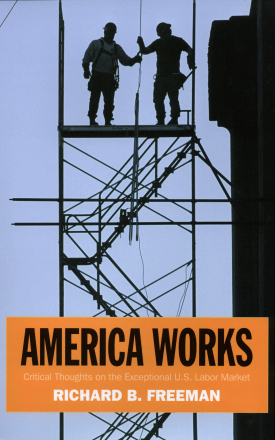
Cover image of the book America Works
Books

America Works

Critical Thoughts on the Exceptional U.S. Labor Market
Author
Richard B. Freeman
Paperback
$25.95
Add to Cart
Publication Date
6 in. × 9 in. 208 pages
ISBN
978-0-87154-326-4
Also Available From

About This Book

The U.S. labor market is the most laissez faire of any developed nation, with a weak social safety net and little government regulation compared to Europe or Japan. Some economists point to this hands-off approach as the source of America’s low unemployment and high per-capita income. But the stagnant living standards and rising economic insecurity many Americans now face take some of the luster off the U.S. model. In America Works, noted economist Richard Freeman reveals how U.S. policies have created a labor market remarkable both for its dynamism and its disparities.

America Works takes readers on a grand tour of America’s exceptional labor market, comparing the economic institutions and performance of the United States to the economies of Europe and other wealthy countries. The U.S. economy has an impressive track record when it comes to job creation and productivity growth, but it isn’t so good at reducing poverty or raising the wages of the average worker. Despite huge gains in productivity, most Americans are hardly better off than they were a generation ago. The median wage is actually lower now than in the early 1970s, and the poverty rate in 2005 was higher than in 1969. So why have the benefits of productivity growth been distributed so unevenly? One reason is that unions have been steadily declining in membership. In Europe, labor laws extend collective bargaining settlements to non-unionized firms. Because wage agreements in America only apply to firms where workers are unionized, American managers have discouraged unionization drives more aggressively. In addition, globalization and immigration have placed growing competitive pressure on American workers. And boards of directors appointed by CEOs have raised executive pay to astronomical levels. Freeman addresses these problems with a variety of proposals designed to maintain the vigor of the U.S. economy while spreading more of its benefits to working Americans. To maintain America’s global competitive edge, Freeman calls for increased R&D spending and financial incentives for students pursuing graduate studies in science and engineering. To improve corporate governance, he advocates licensing individuals who serve on corporate boards. Freeman also makes the case for fostering worker associations outside of the confines of traditional unions and for establishing a federal agency to promote profit-sharing and employee ownership.

Assessing the performance of the U.S. job market in light of other developed countries’ recent history highlights the strengths and weaknesses of the free market model. Written with authoritative knowledge and incisive wit, America Works provides a compelling plan for how we can make markets work better for all Americans.

RICHARD B. FREEMAN is Herbert S. Ascherman Professor of Economics at Harvard University.

A Volume in the the Russell Sage Foundation's Centennial Series

RSF Journal
View Book Series
Sign Up For Our Mailing List
Apply For Funding
Cover image of the book Controversies and Decisions
Books

Controversies and Decisions

The Social Sciences and Public Policy
Editor
Charles Frankel
Hardcover
Add to Cart
Publication Date
6 in. × 9 in. 312 pages
ISBN
978-0-87154-262-5
Also Available From

About This Book

Explores the various aspects of recent debates over the independence of the social sciences. The contributors are Kenneth E. Boulding, Harvey Brooks, Jonathan R. Cole, Stephen Cole, Lee J. Cronbach, Paul Doty, Yaron Ezrahi, Charles Frankel, H. Field Haviland, Hugh Hawkins, Harry G. Johnson, Robert Nisbet, Nicholas Rescher, Edward Shils, and Adam Yarmolinksy. The essays deal with such topics as the relation of "values" to "facts" in social science inquiry; the interplay of theoretical and practical considerations; the moral obligations of social science investigators in political contexts; and the ways and means of protecting and advancing the autonomy of the social sciences.

CHARLES FRANKEL is Old Dominion Professor of Philosophy and Public Affairs at Columbia University.

CONTRIBUTORS: Kenneth E. Boulding, Harvey Brooks, Jonathan Cole, Stephen Cole, Lee J. Cronbach, Paul Doty, Yaron Ezrahi, Charles Frankel, H. Field Haviland, Hugh Hawkins, Harry G. Johnson, Robert Nisbet, Nicholas Rescher, Edward Shils, and Adam Yarmolinsky.

RSF Journal
View Book Series
Sign Up For Our Mailing List
Apply For Funding
Cover image of the book Immigration Research for a New Century
Books

Immigration Research for a New Century

Multidisciplinary Perspectives
Editors
Nancy Foner
Rubén G. Rumbaut
Steven J. Gold
Paperback
Add to Cart
Publication Date
6 in. × 9 in. 508 pages
ISBN
978-0-87154-261-8
Also Available From

About This Book

The rapid rise in immigration over the past few decades has transformed the American social landscape, while the need to understand its impact on society has led to a burgeoning research literature. Predominantly non-European and of varied cultural, social, and economic backgrounds, the new immigrants present analytic challenges that cannot be wholly met by traditional immigration studies. Immigration Research for a New Century demonstrates how sociology, anthropology, history, political science, economics, and other disciplines intersect to answer questions about today's immigrants.

In Part I, leading scholars examine the emergence of an interdisciplinary body of work that incorporates such topics as the social construction of race, the importance of ethnic self-help and economic niches, the influence of migrant-homeland ties, and the types of solidarity and conflict found among migrant populations. The authors also explore the social and national origins of immigration scholars themselves, many of whom cameof age in an era of civil rights and ethnic reaffirmation, and may also be immigrants or children of immigrants. Together these essays demonstrate how social change, new patterns of immigration, and the scholars' personal backgrounds have altered the scope and emphases of the research literature, allowing scholars to ask new questions and to see old problems in new ways.

Part II contains the work of anew generation of immigrant scholars, reflecting the scope of a field bolstered by different disciplinary styles. These essays explore the complex variety of the immigrant experience, ranging from itinerant farmworkers to Silicon Valley engineers. The demands ofthe American labor force, ethnic, racial, and gender stereotyping, and state regulation are all shown to play important roles in the economic adaptation of immigrants. The ways in which immigrants participate politically, their relationships among themselves, their attitudes toward naturalization and citizenship, and their own sense of cultural identity are also addressed.

Immigration Research for a New Century examines the complex effects that immigration has had not only on American society but on scholarship itself, and offers the fresh insights of a new generation of immigration researchers.

NANCY FONER is professor of anthropology at the State University of New York, Purchase.

RUBÉN G. RUMBAUT is professor of sociology at Michigan State University.

STEVEN J. GOLD is professor and associate chair in the Department of Sociology at Michigan State University.

CONTRIBUTORS: Steven J. Gold, Rafael Alarcon, Nancy C. Carnevale, Catherine Ceniza Choy, Josh DeWind, Ingrid Gould Ellen, Herbert J. Gans, Greta Gilbertson, Jennifer S. Hirsch, Jon D. Holtzman, Jane Junn, Kathy A. Kaufman, Fred Krissman, Gallya Lahav, Jennifer Lee, Peggy Levitt, Howard Markel, Gaspar Rivera-Salgado, George J. Sanchez, Audrey Singer, Alexandra Minna Stern, Ayumi Takemaka, Mary C. Waters, Steven S. Zahniser, Aristide R. Zolberg. 

RSF Journal
View Book Series
Sign Up For Our Mailing List
Apply For Funding
Cover image of the book Immigrants and Welfare
Books

Immigrants and Welfare

The Impact of Welfare Reform on America’s Newcomers
Editor
Michael E. Fix
Paperback
$39.95
Add to Cart
Publication Date
6 in. × 9 in. 244 pages
ISBN
978-0-87154-467-4
Also Available From

About This Book

The lore of the immigrant who comes to the United States to take advantage of our welfare system has a long history in America’s collective mythology, but it has little basis in fact. The so-called problem of immigrants on the dole was nonetheless a major concern of the 1996 welfare reform law, the impact of which is still playing out today. While legal immigrants continue to pay taxes and are eligible for the draft, welfare reform has severely limited their access to government supports in times of crisis. Edited by Michael Fix, Immigrants and Welfare rigorously assesses the welfare reform law, questions whether its immigrant provisions were ever really necessary, and examines its impact on legal immigrants’ ability to integrate into American society.

Immigrants and Welfare draws on fields from demography and law to developmental psychology. The first part of the volume probes the politics behind the welfare reform law, its legal underpinnings, and what it may mean for integration policy. Contributor Ron Haskins makes a case for welfare reform’s ultimate success but cautions that excluding noncitizen children (future workers) from benefits today will inevitably have serious repercussions for the American economy down the road. Michael Wishnie describes the implications of the law for equal protection of immigrants under the U.S. Constitution.

The second part of the book focuses on empirical research regarding immigrants’ propensity to use benefits before the law passed, and immigrants’ use and hardship levels afterwards. Jennifer Van Hook and Frank Bean analyze immigrants’ benefit use before the law was passed in order to address the contested sociological theories that immigrants are inclined to welfare use and that it slows their assimilation. Randy Capps, Michael Fix, and Everett Henderson track trends before and after welfare reform in legal immigrants’ use of the major federal benefit programs affected by the law. Leighton Ku looks specifically at trends in food stamps and Medicaid use among noncitizen children and adults and documents the declining health insurance coverage of noncitizen parents and children. Finally, Ariel Kalil and Danielle Crosby use longitudinal data from Chicago to examine the health of children in immigrant families that left welfare.

Even though few states took the federal government’s invitation with the 1996 welfare reform law to completely freeze legal immigrants out of the social safety net, many of the law’s most far-reaching provisions remain in place and have significant implications for immigrants. Immigrants and Welfare takes a balanced look at the politics and history of immigrant access to safety-net supports and the ongoing impacts of welfare.

MICHAEL E. FIX is senior vice president and director of studies at the Migration Policy Institute (MPI) and co-director of MPI’s National Center on Immigrant Integration Policy.

CONTRIBUTORS: Michael E. Fix, Frank D. Bean, Randy Capps, Danielle A. Crosby, Ron Haskins, Everett Henderson, Ariel Kalil, Neeraj Kaushal, Leighton Ku, Jennifer Van Hook, and Michael J. Wishnie.

Copublished with the Migration Policy Institute

RSF Journal
View Book Series
Sign Up For Our Mailing List
Apply For Funding
Cover image of the book Security v. Liberty
Books

Security v. Liberty

Conflicts Between Civil Liberties and National Security in American History
Editor
Daniel Farber
Hardcover
$42.50
Add to Cart
Publication Date
6 in. × 9 in. 256 pages
ISBN
978-0-87154-327-1
Also Available From

About This Book

In the weeks following 9/11, the Bush administration launched the Patriot Act, rejected key provisions of the Geneva Convention, and inaugurated a sweeping electronic surveillance program for intelligence purposes—all in the name of protecting national security. But the current administration is hardly unique in pursuing such measures. In Security v. Liberty, Daniel Farber leads a group of prominent historians and legal experts in exploring the varied ways in which threats to national security have affected civil liberties throughout American history. Has the government’s response to such threats led to a gradual loss of freedoms once taken for granted, or has the nation learned how to restore civil liberties after threats subside and how to put protections in place for the future?

Security v. Liberty focuses on periods of national emergency in the twentieth century—from World War I through the Vietnam War—to explore how past episodes might bear upon today’s dilemma. Distinguished historian Alan Brinkley shows that during World War I the government targeted vulnerable groups—including socialists, anarchists, and labor leaders—not because of a real threat to the nation, but because it was politically expedient to scapegoat unpopular groups. Nonetheless, within ten years the Supreme Court had rolled back the most egregious of the World War I restrictions on civil liberties. Legal scholar John Yoo argues for the legitimacy of the Bush administration’s War on Terror policies—such as the detainment and trials of suspected al Qaeda members—by citing historical precedent in the Roosevelt administration’s prosecution of World War II. Yoo contends that, compared to Roosevelt’s sweeping use of executive orders, Bush has exercised relative restraint in curtailing civil liberties. Law professor Geoffrey Stone describes how J. Edgar Hoover used domestic surveillance to harass anti-war protestors and civil rights groups throughout the 1960s and early 1970s. Congress later enacted legislation to prevent a recurrence of the Hoover era excesses, but Stone notes that the Bush administration has argued for the right to circumvent some of these restrictions in its campaign against terrorism. Historian Jan Ellen Lewis looks at early U.S. history to show how an individual’s civil liberties often depended on the extent to which he or she fit the definition of “American” as the country’s borders expanded. Legal experts Paul Schwartz and Ronald Lee examine the national security implications of rapid advances in information technology, which is increasingly driven by a highly globalized private sector, rather than by the U.S. government.

Security v. Liberty shows that civil liberties are a not an immutable right, but the historically shifting result of a continuous struggle that has extended over two centuries. This important new volume provides a penetrating historical and legal analysis of the trade-offs between security and liberty that have shaped our national history—trade-offs that we confront with renewed urgency in a post-9/11 world.

DANIEL FARBER is Sho Sato Professor of Law at the University of California, Berkeley.

CONTRIBUTORS: Alan Brinkley, Stephen Holmes,  Ronald D. Lee, Jan Ellen Lewis, L.A. Powe Jr., Ellen Schrecker,  Geoffrey R. Stone,  John Yoo. 

RSF Journal
View Book Series
Sign Up For Our Mailing List
Apply For Funding
Cover image of the book Social Science, Social Policy, and the Law
Books

Social Science, Social Policy, and the Law

Editors
Patricia Ewick
Robert A. Kagan
Austin Sarat
Hardcover
$59.95
Add to Cart
Publication Date
6 in. × 9 in. 400 pages
ISBN
978-0-87154-426-1
Also Available From

About This Book

Social science has been an important influence on legal thought since the legal realists of the1930s began to argue that laws should be socially workable as well as legally valid. With the expansion of legal rights in the 1960s, the law and social science were bound together by an optimistic belief that legal interventions, if fully informed by social science, could become an effective instrument of social improvement. Legal justice, it was hoped, could translate directly into social justice. Though this optimism has receded in both disciplines, social science and the law have remained intimately connected. Social Science, Social Policy, and the Law maps out this new relationship, applying social science to particular legal issues and reflecting upon the role of social science in legal thought.

Several case studies illustrate the way that the law is embedded within the tangled interests and incentives that drive the social world. One study examines the entrepreneurialism that has shaped our systems of punishment from the colonial practice of deportation to today's privatized jails. Another case shows how many of those who do not qualify for legal aid cannot afford an effective legal defense with the consequence that economic inequality leads to inequality before the law. Two other studies look at the mixed results of legal regulation: the failure of legal safeguards to stop NASA's fatal 1986 Challenger launch decision, and the complicated effects of regulations to curb conflicts of interest in law firms. These two cases demonstrate that the law's effectiveness can depend, not only on how it is drafted, but also on how well it harmonizes with pre-existing social norms and patterns of self-regulation.

The contributors to this volume share the belief that social science can and should influence legal policymaking. Empirical research is necessary to offset anecdotal evidence and untested assertions. But research that is acceptable to the academy may not stand up in court, and, as a result, social science does not always get a sympathetic hearing from legal decision makers. The relationship between social science and the law will always be complex; this volume takes a lead in showing how it can nonetheless be productive.

PATRICIA EWICK is associate professor of sociology and associate dean at Clark University.

ROBERT A. KAGAN is professor of political science and director of the Center for Law and Society at the University of California at Berkeley.

AUSTIN SARAT is William Nelson Cromwell Professor of Jurisprudence and Political Science at Amherst College and president of the Law and Society Association.

CONTRIBUTORS: Malcolm M. Feeley, Lawrence M. Friedman, Kenneth Mann, Deborah L. Rhode, Neil Vidmar, Jack Katz, David Weisburd, Diane Vaughan, Susan P. Shapiro.

RSF Journal
View Book Series
Sign Up For Our Mailing List
Apply For Funding
Cover image of the book Technological Shortcuts to Social Change
Books

Technological Shortcuts to Social Change

Authors
Amitai Etzioni
Richard Remp
Hardcover
Add to Cart
Publication Date
6 in. × 9 in. 244 pages
ISBN
978-0-87154-236-6
Also Available From

About This Book

Evaluates a technological approach to social change which seeks to cure society's ills by dealing with its symptoms, rather than root causes. It examines four such technological shortcuts in terms of their relevance to specific social problems: methadone in controlling heroin addiction; antabuse in treating alcoholism; the breath analyzer in highway safety; and gun control in reducing crime. The authors seek solutions which do not require large amounts of new resources or planning, and will accelerate the pace of social change. They indicate that technological handling of such problems may be the answer.

AMITAI ETZIONI is professor of sociology at Columbia University and director of the Center for Policy Research.

RICHARD REMP is a doctoral candidate in sociology at Columbia University and research associate at the Center for Policy Research.

RSF Journal
View Book Series
Sign Up For Our Mailing List
Apply For Funding
Cover image of the book The Future of the Voting Rights Act
Books

The Future of the Voting Rights Act

Editors
David Epstein
Richard H. Pildes
Rodolfo O. de la Garza
Sharyn O'Halloran
Paperback
Add to Cart
Publication Date
6.63 in. × 9.25 in. 388 pages
ISBN
978-0-87154-072-0
Also Available From

About This Book

The Voting Rights Act (VRA) stands among the great achievements of American democracy. Originally adopted in 1965, the Act extended full political citizenship to African-American voters in the United States nearly 100 years after the Fifteenth Amendment first gave them the vote. While Section 2 of the VRA is a nationwide, permanent ban on discriminatory election practices, Section 5, which is set to expire in 2007, targets only certain parts of the country, requiring that legislative bodies in these areas—mostly southern states with a history of discriminatory practices—get permission from the federal government before they can implement any change that affects voting. In The Future of the Voting Rights Act, David Epstein, Rodolfo de la Garza, Sharyn O’Halloran, and Richard Pildes bring together leading historians, political scientists, and legal scholars to assess the role Section 5 should play in America’s future.

The contributors offer varied perspectives on the debate. Samuel Issacharoff questions whether Section 5 remains necessary, citing the now substantial presence of blacks in legislative positions and the increasingly partisan enforcement of the law by the Department of Justice (DOJ). While David Epstein and Sharyn O’Halloran are concerned about political misuse of Section 5, they argue that it can only improve minority voting power—even with a partisan DOJ—and therefore continues to serve a valuable purpose. Other contributors argue that the achievements of Section 5 with respect to blacks should not obscure shortcomings in the protection of other groups. Laughlin McDonald argues that widespread and systematic voting discrimination against Native Americans requires that Section 5 protections be expanded to more counties in the west. Rodolfo de la Garza and Louis DeSipio point out that the growth of the Latino population in previously homogenous areas and the continued under-representation of Latinos in government call for an expanded Section 5 that accounts for changing demographics.

As its expiration date approaches, it is vital to examine the role that Section 5 still plays in maintaining a healthy democracy. Combining historical perspective, legal scholarship, and the insight of the social sciences, The Future of the Voting Rights Act is a crucial read for anyone interested in one of this year’s most important policy debates and in the future of civil rights in America.

DAVID L. EPSTEIN is professor of political science at Columbia University.

RICHARD H. PILDES is Sudler Family Professor of Constitutional Law at New York University School of Law.

RODOLFO O. DE LA GARZA is faculty fellow in the Department of Political Science and director of the Project on Immigration, Ethnicity, and Race at the Institute for Social and Economic Research and Policy at Columbia University.

SHARYN O'HALLORAN is the George Blumenthal Professor of Politics and professor of international and public affairs at Columbia University.

CONTRIBUTORS: David L. Epstein, Richard H. Pildes, Rodolfo O. de la Garza, Sharyn O'Halloran, Stephen Ansolabehere, Thomas Brunell, Bruce E. Cain, Guy-Uriel E. Charles, Louis DeSipio, Luis Fuentes-Rohwer, Heather K. Gerken, Bernard Grofman, Richard L. Hasen, Samuel Issacharoff, Karin MacDonald, Peyton McCrary, Laughlin McDonald, Michael P. McDonald, Spencer Overton, Nathaniel Persily, Christopher Seaman, and Richard Valelly.
 

RSF Journal
View Book Series
Sign Up For Our Mailing List
Apply For Funding
Cover image of the book Unmarried Couples with Children
Books

Unmarried Couples with Children

Editors
Paula England
Kathryn Edin
Paperback
$33.95
Add to Cart
Publication Date
6 in. × 9 in. 312 pages
ISBN
978-0-87154-317-2
Also Available From

About This Book

Today, a third of American children are born outside of marriage, up from one child in twenty in the 1950s, and rates are even higher among low-income Americans. Many herald this trend as one of the most troubling of our time. But the decline in marriage does not necessarily signal the demise of the two parent family—over 80 percent of unmarried couples are still romantically involved when their child is born and nearly half are living together. Most claim they plan to marry eventually. Yet half have broken up by their child's third birthday. What keeps some couples together and what tears others apart? After a breakup, how do fathers so often disappear from their children's lives?

An intimate portrait of the challenges of partnering and parenting in these families, Unmarried Couples with Children presents a variety of unique findings. Most of the pregnancies were not explicitly planned, but some couples feel having a child is the natural course of a serious relationship. Many of the parents are living with their child plus the mother’s child from a previous relationship. When the father also has children from a previous relationship, his visits to see them at their mother’s house often cause his current partner to be jealous. Breakups are more often driven by sexual infidelity or conflict than economic problems. After couples break up, many fathers complain they are shut out, especially when the mother has a new partner. For their part, mothers claim to limit dads’ access to their children because of their involvement with crime, drugs, or other dangers. For couples living together with their child several years after the birth, marriage remains an aspiration, but something couples are resolutely unwilling to enter without the financial stability they see as a sine qua non of marriage. They also hold marriage to a high relational standard, and not enough emotional attention from their partners is women’s number one complaint.

Unmarried Couples with Children is a landmark study of the family lives of nearly fifty American children born outside of a marital union at the dawn of the twenty-first century. Based on personal narratives gathered from both mothers and fathers over the first four years of their children’s lives, and told partly in the couples' own words, the story begins before the child is conceived, takes the reader through the tumultuous months of pregnancy to the moment of birth, and on through the child's fourth birthday. It captures in rich detail the complex relationship dynamics and powerful social forces that derail the plans of so many unmarried parents. The volume injects some much-needed reality into the national discussion about family values, and reveals that the issues are more complex than our political discourse suggests.

PAULA ENGLAND is professor of sociology at Stanford University.

KATHRYN EDIN is professor of public policy and management at the John F. Kennedy School of Government at Harvard University.

CONTRIBUTORS:  Amy Claessens,  Mimi Engel,  Christina M. Gibson-Davis,  Heather D. Hill,  Kathryn D. Linnenberg,  Katherine A. Magnuson,  Lindsay M. Monte,  Joanna Reed,  Emily Fitzgibbons Shafer.

RSF Journal
View Book Series
Sign Up For Our Mailing List
Apply For Funding
Cover image of the book Addiction
Books

Addiction

Entries and Exits
Editor
Jon Elster
Hardcover
Add to Cart
Publication Date
6 in. × 9 in. 332 pages
ISBN
978-0-87154-235-9
Also Available From

About This Book

Addiction focuses on the emergence, nature, and persistence of addictive behavior, as well as the efforts of addicts to overcome their condition. Do addicts act of their own free will, or are they driven by forces beyond their control? Do structured treatment programs offer more hope for recovery? What causes relapses to occur? Recent scholarship has focused attention on the voluntary aspects of addiction, particularly the role played by choice. Addiction draws upon this new research and the investigations of economists, psychiatrists, philosophers, neuropharmacologists, historians, and sociologists to offer an important new approach to our understanding of addictive behavior.

The notion that addicts favor present rewards over future gains or penalties echoes throughout the chapters in Addiction. The effect of cultural values and beliefs on addicts, and on those who treat them, is also explored, particularly in chapters by Elster on alcoholism and by Acker on American heroin addicts in the 1920s and 1930s. Essays by Gardner and by Waal and Mørland discuss the neurobiological roots of addiction Among their findings are evidence that addictive drugs also have an important effect on areas of the central nervous system unrelated to euphoria or dysphoria, and that tolerance and withdrawal phenomena vary greatly from drug to drug.

The plight of addicts struggling to regain control of their lives receives important consideration in Addiction. Elster, Skog, and O'Donoghue and Rabin look at self-administered therapies ranging from behavioral modifications to cognitive techniques, and discuss conditions under which various treatment strategies work. Drug-based forms of treatment are discussed by Gardner, drawing on work that suggests that parts of the population have low levels of dopamine, inducing a tendency toward sensation-seeking.

There are many different explanations for the impulsive, self-destructive behavior that is addiction. By bringing the triple perspective of neurobiology, choice, and culture to bear on the phenomenon, Addiction offers a unique and valuable source of information and debate on a problem of world-wide proportions.

JON ELSTER is Edward L. Ryerson Distinguished Service Professor of Political Science and Philosophy at the University of Chicago.

CONTRIBUTORS: Caroline Jean Acker, George Ainslie, Jon Elster, Eliot L. Gardner, Olav Gjelsvik, Jørg Mørland, Ted O’Donoghue, Matthew Rabin, Ole-Jørgen Skog, Helge Waal, and Gary Watson
 

RSF Journal
View Book Series
Sign Up For Our Mailing List
Apply For Funding