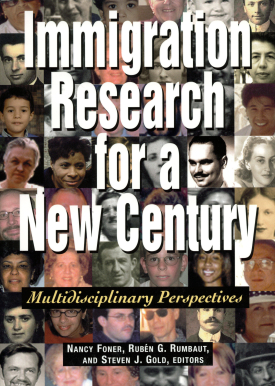
Cover image of the book Immigration Research for a New Century
Books

Immigration Research for a New Century

Multidisciplinary Perspectives
Editors
Nancy Foner
Rubén G. Rumbaut
Steven J. Gold
Paperback
Add to Cart
Publication Date
6 in. × 9 in. 508 pages
ISBN
978-0-87154-261-8
Also Available From

About This Book

"Anyone serious about immigration studies needs to read this book."
-Choice

"Immigration is transforming America. It's also producing a new generation of immigration researchers, fully equipped with the tools needed to illuminate the distinctive immigrant reality of the twenty-first century. This new collection offers a first harvest of today's emerging scholarship, assembling authors from a variety of disciplines, who engage this always vital topic in new, incisive, and stimulating ways."
-ROGER WALDINGER, UCLA

"Immigration Research for a New Century offers an incredible potpourri of research on the post-1965 wave of immigrants to the United States by a new generation of younger immigration scholars. The chapters cover almost every group from high tech engineers in Silicon Valley to Nuer refugees from the Sudan in Minnesota. Many of these studies report novel findings and fresh interpretations. For example, Greta Gilbertson and Audrey Singer find that some Dominican immigrants acquire U.S. citizenship not as the final stage of settlement, but as an insurance policy before returning to the Dominican Republic. In another chapter, Jennifer Lee explains the advantages of immigrant entrepreneurs relative to African American small businesses through differential access to networks of wholesalers and suppliers. Several papers describe the organization and content of 'transnational ties' among contemporary immigrants in the United States. There are many more gems sprinkled among the chapters in this fine volume."
-CHARLES HIRSCHMAN, University of Washington, Seattle

"This thought-provoking book offers fresh, valuable insights into a wide range of issues in immigration research. A prominent characteristic and strength of this volume is the immigration research from a broad disciplinary and methodological spectrum. This fine collection should not be missed by any student of immigration."
-PHILIP Q. YANG, Contemporary Sociology

The rapid rise in immigration over the past few decades has transformed the American social landscape, while the need to understand its impact on society has led to a burgeoning research literature. Predominantly non-European and of varied cultural, social, and economic backgrounds, the new immigrants present analytic challenges that cannot be wholly met by traditional immigration studies. Immigration Research for a New Century demonstrates how sociology, anthropology, history, political science, economics, and other disciplines intersect to answer questions about today's immigrants.

In Part I, leading scholars examine the emergence of an interdisciplinary body of work that incorporates such topics as the social construction of race, the importance of ethnic self-help and economic niches, the influence of migrant-homeland ties, and the types of solidarity and conflict found among migrant populations. The authors also explore the social and national origins of immigration scholars themselves, many of whom cameof age in an era of civil rights and ethnic reaffirmation, and may also be immigrants or children of immigrants. Together these essays demonstrate how social change, new patterns of immigration, and the scholars' personal backgrounds have altered the scope and emphases of the research literature, allowing scholars to ask new questions and to see old problems in new ways.

Part II contains the work of anew generation of immigrant scholars, reflecting the scope of a field bolstered by different disciplinary styles. These essays explore the complex variety of the immigrant experience, ranging from itinerant farmworkers to Silicon Valley engineers. The demands ofthe American labor force, ethnic, racial, and gender stereotyping, and state regulation are all shown to play important roles in the economic adaptation of immigrants. The ways in which immigrants participate politically, their relationships among themselves, their attitudes toward naturalization and citizenship, and their own sense of cultural identity are also addressed.

Immigration Research for a New Century examines the complex effects that immigration has had not only on American society but on scholarship itself, and offers the fresh insights of a new generation of immigration researchers.

NANCY FONER is professor of anthropology at the State University of New York, Purchase.

RUBÉN G. RUMBAUT is professor of sociology at Michigan State University.

STEVEN J. GOLD is professor and associate chair in the Department of Sociology at Michigan State University.

CONTRIBUTORS: Steven J. Gold, Rafael Alarcon, Nancy C. Carnevale, Catherine Ceniza Choy, Josh DeWind, Ingrid Gould Ellen, Herbert J. Gans, Greta Gilbertson, Jennifer S. Hirsch, Jon D. Holtzman, Jane Junn, Kathy A. Kaufman, Fred Krissman, Gallya Lahav, Jennifer Lee, Peggy Levitt, Howard Markel, Gaspar Rivera-Salgado, George J. Sanchez, Audrey Singer, Alexandra Minna Stern, Ayumi Takemaka, Mary C. Waters, Steven S. Zahniser, Aristide R. Zolberg. 
RSF Journal
View Book Series
Sign Up For Our Mailing List
Apply For Funding
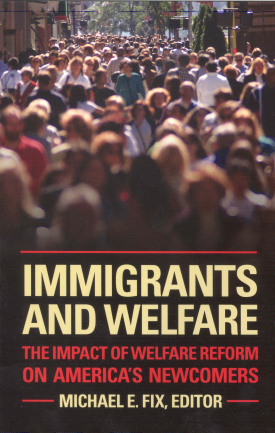
Cover image of the book Immigrants and Welfare
Books

Immigrants and Welfare

The Impact of Welfare Reform on America’s Newcomers
Editor
Michael E. Fix
Paperback
$39.95
Add to Cart
Publication Date
6 in. × 9 in. 244 pages
ISBN
978-0-87154-467-4
Also Available From

About This Book

"Immigrants and Welfare assembles the authoritative set of papers on the history, law, and social science of immigration and welfare reform. It is required reading as the United States prepares for an epic exploration of immigration and immigrants in a well-ordered society: How do societies recruit their members? What are the criteria for membership? What characteristics are desirable and undesirable in recruits? What characteristics merit differential treatment? How do societies mentor their recruits? How do societies put boundaries on their bounty?"
-GUILLERMINA JASSO, Silver Professor, Department of Sociology, New York University

"In the mid-1990s, the U.S. government not only 'ended welfare as we know it,' but it also fundamentally altered its relationships with immigrants and their progeny through changes in welfare and immigration law that have been much less well-regarded in policy and research circles. The legislative changes created new distinctions in the definition of what it meant to be a member of U.S. society and to be eligible for needed assistance, drawing sharper lines between immigrants and natives, and within groups of immigrants. In this incisive volume, Michael E. Fix and his colleagues give us the most comprehensive compilation of the evidence on immigrants' use of public benefits before and after welfare reform. It both challenges some of the popular misconceptions about immigrants' costs to the polity that fueled a backlash against newcomers to the country in the welfare and immigration law changes of the 1990s, and vigorously informs us about the impacts of those changes for immigrants and their children. Immigrants and Welfare is timely and much-needed. Just as the nation prepares in the coming year to debate necessary comprehensive immigration reform, we can only hope that our leaders take these facts into account and lead us to where the evidence and our values suggest is a better place."
-AJAY CHAUDRY, director, Center on Labor, Human Services, and Population, The Urban Institute

"Immigrants and Welfare takes a careful look at the aftermath of the landmark welfare reform legislation of the mid-1990s. The volume's contributors examine the reweaving of the American safety net for immigrants and their families, both citizens and noncitizens. The research challenges oft-made assertions that the U.S. welfare system provides a strong magnet for immigrants destined to become dependent on public assistance, and instead points to the potential benefits of providing more coherent and less restrictive policies for new arrivals and their families. This informed volume is necessary reading for those interested in the continuing debate of U.S. immigration policy."
-MICHAEL J. WHITE, professor of sociology and director, Population Studies and Training Center, Brown University 

The lore of the immigrant who comes to the United States to take advantage of our welfare system has a long history in America’s collective mythology, but it has little basis in fact. The so-called problem of immigrants on the dole was nonetheless a major concern of the 1996 welfare reform law, the impact of which is still playing out today. While legal immigrants continue to pay taxes and are eligible for the draft, welfare reform has severely limited their access to government supports in times of crisis. Edited by Michael Fix, Immigrants and Welfare rigorously assesses the welfare reform law, questions whether its immigrant provisions were ever really necessary, and examines its impact on legal immigrants’ ability to integrate into American society.

Immigrants and Welfare draws on fields from demography and law to developmental psychology. The first part of the volume probes the politics behind the welfare reform law, its legal underpinnings, and what it may mean for integration policy. Contributor Ron Haskins makes a case for welfare reform’s ultimate success but cautions that excluding noncitizen children (future workers) from benefits today will inevitably have serious repercussions for the American economy down the road. Michael Wishnie describes the implications of the law for equal protection of immigrants under the U.S. Constitution.

The second part of the book focuses on empirical research regarding immigrants’ propensity to use benefits before the law passed, and immigrants’ use and hardship levels afterwards. Jennifer Van Hook and Frank Bean analyze immigrants’ benefit use before the law was passed in order to address the contested sociological theories that immigrants are inclined to welfare use and that it slows their assimilation. Randy Capps, Michael Fix, and Everett Henderson track trends before and after welfare reform in legal immigrants’ use of the major federal benefit programs affected by the law. Leighton Ku looks specifically at trends in food stamps and Medicaid use among noncitizen children and adults and documents the declining health insurance coverage of noncitizen parents and children. Finally, Ariel Kalil and Danielle Crosby use longitudinal data from Chicago to examine the health of children in immigrant families that left welfare.

Even though few states took the federal government’s invitation with the 1996 welfare reform law to completely freeze legal immigrants out of the social safety net, many of the law’s most far-reaching provisions remain in place and have significant implications for immigrants. Immigrants and Welfare takes a balanced look at the politics and history of immigrant access to safety-net supports and the ongoing impacts of welfare.

MICHAEL E. FIX is senior vice president and director of studies at the Migration Policy Institute (MPI) and co-director of MPI’s National Center on Immigrant Integration Policy.

CONTRIBUTORS: Michael E. Fix, Frank D. Bean, Randy Capps, Danielle A. Crosby, Ron Haskins, Everett Henderson, Ariel Kalil, Neeraj Kaushal, Leighton Ku, Jennifer Van Hook, and Michael J. Wishnie.

Copublished with the Migration Policy Institute

RSF Journal
View Book Series
Sign Up For Our Mailing List
Apply For Funding
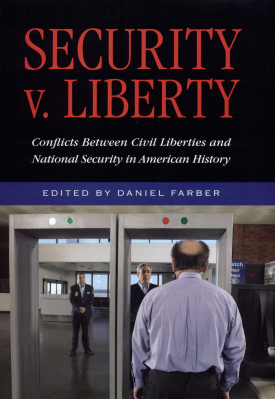
Cover image of the book Security v. Liberty
Books

Security v. Liberty

Conflicts Between Civil Liberties and National Security in American History
Editor
Daniel Farber
Hardcover
$42.50
Add to Cart
Publication Date
6 in. × 9 in. 256 pages
ISBN
978-0-87154-327-1
Also Available From

About This Book

“This outstanding collection of essays, by an accomplished group of historians and legal academics, describes how civil liberties have been limited in the name of real or imagined threats to the nation’s security in the past—and then shows how we might apply the lessons of earlier eras to our current situation. It is hard to think of a more important subject, or of a group of authors who are better qualified to teach us about it.”
—David A. Strauss , Gerald Ratner Distinguished Service Professor of Law, University of Chicago Law School 

“Since 9/11 the tension between national security and civil liberties has again become a pressing issue of public concern. The concise, thoughtful, and well-written essays in this volume provide valuable perspectives on current debates by analyzing this tension during key episodes throughout American history. Contributed by a diverse group of leading scholars, Security v. Liberty raises fascinating questions and reaches provocative conclusions about both the similarities and the differences between the response to 9/11 and the experience of the past.”
—David M. Rabban, Dahr Jamail, Randall Hage Jamail, and Robert Lee Jamail Regents Chair in Law and Distinguished Teaching Professor, University of Texas School of Law 

“What is and what is not unprecedented about national security in a post-9/11 world? What is or is not unprecedented about the Bush administration’s reaction to that world? Security v. Liberty helps us break out of our reflexive debate about civil liberties in times of crisis by looking back to our historical experience, and then insisting on distinguishing between appropriate and outmoded historical lessons. These essays by lawyers, historians, and political and legal scholars challenge our assumptions about just what may be at risk in an emergency that is both very similar and very different from those we have confronted in the past, and press us to consider not only the traditional concerns about speech and the freedom to criticize the government and its policies, but also about some very different threats to liberty involving the judicial and political branches of government itself, and their ability to check and balance each other. How those institutions have-and how they might yet-respond to these new challenges is the debate we need to have, and Security v. Liberty provides a provocative and compelling foundation on which to build that debate.”
—Gordon Silverstein, assistant professor of political science, University of California, Berkeley

In the weeks following 9/11, the Bush administration launched the Patriot Act, rejected key provisions of the Geneva Convention, and inaugurated a sweeping electronic surveillance program for intelligence purposes—all in the name of protecting national security. But the current administration is hardly unique in pursuing such measures. In Security v. Liberty, Daniel Farber leads a group of prominent historians and legal experts in exploring the varied ways in which threats to national security have affected civil liberties throughout American history. Has the government’s response to such threats led to a gradual loss of freedoms once taken for granted, or has the nation learned how to restore civil liberties after threats subside and how to put protections in place for the future?

Security v. Liberty focuses on periods of national emergency in the twentieth century—from World War I through the Vietnam War—to explore how past episodes might bear upon today’s dilemma. Distinguished historian Alan Brinkley shows that during World War I the government targeted vulnerable groups—including socialists, anarchists, and labor leaders—not because of a real threat to the nation, but because it was politically expedient to scapegoat unpopular groups. Nonetheless, within ten years the Supreme Court had rolled back the most egregious of the World War I restrictions on civil liberties. Legal scholar John Yoo argues for the legitimacy of the Bush administration’s War on Terror policies—such as the detainment and trials of suspected al Qaeda members—by citing historical precedent in the Roosevelt administration’s prosecution of World War II. Yoo contends that, compared to Roosevelt’s sweeping use of executive orders, Bush has exercised relative restraint in curtailing civil liberties. Law professor Geoffrey Stone describes how J. Edgar Hoover used domestic surveillance to harass anti-war protestors and civil rights groups throughout the 1960s and early 1970s. Congress later enacted legislation to prevent a recurrence of the Hoover era excesses, but Stone notes that the Bush administration has argued for the right to circumvent some of these restrictions in its campaign against terrorism. Historian Jan Ellen Lewis looks at early U.S. history to show how an individual’s civil liberties often depended on the extent to which he or she fit the definition of “American” as the country’s borders expanded. Legal experts Paul Schwartz and Ronald Lee examine the national security implications of rapid advances in information technology, which is increasingly driven by a highly globalized private sector, rather than by the U.S. government.

Security v. Liberty shows that civil liberties are a not an immutable right, but the historically shifting result of a continuous struggle that has extended over two centuries. This important new volume provides a penetrating historical and legal analysis of the trade-offs between security and liberty that have shaped our national history—trade-offs that we confront with renewed urgency in a post-9/11 world.

DANIEL FARBER is Sho Sato Professor of Law at the University of California, Berkeley.

CONTRIBUTORS: Alan Brinkley, Stephen Holmes,  Ronald D. Lee, Jan Ellen Lewis, L.A. Powe Jr., Ellen Schrecker,  Geoffrey R. Stone,  John Yoo. 

RSF Journal
View Book Series
Sign Up For Our Mailing List
Apply For Funding
Cover image of the book Social Science, Social Policy, and the Law
Books

Social Science, Social Policy, and the Law

Editors
Patricia Ewick
Robert A. Kagan
Austin Sarat
Hardcover
$59.95
Add to Cart
Publication Date
6 in. × 9 in. 400 pages
ISBN
978-0-87154-426-1
Also Available From

About This Book

Social science has been an important influence on legal thought since the legal realists of the1930s began to argue that laws should be socially workable as well as legally valid. With the expansion of legal rights in the 1960s, the law and social science were bound together by an optimistic belief that legal interventions, if fully informed by social science, could become an effective instrument of social improvement. Legal justice, it was hoped, could translate directly into social justice. Though this optimism has receded in both disciplines, social science and the law have remained intimately connected. Social Science, Social Policy, and the Law maps out this new relationship, applying social science to particular legal issues and reflecting upon the role of social science in legal thought.

Several case studies illustrate the way that the law is embedded within the tangled interests and incentives that drive the social world. One study examines the entrepreneurialism that has shaped our systems of punishment from the colonial practice of deportation to today's privatized jails. Another case shows how many of those who do not qualify for legal aid cannot afford an effective legal defense with the consequence that economic inequality leads to inequality before the law. Two other studies look at the mixed results of legal regulation: the failure of legal safeguards to stop NASA's fatal 1986 Challenger launch decision, and the complicated effects of regulations to curb conflicts of interest in law firms. These two cases demonstrate that the law's effectiveness can depend, not only on how it is drafted, but also on how well it harmonizes with pre-existing social norms and patterns of self-regulation.

The contributors to this volume share the belief that social science can and should influence legal policymaking. Empirical research is necessary to offset anecdotal evidence and untested assertions. But research that is acceptable to the academy may not stand up in court, and, as a result, social science does not always get a sympathetic hearing from legal decision makers. The relationship between social science and the law will always be complex; this volume takes a lead in showing how it can nonetheless be productive.

PATRICIA EWICK is associate professor of sociology and associate dean at Clark University.

ROBERT A. KAGAN is professor of political science and director of the Center for Law and Society at the University of California at Berkeley.

AUSTIN SARAT is William Nelson Cromwell Professor of Jurisprudence and Political Science at Amherst College and president of the Law and Society Association.

CONTRIBUTORS: Malcolm M. Feeley, Lawrence M. Friedman, Kenneth Mann, Deborah L. Rhode, Neil Vidmar, Jack Katz, David Weisburd, Diane Vaughan, Susan P. Shapiro.

RSF Journal
View Book Series
Sign Up For Our Mailing List
Apply For Funding
Cover image of the book Technological Shortcuts to Social Change
Books

Technological Shortcuts to Social Change

Authors
Amitai Etzioni
Richard Remp
Hardcover
Add to Cart
Publication Date
6 in. × 9 in. 244 pages
ISBN
978-0-87154-236-6
Also Available From

About This Book

Evaluates a technological approach to social change which seeks to cure society's ills by dealing with its symptoms, rather than root causes. It examines four such technological shortcuts in terms of their relevance to specific social problems: methadone in controlling heroin addiction; antabuse in treating alcoholism; the breath analyzer in highway safety; and gun control in reducing crime. The authors seek solutions which do not require large amounts of new resources or planning, and will accelerate the pace of social change. They indicate that technological handling of such problems may be the answer.

AMITAI ETZIONI is professor of sociology at Columbia University and director of the Center for Policy Research.

RICHARD REMP is a doctoral candidate in sociology at Columbia University and research associate at the Center for Policy Research.

RSF Journal
View Book Series
Sign Up For Our Mailing List
Apply For Funding
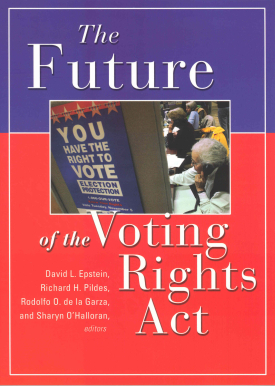
Cover image of the book The Future of the Voting Rights Act
Books

The Future of the Voting Rights Act

Editors
David Epstein
Richard H. Pildes
Rodolfo O. de la Garza
Sharyn O'Halloran
Paperback
Add to Cart
Publication Date
6.63 in. × 9.25 in. 388 pages
ISBN
978-0-87154-072-0
Also Available From

About This Book

The Voting Rights Act (VRA) stands among the great achievements of American democracy. Originally adopted in 1965, the Act extended full political citizenship to African-American voters in the United States nearly 100 years after the Fifteenth Amendment first gave them the vote. While Section 2 of the VRA is a nationwide, permanent ban on discriminatory election practices, Section 5, which is set to expire in 2007, targets only certain parts of the country, requiring that legislative bodies in these areas—mostly southern states with a history of discriminatory practices—get permission from the federal government before they can implement any change that affects voting. In The Future of the Voting Rights Act, David Epstein, Rodolfo de la Garza, Sharyn O’Halloran, and Richard Pildes bring together leading historians, political scientists, and legal scholars to assess the role Section 5 should play in America’s future.

The contributors offer varied perspectives on the debate. Samuel Issacharoff questions whether Section 5 remains necessary, citing the now substantial presence of blacks in legislative positions and the increasingly partisan enforcement of the law by the Department of Justice (DOJ). While David Epstein and Sharyn O’Halloran are concerned about political misuse of Section 5, they argue that it can only improve minority voting power—even with a partisan DOJ—and therefore continues to serve a valuable purpose. Other contributors argue that the achievements of Section 5 with respect to blacks should not obscure shortcomings in the protection of other groups. Laughlin McDonald argues that widespread and systematic voting discrimination against Native Americans requires that Section 5 protections be expanded to more counties in the west. Rodolfo de la Garza and Louis DeSipio point out that the growth of the Latino population in previously homogenous areas and the continued under-representation of Latinos in government call for an expanded Section 5 that accounts for changing demographics.

As its expiration date approaches, it is vital to examine the role that Section 5 still plays in maintaining a healthy democracy. Combining historical perspective, legal scholarship, and the insight of the social sciences, The Future of the Voting Rights Act is a crucial read for anyone interested in one of this year’s most important policy debates and in the future of civil rights in America.

DAVID L. EPSTEIN is professor of political science at Columbia University.

RICHARD H. PILDES is Sudler Family Professor of Constitutional Law at New York University School of Law.

RODOLFO O. DE LA GARZA is faculty fellow in the Department of Political Science and director of the Project on Immigration, Ethnicity, and Race at the Institute for Social and Economic Research and Policy at Columbia University.

SHARYN O'HALLORAN is the George Blumenthal Professor of Politics and professor of international and public affairs at Columbia University.

CONTRIBUTORS: David L. Epstein, Richard H. Pildes, Rodolfo O. de la Garza, Sharyn O'Halloran, Stephen Ansolabehere, Thomas Brunell, Bruce E. Cain, Guy-Uriel E. Charles, Louis DeSipio, Luis Fuentes-Rohwer, Heather K. Gerken, Bernard Grofman, Richard L. Hasen, Samuel Issacharoff, Karin MacDonald, Peyton McCrary, Laughlin McDonald, Michael P. McDonald, Spencer Overton, Nathaniel Persily, Christopher Seaman, and Richard Valelly.
 

RSF Journal
View Book Series
Sign Up For Our Mailing List
Apply For Funding
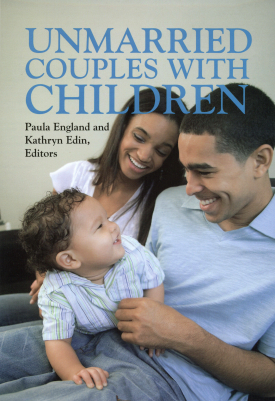
Cover image of the book Unmarried Couples with Children
Books

Unmarried Couples with Children

Editors
Paula England
Kathryn Edin
Paperback
$33.95
Add to Cart
Publication Date
6 in. × 9 in. 312 pages
ISBN
978-0-87154-317-2
Also Available From

About This Book

"Unmarried Couples with Children provides a very valuable portrait of the cohabiting couples, little noticed by most Americans, who are the parents of one out of six American babies born today."
-ANDREW CHERLIN, Griswold Professor of Sociology and Public Policy and director, Hopkins Population Center, Johns Hopkins University

"Too many children face the multiple disadvantages of being born to unmarried parents. Unmarried Couples with Children provides the most detailed information yet available about how these fragile families are formed, how they function, why they breakup, and what happens after the breakup. The volume is indispensable for anyone hoping to understand these families and how to help them."
-RON HASKINS, senior fellow, Economic Studies, and codirector, Center on Children and Families, Brookings Institution

"This stellar volume marries ethnograpy with demography, getting inside the lives of fragile families as they negotiate their fierce commitments to their children. Each of the chapters explores a different aspect of data collected in a unique qualitative add-on to a large-scale longitudinal study of low-income parents. The innovative research methodology and fascinating findings in Unmarried Couples with Children vindicate a new style of social scientific research."
-NANCY FOLBRE, professor of economics, University of Massachusetts, Amherst

"[Unmarried Couples with Children] is a thorough, methodologically sophisticated piece of research that examines family planning, economic issues, reasons for couple breakup, parenting behavior post-breakup, and the formation of new families among low-income families in cases where the biological parents were not married at the time of the child's birth. This collection is definitely one of if not the most exhaustive and indispensable resources for anyone interested in understanding the issues, dynamics, and experiences surrounding unmarried couples with children, and in providing resources for families such as these."
-CHOICE magazine

Today, a third of American children are born outside of marriage, up from one child in twenty in the 1950s, and rates are even higher among low-income Americans. Many herald this trend as one of the most troubling of our time. But the decline in marriage does not necessarily signal the demise of the two parent family—over 80 percent of unmarried couples are still romantically involved when their child is born and nearly half are living together. Most claim they plan to marry eventually. Yet half have broken up by their child's third birthday. What keeps some couples together and what tears others apart? After a breakup, how do fathers so often disappear from their children's lives?

An intimate portrait of the challenges of partnering and parenting in these families, Unmarried Couples with Children presents a variety of unique findings. Most of the pregnancies were not explicitly planned, but some couples feel having a child is the natural course of a serious relationship. Many of the parents are living with their child plus the mother’s child from a previous relationship. When the father also has children from a previous relationship, his visits to see them at their mother’s house often cause his current partner to be jealous. Breakups are more often driven by sexual infidelity or conflict than economic problems. After couples break up, many fathers complain they are shut out, especially when the mother has a new partner. For their part, mothers claim to limit dads’ access to their children because of their involvement with crime, drugs, or other dangers. For couples living together with their child several years after the birth, marriage remains an aspiration, but something couples are resolutely unwilling to enter without the financial stability they see as a sine qua non of marriage. They also hold marriage to a high relational standard, and not enough emotional attention from their partners is women’s number one complaint.

Unmarried Couples with Children is a landmark study of the family lives of nearly fifty American children born outside of a marital union at the dawn of the twenty-first century. Based on personal narratives gathered from both mothers and fathers over the first four years of their children’s lives, and told partly in the couples' own words, the story begins before the child is conceived, takes the reader through the tumultuous months of pregnancy to the moment of birth, and on through the child's fourth birthday. It captures in rich detail the complex relationship dynamics and powerful social forces that derail the plans of so many unmarried parents. The volume injects some much-needed reality into the national discussion about family values, and reveals that the issues are more complex than our political discourse suggests.

PAULA ENGLAND is professor of sociology at Stanford University.

KATHRYN EDIN is professor of public policy and management at the John F. Kennedy School of Government at Harvard University.

CONTRIBUTORS:  Amy Claessens,  Mimi Engel,  Christina M. Gibson-Davis,  Heather D. Hill,  Kathryn D. Linnenberg,  Katherine A. Magnuson,  Lindsay M. Monte,  Joanna Reed,  Emily Fitzgibbons Shafer.

RSF Journal
View Book Series
Sign Up For Our Mailing List
Apply For Funding
Cover image of the book Addiction
Books

Addiction

Entries and Exits
Editor
Jon Elster
Hardcover
Add to Cart
Publication Date
6 in. × 9 in. 332 pages
ISBN
978-0-87154-235-9
Also Available From

About This Book

"This pathbreaking interdisciplinary collection of essays challenges many of our preconceptions about addiction and offers researchers productive new paradigms for studying and treating self-defeating behavior."
-DAVID LAIBSON, Harvard University

"This book is on the cutting edge of thought about the phenomenon of addiction. The chapters cover all aspects of addiction, from philosophical, to physiological, to psychological, to social. The common notion that addicts are helpless and hopeless prisoners of their habit is effectively rejected by these authors. Anyone involved in the study of addictive behavior or anyone interested in the phenomenon of addiction will find Addiction a valuable resource."
-HOWARD RACHLIN, State University of New York at Stony Brook

Addiction focuses on the emergence, nature, and persistence of addictive behavior, as well as the efforts of addicts to overcome their condition. Do addicts act of their own free will, or are they driven by forces beyond their control? Do structured treatment programs offer more hope for recovery? What causes relapses to occur? Recent scholarship has focused attention on the voluntary aspects of addiction, particularly the role played by choice. Addiction draws upon this new research and the investigations of economists, psychiatrists, philosophers, neuropharmacologists, historians, and sociologists to offer an important new approach to our understanding of addictive behavior.

The notion that addicts favor present rewards over future gains or penalties echoes throughout the chapters in Addiction. The effect of cultural values and beliefs on addicts, and on those who treat them, is also explored, particularly in chapters by Elster on alcoholism and by Acker on American heroin addicts in the 1920s and 1930s. Essays by Gardner and by Waal and Mørland discuss the neurobiological roots of addiction Among their findings are evidence that addictive drugs also have an important effect on areas of the central nervous system unrelated to euphoria or dysphoria, and that tolerance and withdrawal phenomena vary greatly from drug to drug.

The plight of addicts struggling to regain control of their lives receives important consideration in Addiction. Elster, Skog, and O'Donoghue and Rabin look at self-administered therapies ranging from behavioral modifications to cognitive techniques, and discuss conditions under which various treatment strategies work. Drug-based forms of treatment are discussed by Gardner, drawing on work that suggests that parts of the population have low levels of dopamine, inducing a tendency toward sensation-seeking.

There are many different explanations for the impulsive, self-destructive behavior that is addiction. By bringing the triple perspective of neurobiology, choice, and culture to bear on the phenomenon, Addiction offers a unique and valuable source of information and debate on a problem of world-wide proportions.

JON ELSTER is Edward L. Ryerson Distinguished Service Professor of Political Science and Philosophy at the University of Chicago.

CONTRIBUTORS: Caroline Jean Acker, George Ainslie, Jon Elster, Eliot L. Gardner, Olav Gjelsvik, Jørg Mørland, Ted O’Donoghue, Matthew Rabin, Ole-Jørgen Skog, Helge Waal, and Gary Watson
 

RSF Journal
View Book Series
Sign Up For Our Mailing List
Apply For Funding
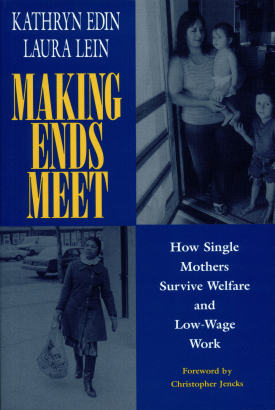
Cover image of the book Making Ends Meet
Books

Making Ends Meet

How Single Mothers Survive Welfare and Low-Wage Work
Authors
Kathryn Edin
Laura Lein
Paperback
$32.00
Add to Cart
Publication Date
6 in. × 9 in. 340 pages
ISBN
978-0-87154-234-2
Also Available From

About This Book

"A highly topical and uniquely strategic book [which] offers an early look at some likely effects of the so-called welfare reform .... Edin and Lein paint a moving portrait of hard-working mothers who, despite their never-ending hardships, still strive to enable their children to achieve the American Dream."
-HERBERT J. GANS, Columbia University

"Making Ends Meet tells how low income mothers really get by. I know of no research more important for current U.S. debates about poverty, welfare reform, and support for working parents."
-THEDA SKOCPOL, Harvard University

Welfare mothers are popularly viewed as passively dependent on their checks and averse to work. Reformers across the political spectrum advocate moving these women off the welfare rolls and into the labor force as the solution to their problems. Making Ends Meet offers dramatic evidence toward a different conclusion: In the present labor market, unskilled single mothers who hold jobs are frequently worse off than those on welfare, and neither welfare nor low-wage employment alone will support a family at subsistence levels.

Kathryn Edin and Laura Lein interviewed nearly four hundred welfare and low-income single mothers from cities in Massachusetts, Texas, Illinois, and South Carolina over a six year period. They learned the reality of these mothers' struggles to provide for their families: where their money comes from, what they spend it on, how they cope with their children's needs, and what hardships they suffer. Edin and Lein's careful budgetary analyses reveal that even a full range of welfare benefits—AFDC payments, food stamps, Medicaid, and housing subsidies—typically meet only three-fifths of a family's needs, and that funds for adequate food, clothing and other necessities are often lacking. Leaving welfare for work offers little hope for improvement, and in many cases threatens even greater hardship. Jobs for unskilled and semi-skilled women provide meager salaries, irregular or uncertain hours, frequent layoffs, and no promise of advancement. Mothers who work not only assume extra child care, medical, and transportation expenses but are also deprived of many of the housing and educational subsidies available to those on welfare. Regardless of whether they are on welfare or employed, virtually all these single mothers need to supplement their income with menial, off-the-books work and intermittent contributions from family, live-in boyfriends, their children's fathers, and local charities. In doing so, they pay a heavy price. Welfare mothers must work covertly to avoid losing benefits, while working mothers are forced to sacrifice even more time with their children.

Making Ends Meet demonstrates compellingly why the choice between welfare and work is more complex and risky than is commonly recognized by politicians, the media, or the public. Almost all the welfare-reliant women interviewed by Edin and Lein made repeated efforts to leave welfare for work, only to be forced to return when they lost their jobs, a child became ill, or they could not cover their bills with their wages. Mothers who managed more stable employment usually benefited from a variety of mitigating circumstances such as having a relative willing to watch their children for free, regular child support payments, or very low housing, medical, or commuting costs.

With first hand accounts and detailed financial data, Making Ends Meet tells the real story of the challenges, hardships, and survival strategies of America's poorest families. If this country's efforts to improve the self-sufficiency of female-headed families is to succeed, reformers will need to move beyond the myths of welfare dependency and deal with the hard realities of an unrewarding American labor market, the lack of affordable health insurance and child care for single mothers who work, and the true cost of subsistence living. Making Ends Meet is a realistic look at a world that so many would change and so few understand.

KATHRYN EDIN is assistant professor, department of sociology and Center for Urban Policy Research at Rutgers University.

LAURA LEIN is senior lecturer, department of anthropology, and senior lecturer and research scientist, the School of Social Work, the University of Texas at Austin.

RSF Journal
View Book Series
Sign Up For Our Mailing List
Apply For Funding
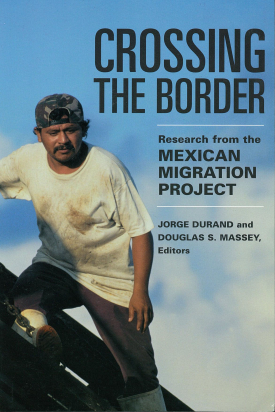
Cover image of the book Crossing the Border
Books

Crossing the Border

Research from the Mexican Migration Project
Editors
Jorge Durand
Douglas S. Massey
Paperback
$32.50
Add to Cart
Publication Date
6 in. × 9 in. 356 pages
ISBN
978-0-87154-289-2
Also Available From

About This Book

"Jorge Durand and Douglas S. Massey have done it again! Crossing the Border is an authoritative collection of rigorous empirical analyses that synthesize several substantive findings about the changing character and consequences of U.S .- bound Mexican migration during the 1990s. Its authority derives both from the theoretical and methodological foundations of the ambitious, multi-decade Mexican Migration Project that revolutionized the scientific study of population movement, from the technical sophistication of the empirical analyses, and from the broad scope of topics analyzed. These include the broadened geographic origins and destinations of migrants, the transformation of gender and family roles, and the role of U.S. policy in transforming rather than ebbing the flow of new migrants. This volume is an excellent classroom companion to Beyond Smoke and Mirrors."
-MARTA TIENDA, Princeton University

"The bi-national Mexican Migration Project (MMP) represents the most significant, sustained research effort on Mexican migration to the United States conducted over the past twenty-five years. Crossing the Border systematically exploits the MMP to understand what propels this migration, how it is changing, and how it affects peoples and communities on both sides of the U.S .- Mexico border. A companion volume to Massey, Durand, and Malone's path- breaking Beyond Smoke and Mirrors and an invaluable resource in and of itself."
-ROGER WALDINGER, U.C.L.A.

"If Americans often extol European immigration to the United States, they no less frequently denigrate migration from Mexico, often in distorting and disdainful terms. For over twenty years, Douglas S. Massey and Jorge Durand have collected pioneering data on Mexican migrants to the United States. At least as much anything else, analyses of their data help to dispel negative images and myths about U.S. Mexican immigrants. Crossing the Border, an enormously insightful and useful book, contains the best and most representative examples of these analyses, thus demonstrating why the Mexican Migration Project is one of the most significant and policy-relevant social science accomplishments of the latter part of the twentieth century."
-FRANK D. BEAN, University of California, Irvine

"For the past twenty years, Jorge Durand and Douglas S. Massey have continued to produce pioneering findings in the field of Mexico-U.S. immigration. Aside from their important intellectual findings, Durand and Massey have furnished a model for doing social science research. Combining surveys in scores of Mexican locales with intensive ethnographies, they have amassed an exemplary data set and in the process, they have also trained countless social scientists in data gathering and analysis. Much of that work appears in this book. Durand, Massey, and their collaborators have produced a rich and compelling volume about many dimensions of Mexican immigration."
-EDWARD TELLES, U.C.L.A.

Discussion of Mexican migration to the United States is often infused with ideological rhetoric, untested theories, and few facts. In Crossing the Border, editors Jorge Durand and Douglas Massey bring the clarity of scientific analysis to this hotly contested but under-researched topic. Leading immigration scholars use data from the Mexican Migration Project—the largest, most comprehensive, and reliable source of data on Mexican immigrants currently available—to answer such important questions as: Who are the people that migrate to the United States from Mexico? Why do they come? How effective is U.S. migration policy in meeting its objectives?

Crossing the Border dispels two primary myths about Mexican migration: First, that those who come to the United States are predominantly impoverished and intend to settle here permanently, and second, that the only way to keep them out is with stricter border enforcement. Nadia Flores, Rubén Hernández-León, and Douglas Massey show that Mexican migrants are generally not destitute but in fact cross the border because the higher comparative wages in the United States help them to finance homes back in Mexico, where limited credit opportunities makes it difficult for them to purchase housing. William Kandel’s chapter on immigrant agricultural workers debunks the myth that these laborers are part of a shadowy, underground population that sponges off of social services. In contrast, he finds that most Mexican agricultural workers in the United States are paid by check and not under the table. These workers pay their fair share in U.S. taxes and—despite high rates of eligibility—they rarely utilize welfare programs. Research from the project also indicates that heightened border surveillance is an ineffective strategy to reduce the immigrant population. Pia Orrenius demonstrates that strict barriers at popular border crossings have not kept migrants from entering the United States, but rather have prompted them to seek out other crossing points. Belinda Reyes uses statistical models and qualitative interviews to show that the militarization of the Mexican border has actually kept immigrants who want to return to Mexico from doing so by making them fear that if they leave they will not be able to get back into the United States.

By replacing anecdotal and speculative evidence with concrete data, Crossing the Border paints a picture of Mexican immigration to the United States that defies the common knowledge. It portrays a group of committed workers, doing what they can to realize the dream of home ownership in the absence of financing opportunities, and a broken immigration system that tries to keep migrants out of this country, but instead has kept them from leaving.

JORGE DURAND is professor in the Department for the Study of Social Movements at the University of Guadalajara and codirector of the Mexican Migration Project.

DOUGLAS S. MASSEY is professor of sociology and public affairs at the Woodrow Wilson School of Public and International Affairs, Princeton University, and codirector of the Mexican Migration Project.

CONTRIBUTORS: Patricia Arias, Maria Aysa, Marcela Cerrutti, Enrique Martinez Curiel, Katharine M. Donato, Jorge Durand, Nadia Y. Flores, Elizabeth Fussell, Ruben Hernandez-Leon, William A. Kandel, Douglas S. Massey, Margarita Mooney, Pia M. Orrenius, Emilio A. Parrado, Evelyn Patterson, Belinda I. Reyes, Fernando Riosmena, and Estela Rivero-Fuentes. 

RSF Journal
View Book Series
Sign Up For Our Mailing List
Apply For Funding