Cover image of the book Sources of Speakers and Topics for Public Lectures in School Buildings
Books

Sources of Speakers and Topics for Public Lectures in School Buildings

Author
Clarence Arthur Perry
Ebook
Publication Date
34 pages

About This Book

A directory of organizations which used the public lecture platform and their topics, published by the Foundation's Division of Recreation in 1915.

CLARENCE ARTHUR PERRY, Department of Child Hygiene, Russell Sage Foundation

RSF Journal
View Book Series
Sign Up For Our Mailing List
Apply For Funding
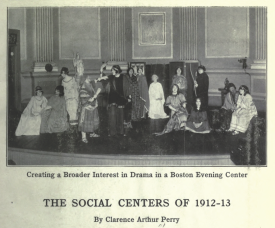
Cover image of the book The Social Centers of 1912-13
Books

The Social Centers of 1912-13

Author
Clarence Arthur Perry
Ebook
Publication Date
11 pages

About This Book

A 1912 report on the results of a schools survey taken to obtain data on evening "social center" activities hosted.

CLARENCE ARTHUR PERRY, Department of Child Hygiene, Russell Sage Foundation

RSF Journal
View Book Series
Sign Up For Our Mailing List
Apply For Funding
Cover image of the book Household Management
Books

Household Management

Author
Florence Nesbitt
Ebook
Publication Date
170 pages
Also Available From

About This Book

A volume of the Russell Sage Foundation's Social Work Series, written in 1918.  The book is primarily a home economics study of how low-income households of the time managed money.

FLORENCE NESBITT was director of the food conservation section of the Cleveland Women's Committee of the Council of National Defense.

RSF Journal
View Book Series
Sign Up For Our Mailing List
Apply For Funding

This feature is part of an ongoing RSF blog series, Work in Progress, which highlights some of the ongoing research of our current class of Visiting Scholars.

During his time in residence at the Russell Sage Foundation, Thomas Palfrey (California Institute of Technology) is writing a book on Quantal Response Equilibrium (QRE) and its applications to the social sciences. Developed by Palfrey and Richard McKelvey, QRE is a game theory concept that is now one of the leading approaches to modeling bounded rationality—the idea that individuals’ rationality is limited by the information they have—in games.

In a new interview with the Foundation, Palfrey explained some of the basic applications of game theory to public policy, and the limitations of those approaches.

Q. What is Nash Equilibrium? How has it been applied to public policy, and what are its limitations?

A new article by RSF grantee Sadeq Rahimi, who also contributed to the 2011 RSF publication Shattering Culture, has been published in Anthropology & Medicine. The abstract states:

It is not uncommon to encounter ‘the culture of psychiatry’ used as a descriptive or even explanatory concept in discussions of psychiatric practices and services, specifically in research addressing cultural aspects of psychiatry. Drawing on data from research on the role of culture in psychiatric services in the Boston area, this paper critically examines the attribution of a ‘culture’ to psychiatry, which is prevalent not simply in mainstream psychiatric literature, but also in certain lines of cultural psychiatry, specifically those dedicated to political and anti-racist activism. It is argued that the use of such terminology could be misleading as it implicitly attributes a sense of coherence and agency to what may best be described as a set of related discourses and sociopolitical practices. It is further suggested that, given the implications of using such terminology as ‘culture’ in our discussions of psychiatry as a social institution, a scientific discourse, or a clinical practice, it would be more fruitful to address the analytic concepts of power, meaning, and the sociopolitical functions of psychiatry instead.

Sadeq Rahimi
University of Saskatchewan

Below is a first look at new and forthcoming books from the Foundation for Spring 2015. The list includes Beyond Obamacare, a major new analysis of how to reorient the broken health care system in the U.S.; The Asian American Achievement Paradox, an investigation of the “model minority” stereotype and why certain immigrant groups succeed; Too Many Children Left Behind, a comparative study across four countries of the socioeconomic achievement gap among grade-school children; and Gender and International Migration, a historical evaluation of the changes in gendered migration patterns over several centuries.

To request a printed copy of our Spring 2015 catalog, please contact Bruce Thongsack at bruce@rsage.org, or view the complete list of RSF books on our publications page.

This feature is part of an ongoing RSF blog series, Work in Progress, which highlights some of the ongoing research of our current class of Visiting Scholars.

During her time in residence at the Russell Sage Foundation, Susan Stokes (Yale) is writing a book investigating why people choose to participate in elections and demonstrations. She argues that the cost of abstention—or how much a person feels he or she will lose by not voting—can explain why people turn out at higher rates when the office to be filled is elevated. Stokes is also exploring how the cost of abstention may shed new insight on why low-income populations vote at lower rates than more affluent populations.

In a new interview with the Foundation, Stokes discussed how this theory complements prior models of political participation. She also detailed how the cost of abstention can help us understand what drives people to vote and to take part in political demonstrations—including, surprisingly, when violent police repression occurs.

Q. Much of the research on political participation has focused on the cost of participation. By contrast, your current research offers a model of the cost of abstention, which includes factors like the guilt or discomfort that may result from not voting. How does this complement the classic Riker and Ordeshook theory of the calculus of voting? Can we think of the costs of abstention as being similar to feeling a sense of duty when it comes to political participation?

Cover image of the book Gender and International Migration
Books

Gender and International Migration

From the Slavery Era to the Global Age
Authors
Katharine M. Donato
Donna Gabaccia
Paperback
$47.50
Add to Cart
Publication Date
6 in. × 9 in. 270 pages
ISBN
978-0-87154-546-6
Also Available From

About This Book

Honorable Mention, 2016 Thomas and Znaniecki Award from the International Migration Section of the American Sociological Association

“In this well-researched, ambitious book Katharine Donato and Donna Gabaccia document previously undocumented patterns of women’s migration historically and across nations. Gender and International Migration is a tour de force and indispensable reading for anyone interested in gender and migration.”

—SUSAN ECKSTEIN, professor of sociology and international relations, Boston University

“This important book shows that critical theory, culture history, and quantitative data need not make an impossible marriage. By looking critically at the assumptions underlying statistical categories, without dismissing them, Katharine Donato and Donna Gabaccia have delivered the social sciences and social and migration history a great service. This path-breaking study not only rejects the simplistic notion of the ‘feminization of migration,’ but also forces us to fundamentally rethink the role of men and women in human migrations in the past five hundred years. It offers a fresh and global perspective that hopefully once and for all will do away with the stereotype of migrants as rationale male individuals, with women trailing behind. Instead Gender and International Migration puts mobile human beings back in their (gendered) social worlds. A world in which migration is the rule and individuals, families, and society are highly intertwined.”

—LEO LUCASSEN, director of research, International Institute of Social History, Amsterdam

In 2006, the United Nations reported on the “feminization” of migration, noting that the number of female migrants had doubled over the last five decades. Likewise, global awareness of issues like human trafficking and the exploitation of immigrant domestic workers has increased attention to the gender makeup of migrants. But are women really more likely to migrate today than they were in earlier times? In Gender and International Migration, sociologist and demographer Katharine Donato and historian Donna Gabaccia evaluate the historical evidence to show that women have been a significant part of migration flows for centuries. The first scholarly analysis of gender and migration over the centuries, Gender and International Migration demonstrates that variation in the gender composition of migration reflects not only the movements of women relative to men, but larger shifts in immigration policies and gender relations in the changing global economy.

While most research has focused on women migrants after 1960, Donato and Gabaccia begin their analysis with the fifteenth century, when European colonization and the transatlantic slave trade led to large-scale forced migration, including the transport of prisoners and indentured servants to the Americas and Australia from Africa and Europe. Contrary to the popular conception that most of these migrants were male, the authors show that a significant portion were women. The gender composition of migrants was driven by regional labor markets and local beliefs of the sending countries. For example, while coastal ports of western Africa traded mostly male slaves to Europeans, most slaves exiting east Africa for the Middle East were women due to this region’s demand for female reproductive labor.

Donato and Gabaccia show how the changing immigration policies of receiving countries affect the gender composition of global migration. Nineteenth-century immigration restrictions based on race, such as the Chinese Exclusion Act in the United States, limited male labor migration. But as these policies were replaced by regulated migration based on categories such as employment and marriage, the balance of men and women became more equal—both in large immigrant-receiving nations such as the United States, Canada, and Israel, and in nations with small immigrant populations such as South Africa, the Philippines, and Argentina. The gender composition of today’s migrants reflects a much stronger demand for female labor than in the past. The authors conclude that gender imbalance in migration is most likely to occur when coercive systems of labor recruitment exist, whether in the slave trade of the early modern era or in recent guest-worker programs.

Using methods and insights from history, gender studies, demography, and other social sciences, Gender and International Migration shows that feminization is better characterized as a gradual and ongoing shift toward gender balance in migrant populations worldwide. This groundbreaking demographic and historical analysis provides an important foundation for future migration research.

KATHARINE M. DONATO is professor and chair of sociology at Vanderbilt University.

DONNA GABACCIA is professor of history in the Department of Historical and Cultural Studies at the University of Toronto-Scarborough.

RSF Journal
View Book Series
Sign Up For Our Mailing List
Apply For Funding

In his State of the Union address on January 20, President Obama introduced the idea of “middle-class economics.” Recounting the story of the Erlers, a Minneapolis family struggling to pay off student loans and recover from a stint of unemployment, Obama stressed the need to “restore the link between hard work and growing opportunity for every American.” Middle-class economics would entail more aid for working families such as a higher minimum wage, quality child care, access to higher education, and paid sick leave. These policies, he concluded, would support “the idea that this country does best when everyone gets their fair shot, everyone does their fair share, everyone plays by the same set of rules.”

A new article in the New York Times confirms that America’s middle class has, indeed, been floundering. Though most Americans continue to identify as middle class—and 60% of those believe that it is still possible for them to become rich—incomes have stagnated, leaving more and more families struggling to get by. The Times article cites RSF trustee Lawrence Katz, who observed that while those at the top of the income ladder have benefited from the economy’s slow recovery from the Great Recession, most middle-class workers have seen few economic gains. He noted, “You’ve got an iPhone now and a better TV, but your median income hasn’t changed. What’s really changed is the penthouse has become supernice.”