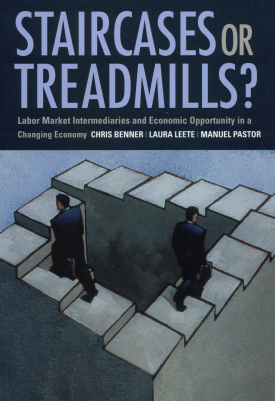
Cover image of the book Staircases or Treadmills?
Books

Staircases or Treadmills?

Labor Market Intermediaries and Economic Opportunity in a Changing Economy
Authors
Chris Benner
Laura Leete
Manuel Pastor
Hardcover
$42.50
Add to Cart
Publication Date
6 in. × 9 in. 312 pages
ISBN
978-0-87154-169-7
Also Available From

About This Book

"The Silicon Valley is seen as the exemplar of the new economy and Milwaukee represents the old. Yet are these labor markets truly different and if so in what ways? Staircases or Treadmills? takes on the challenge of answering this question and does so with a focus on those outside the relatively small elite who have prospered in the past decades. The original fieldwork and survey research reported in this important book adds to our knowledge of the role of institutions and personal networks in shaping outcomes. This is empirical research at its best."
-PAUL OSTERMAN, MIT Sloan School

"Staircases or Treadmills? is a carefully-researched, well-argued, important book. As more and more people turn to a variety of private and public organizations to help them find new or better jobs, the authors' deep understanding of intermediary types, market niches, and outcomes is a significant contribution. Some findings are surprising; all will be useful to researchers, activists, and policymakers concerned about how best to help low-income workers advance."
-RICHARD KAZIS, Jobs for the Future

"Staircases or Treadmills? presents a rich and detailed portrait of the workforce-intermediary landscape in two specific regional labor markets. It offers a useful framework for analyzing the services of workforce intermediaries that covers a wide range of organizational types. The book illuminates the growing influence of a range of organizations that play a role in mediating the hiring process in these two labor markets, and how these organizations have in turn influenced the labor-market prospects and outcomes of low- wage workers. This picture of the tremendous fragmentation, variability of service provision, and uneven quality among workforce-intermediary service providers illustrates the challenge that workers and employers face. Staircases or Treadmills? is essential reading for anyone interested in improving labor-market functioning and facilitating improved outcomes for low-income workers."
-MAUREEN CONWAY, The Aspen Institute

Globalization, technological change, and deregulation have made the American marketplace increasingly competitive in recent decades, but for many workers this “new economy” has entailed heightened job insecurity, lower wages, and scarcer benefits. As the job market has grown more volatile, a variety of labor market intermediaries—organizations that help job seekers find employment—have sprung up, from private temporary agencies to government “One-Stop Career Centers.” In Staircases or Treadmills? Chris Benner, Laura Leete, and Manuel Pastor investigate what approaches are most effective in helping workers to secure jobs with decent wages and benefits, and they provide specific policy recommendations for how job-matching organizations can better serve disadvantaged workers.

Staircases or Treadmills? is the first comprehensive study documenting the prevalence of all types of labor market intermediaries and investigating how these intermediaries affect workers’ employment opportunities. Benner, Leete, and Pastor draw on years of research in two distinct regional labor markets—“old economy” Milwaukee and “new economy” Silicon Valley—including a first-of-its-kind random survey of the prevalence and impacts of intermediaries, and a wide range of interviews with intermediary agencies’ staff and clients. One of the main obstacles that disadvantaged workers face is that social networks of families and friends are less effective in connecting job-seekers to stable, quality employment. Intermediaries often serve as a substitute method for finding a job.  Which substitute is chosen, however, matters: The authors find that the most effective organizations—including many unions, community colleges, and local non-profits—actively foster contacts between workers and employers, tend to make long-term investments in training for career development, and seek to transform as well as satisfy market demands. But without effective social networks to help workers locate the best intermediaries, most rely on private temporary agencies and other organizations that offer fewer services and, statistical analysis shows, often channel their participants into jobs with low wages and few benefits. Staircases or Treadmills? suggests that, to become more effective, intermediary organizations of all types need to focus more on training workers, teaching networking skills, and fostering contact between workers and employers in the same industries.

A generation ago, rising living standards were broadly distributed and coupled with relatively secure employment. Today, many Americans fear that heightened job insecurity is overshadowing the benefits of dynamic economic growth. Staircases or Treadmills? is a stimulating guide to how private and public job-matching institutions can empower disadvantaged workers to share in economic progress.

CHRIS BENNER is assistant professor of urban and economic geography at Pennsylvania State University.

LAURA LEETE is the Fred H. Paulus Director of Public Policy Research and associate professor of economics and public policy at Willamette University.

MANUEL PASTOR is a professor of geography and American Studies and ethnicity at the University of Southern California.

RSF Journal
View Book Series
Sign Up For Our Mailing List
Apply For Funding
Cover image of the book The Two New Yorks
Books

The Two New Yorks

State-City Relations in the Changing Federal System
Editors
Gerald Benjamin
Charles Brecher
Hardcover
Add to Cart
Publication Date
6 in. × 9 in. 576 pages
ISBN
978-0-87154-107-9
Also Available From

About This Book

Over the past eight years, a marked shift in the national political mood has substantially reduced the federal government's involvement in ameliorating urban problems and enhanced the prominence of state and local governments in the domestic policy arena. Many states and big cities have been forced to reassess their traditionally vexed relationships.

Nowhere has this drama been played out more stormily than in New York. In The Two New Yorks, experts from government, the academy, and the non-profit sector examine aspects of an interaction that has a major impact on the performance of state and city institutions. The analyses presented here explore current state-city strategies for handling such troubling policy areas as education, health care, and housing. Attention is also given to important contextual factors such as economic and demographic trends, and to structural features such as the political framework, relationships with the national government, and the system of public finance.

Despite its uniquely large scope, the drama of the new New Yorks parallels or presages issues faced by virtually all large cities and their states. This unprecedented study makes a vital contribution in an era of declining federal aid and pressing urban need.

GERALD BENJAMIN is at SUNY New Paltz.

CHARLES BRECHER is at New York University.

CONTRIBUTORS: Richard D. Alba, Mary Jo Bane, Gerald Benjamin, Robert Berne, Susan Blamk, Barbara B. Blum, Matthew Drennan, Barbara Gordon Espejo, Ester Fuchs, Cynthia B. Green, James M. Hartman, Raymond D. Horton, Sarah F. Liebschutz, David Lewin, Irene Lurie, Paul D. Moore, James C. Musselwhite Jr., Martin Shefter, Kenneth E. Thorpe, Emanuel Tobier, Katherine Trent, 

RSF Journal
View Book Series
Sign Up For Our Mailing List
Apply For Funding
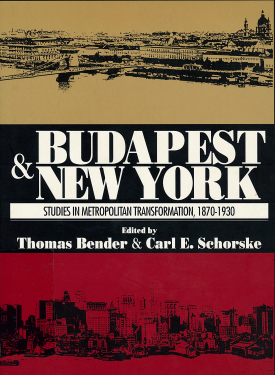
Cover image of the book Budapest and New York
Books

Budapest and New York

Studies in Metropolitan Transformation, 1870-1930
Editors
Thomas Bender
Carl E. Schorske
Hardcover
Add to Cart
Publication Date
6 in. × 9 in. 416 pages
ISBN
978-0-87154-113-0
Also Available From

About This Book

Little over a century ago, New York and Budapest were both flourishing cities engaging in spectacular modernization. By 1930, New York had emerged as an innovating cosmopolitan metropolis, while Budapest languished under the conditions that would foster fascism. Budapest and New York explores the increasingly divergent trajectories of these once-similar cities through the perspectives of both Hungarian and American experts in the fields of political, cultural, social and art history. Their original essays illuminate key aspects of urban life that most reveal the turn-of-the-century evolution of New York and Budapest: democratic participation, use of public space, neighborhood ethnicity, and culture high and low.

What comes across most strikingly in these essays is New York's cultivation of social and political pluralism, a trend not found in Budapest. Nationalist ideology exerted tremendous pressure on Budapest's ethnic groups to assimilate to a single Hungarian language and culture. In contrast, New York's ethnic diversity was transmitted through a mass culture that celebrated ethnicity while muting distinct ethnic traditions, making them accessible to a national audience. While Budapest succumbed to the patriotic imperatives of a nation threatened by war, revolution, and fascism, New York, free from such pressures, embraced the variety of its people and transformed its urban ethos into a paradigm for America.

Budapest and New York is the lively story of the making of metropolitan culture in Europe and America, and of the influential relationship between city and nation. In unifying essays, the editors observe comparisons not only between the cities, but in the scholarly outlooks and methodologies of Hungarian and American histories. This volume is a unique urban history. Begun under the unfavorable conditions of a divided world, it represents a breakthrough in cross-cultural, transnational, and interdisciplinary historical work.

THOMAS BENDER is University Professor of the Humanities and professor of history at New York University.

CARL E. SCHORSKE is professor emeritus at Princeton University, and the Pulitzer Prize winning author of Fin-de-Siecle Vienna: Politics and Culture.

CONTRIBUTORS: Thomas Bender, Elizabeth Blackmar, Geza Buzinkay, Wanda M. Corn, Deborah Dash Moore, Philip Fisher, Eva Forgacs, Gabor Gyani, David C. Hammack, Peter Hanak, Neil Harris, Miklos Lacko, Zsuzsa L. Nagy, Roy Rosenzweig, Carl E. Schorske, Robert W. Snyder, and Istvan Teplan.

RSF Journal
View Book Series
Sign Up For Our Mailing List
Apply For Funding

In 1994 the Foundation approved the formation of a working group of political scientists interested in probing what they perceived as growing citizen disenchantment with the nation's political system. Specifically they have been interested in studying how the nation's two major political parties have each attempted to create a new political coalition organized around different ideological responses to the belief that government was not meeting the needs of its citizens.

Cover image of the book Sociology of the Future
Books

Sociology of the Future

Theory, Cases, and Annotated Bibliography
Editors
Wendell Bell
James A. Mau
Hardcover
Add to Cart
Publication Date
6 in. × 9 in. 480 pages
ISBN
978-0-87154-106-2
Also Available From

About This Book

Concerns itself with the future of sociology, and of all social science. The thirteen authors—among them Wendell Bell, Kai T. Erikson, Scott Greer, Robert Boguslaw, James Mau, and Ivar Oxaal—are oriented toward a redefinition of the role of the social scientist as advisor to policymakers and administrators in all major areas of social concern, for the purpose of studying and shaping the future. This book contains research strategies for such "futurologistic" study, theories on its merits and dangers, as well as an annotated bibliography of social science studies of the future.

WENDELL BELL is professor of sociology at Yale University.

JAMES A. MAU is associate professor of sociology and associate dean of the Graduate School at Yale University.

CONTRIBUTORS: J. Victor Baldridge, Pauline B. Bart, Robert Boguslaw, Menno Boldt, William R. Burch Jr., Kai T. Erikson, Scorr Greer, Paul Hollander, Bettina J. Huber, Ivar Oxall, Henry Winthrop.

RSF Journal
View Book Series
Sign Up For Our Mailing List
Apply For Funding
Cover image of the book Corporate Social Audit, The
Books

Corporate Social Audit, The

Authors
Raymond A. Bauer
Dan H. Fenn, Jr.
Paperback
Add to Cart
Publication Date
6 in. × 9 in. 276 pages
ISBN
978-0-87154-103-1
Also Available From

About This Book

Much has been said about the general subject [of how to measure a corporation's social performance] but little has been contributed to answering this fundamental question. Thus, in November 1971, Russell Sage Foundation sponsored a development effort aimed at examining the "state-of-the-art" and at suggesting a program of research that would advance that state.

"Raymond Bauer and Dan Fenn have provided us with a first product—a state-of-the-art conception and description, and recommendations for future development. They are to be commended for their astute considerations and their clear thinking in the murky pond of corporate social audits. Their effort has provided the social science community with a point of departure for future research in the area."—Eleanor Bernert Sheldon

RAYMOND A. BAUER is Professor of Business Administration at the Harvard University Graduate School of Education.

A Volume in the the Russell Sage Foundation's Social Science Frontiers Series

RSF Journal
View Book Series
Sign Up For Our Mailing List
Apply For Funding
Cover image of the book Research on Human Subjects
Books

Research on Human Subjects

Problems of Social Control in Medical Experimentation
Authors
Bernard Barber
John J. Lally
Julia Loughlin Makarushka
Daniel Sullivan
Hardcover
Add to Cart
Publication Date
6 in. × 9 in. 272 pages
ISBN
978-0-87154-090-4
Also Available From

About This Book

How are human subjects treated in biomedical research? What are the expressed standards and self-reported behavior of biomedical researchers in regard to what has sometimes been called their “animal of necessity”? What are some of the determinants of the “strict” and “permissive” patterns which describe the standards and behavior of biomedical researchers? These are the important questions asked and answered in Research on Human Subjects. It is a book based on four years of intensive research. Two studies were completed, one on a nationally representative sample of biomedical research institutions, a second on a sample of 350 researchers who actually use human subjects.

In their chapters on “the dilemma of science and therapy,” the authors look at the tension between the values of humane therapy and discovery in science. They show that the significant minority of researchers who are “permissive” on the issues of informed consent and a favorable risk-benefit ratio are more likely to be those who are “relative failures” in pursuing the science value.

Research on Human Subjects also documents the inadequate training that biomedical researchers get in the ethics of research on human subjects not only in medical schools but in their postgraduate training as well. The medical schools pay relatively more attention to the scientific training of their students than they do to the ethical training that should be its essential complement.

The local peer review groups that screen research on human subjects in the institutions where it is carried on are another central focus of attention of the research and analysis reported in this book. The peer review groups do a fairly good job but, the authors show, there are various conditions of their relative efficacy which are not met by review groups in many important research institutions. The medical school review groups, for example, have not been outstanding performers with respect to the several conditions of relative efficacy.

In the concluding chapter, the authors discuss the general problem of the social responsibilities of powerful professions and make very specific suggestions for policy change and reform for the biomedical research profession and its use of human subjects.

BERNARD BARBER is on the Barnard College and Graduate Faculties of Columbia University.

JOHN J. LALLY is at Lehman College, CUNY.

JULIA LOUGHLIN MAKARUSHKA is at Barnard College, Columbia University.

DANIEL SULLIVAN, formerly of Barnard College, now teaches at Carleton College.

RSF Journal
View Book Series
Sign Up For Our Mailing List
Apply For Funding
Cover image of the book Effective Social Science
Books

Effective Social Science

Eight Cases in Economics, Political Science, and Social Science
Author
Bernard Barber
Hardcover
Add to Cart
Publication Date
6 in. × 9 in. 216 pages
ISBN
978-0-87154-091-1
Also Available From

About This Book

Does social science influence social policy? This is a topic of perennial concern among students of politics, the economy, and other social institutions. In Effective Social Science, eight prominent social researchers offer first-hand descriptions of the impact of their work on government and corporate policy.

In their own words, these noted political scientists, economists, and sociologists—among them such influential scholars as James Coleman, Joseph Pechman, and Eliz Ginzberg—tell us what it was like to become involved in the making of social policy. These rich personal narratives, derived from detailed interviews conducted by Bernard Barber (himself a veteran of the biomedical poliy arena), illuminate the role of social science in diverse areas, including school desegregation, comprehensive income taxation, military manpower utilization, transportation deregulation, and the protection of privacy.

The patterns traced in this volume indicate that social science can influence policy, but only as part of a pluralistic, political process; effective social research requires advocacy as well as a conducive social and idealogical climate. For anyone curious about the relationship between social knowledge and social action, this book provides striking illustration and fruitful analysis.

BERNARD BARBER is professor at Barnard College and the Graduate faculties at Columbia University.

RSF Journal
View Book Series
Sign Up For Our Mailing List
Apply For Funding
Cover image of the book The Free List
Books

The Free List

Property without Taxes
Author
Alfred Balk
Hardcover
Add to Cart
Publication Date
6 in. × 9 in. 284 pages
ISBN
978-0-87154-083-6
Also Available From

About This Book

A recent Supreme Court decision confirmed the churches' right to tax exemption for religious property. In this highly relevant book, Alfred Balk places this question in social perspective and demonstrates how tax exemption and immunity affect the fiscal load of local communities and the well-being of our whole society. Among the "free list" or tax-free properties which the author examines are churches, hospitals, schools, and government buildings. Seven specific proposals for reform are set forth.

ALFRED BALK is visiting editor of the Columbia Journalism Review and an Editor-at-Large of Saturday Review. He has written more than a hundred articles for national magazines, including Harper’s, Saturday Review, Saturday Evening Post, New York Times Magazine, Reader’s Digest, This Week, The Nation, McCall’s, and The Reporter. He also is the author of The Religion Business (John Knox, 1968), and a contributor to a number of anthologies.

RSF Journal
View Book Series
Sign Up For Our Mailing List
Apply For Funding
Cover image of the book Dialectics of Legal Repression
Books

Dialectics of Legal Repression

Black Rebels Before the American Criminal Courts
Author
Isaac D. Balbus
Hardcover
Add to Cart
Publication Date
6 in. × 9 in. 288 pages
ISBN
978-0-87154-081-2
Also Available From

About This Book

Winner of the 1973 C. Wright Mills Award from the Society for the Study of Social Problems

Less than 2 percent of some 4000 adults prosecuted for participating in the bloodiest ghetto revolt of this generation served any time in jail as a result of their conviction and sentencing. Why? Why, in contrast, did the majority of those arrested following a brief and minor confrontation with police in a different city receive far harsher treatment than ordinarily meted out for comparable offenses in "normal" times? What do these incidents tell us about the nature of legal repression in the American state?

No coherent theory of political repression in the liberal state exists today. Neither the liberal view of repression as "anomaly" nor the radical view of repression as "fascist core" appears to come to grips with the distinctive characteristics of legal repression in the liberal state.

This book attempts to arrive at a more adequate understanding of these "distinctive characteristics" by means of a detailed analysis of the legal response to the most serious violent challenge to the existing political order since the Great Depression—the black ghetto revolts between 1964 and 1968.

Using police and court records, and extensive interviews with judges, defense attorneys, prosecutors, and detention officials, Professor Balbus provides a complete reconstruction of the response of the criminal courts of Los Angeles, Detroit, and Chicago to the "civil disorders" that occurred in these cities. What emerges is a disturbing picture of the relationship between court systems and participants and the local political environments in which they operate.

ISAAC D. BALBUS has been assistant professor of politics at Princeton University, and will join the faculty of York College of the City University of New York as associate professor of political science in the fall of 1973. He received his B.A. in Government from Colby College and his M.A. and Ph.D. in Political Science from the University of Chicago. He is the author of a number of articles on Marxism, Elitist Theory, and Pluralism.

RSF Journal
View Book Series
Sign Up For Our Mailing List
Apply For Funding