The United States is experiencing the most severe economic downturn since the Great Depression. Despite signs of recovery, millions of Americans remain out of work, out of savings, and near the end of their employment benefits. And the U.S. work-based safety net seems increasingly vulnerable to failure at a time when jobs are scarce. Numerous studies have demonstrated the negative impact on health that job loss can create – from overall poorer health status to increased risk of heart attack and stroke in older workers.
Books
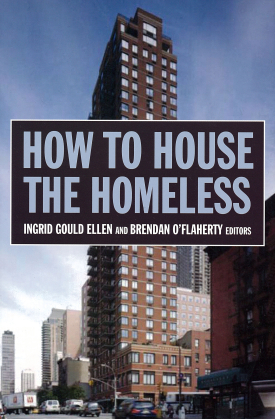
How to House the Homeless
About This Book
"Homelessness is a transient condition for most of those afflicted, but is a continuing frustration for urban policy. This provocative volume engages public health scholars as well as planners, policy makers, and economists in linking interventions to outcomes. We are reminded again of the importance of risk, uncertainty, and savings incentives on economic outcomes-in this case, the transitions in and out of homelessness. Detailed studies of mental health treatments offered to vulnerable populations confirm their overall importance, but suggest that their effects on homelessness per se are small. Reviews of policies designed to address populations at greater risk of homelessness illustrate the tradeoff policy makers face between programs highly targeted to vulnerable populations and the moral hazard these programs encourage. How to House the Homeless offers concrete ideas to reduce the incidence of homelessness and to help in the design of more effective long-run policies."
-JOHN M. QUIGLEY, I. Donald Terner Distinguished Professor and professor of economics, University of California, Berkeley
"This is the most rigorous treatment I know of the problem of homelessness. The chapters have excellent empirical analysis leading naturally to policy implications. How to House the Homeless is particularly successful at characterizing the extent that homelessness is, per se, a housing problem."
-RICHARD GREEN, director and chair of the Lusk Center for Real Estate and professor in the School of Policy, Planning, and Development and the Marshall School of Business, University of Southern California
"How to House the Homeless sharpens our thinking about how housing policy can end homelessness as we know it. Its top-flight interdisciplinary group of authors offers a fresh review of key programs and policies including Housing First, subsidized housing, and land-use regulations. It is a must read for anyone who wants to understand fundamental debates in the field, challenging us to consider why assisted housing is the answer-and why it can never be the answer."
-SANDRA NEWMAN, professor of policy studies, Johns Hopkins University
How to House the Homeless, editors Ingrid Gould Ellen and Brendan O’Flaherty propose that the answers entail rethinking how housing markets operate and developing more efficient interventions in existing service programs. The book critically reassesses where we are now, analyzes the most promising policies and programs going forward, and offers a new agenda for future research.
How to House the Homeless makes clear the inextricable link between homelessness and housing policy. Contributor Jill Khadduri reviews the current residential services system and housing subsidy programs. For the chronically homeless, she argues, a combination of assisted housing approaches can reach the greatest number of people and, specifically, an expanded Housing Choice Voucher system structured by location, income, and housing type can more efficiently reach people at-risk of becoming homeless and reduce time spent homeless. Robert Rosenheck examines the options available to homeless people with mental health problems and reviews the cost-effectiveness of five service models: system integration, supported housing, clinical case management, benefits outreach, and supported employment. He finds that only programs that subsidize housing make a noticeable dent in homelessness, and that no one program shows significant benefits in multiple domains of life.
Contributor Sam Tsemberis assesses the development and cost-effectiveness of the Housing First program, which serves mentally ill homeless people in more than four hundred cities. He asserts that the program’s high housing retention rate and general effectiveness make it a viable candidate for replication across the country. Steven Raphael makes the case for a strong link between homelessness and local housing market regulations—which affect housing affordability—and shows that the problem is more prevalent in markets with stricter zoning laws. Finally, Brendan O’Flaherty bridges the theoretical gap between the worlds of public health and housing research, evaluating the pros and cons of subsidized housing programs and the economics at work in the rental housing market and home ownership. Ultimately, he suggests, the most viable strategies will serve as safety nets—“social insurance”—to reach people who are homeless now and to prevent homelessness in the future.
It is crucial that the links between effective policy and the whole cycle of homelessness—life conditions, service systems, and housing markets—be made clear now. With a keen eye on the big picture of housing policy, How to House the Homeless shows what works and what doesn’t in reducing the numbers of homeless and reaching those most at risk.
INGRID GOULD ELLEN is professor of public policy and urban planning at the New York University Robert F. Wagner Graduate School of Public Service.
BRENDAN O’FLAHERTY is professor of economics at Columbia University.
CONTRIBUTORS: Ingrid Gould Ellen, Jill Khadduri, Brendan O’Flaherty, Edgar O. Olsen, Stephen Raphael, Robert Rosenheck, Sam Tsemberis
Related Events & Media
RSF Journal
View Book Series
Sign Up For Our Mailing List
Apply For Funding
Books
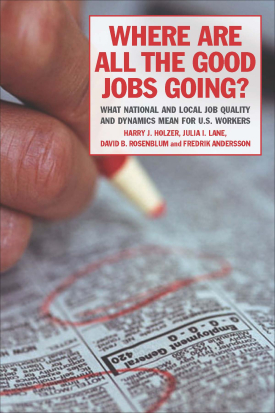
Where Are All the Good Jobs Going?
What National and Local Job Quality and Dynamics Mean for U.S. Workers
About This Book
"At a time when we are desperate for any jobs at all, we must remember that the quality of work is also important. Far too many people work hard yet cannot support their families and have few prospects for upward mobility. Harry Holzer, Julia Lane, David Rosenblum, and Fredrik Andersson help us understand the trajectory of job creation in America and where good jobs come from. They utilize a unique data source that has the great virtue of including information on employers as well as the more standard measures of individual traits and hence they can study the interaction of firm and worker characteristics. They are able to describe the processes of job creation-birth and death of firms as well as their expansion and contraction-and they bring geography into the mix and show how the creation, or lack thereof, of good jobs varies by metropolitan area. This rich and detailed book will be essential for anyone interested in job quality in America."
-PAUL OSTERMAN, Nanyang Technological University Professor of Human Resources and Management, the M.I.T. Sloan School of Management
"Reversing the rise in income inequality and the increasing polarization of the labor market will take a concerted focus on both the quality of jobs employers create and the education and skills of the workforce. Using a unique matched data set of employers and employees, Where Are All the Good Jobs Going? provides a new take on some old issues, importantly on the relationship between job quality and job displacement and on strategies metropolitan areas can use to support new businesses that create good jobs."
-EILEEN APPELBAUM, senior economist, Center for Economic and Policy Research
Deindustrialization in the United States has triggered record-setting joblessness in manufacturing centers from Detroit to Baltimore. At the same time, global competition and technological change have actually stimulated both new businesses and new jobs. The jury is still out, however, on how many of these positions represent a significant source of long-term job quality and security. Where Are All the Good Jobs Going? addresses the most pressing questions for today’s workers: whether the U.S. labor market can still produce jobs with good pay and benefits for the majority of workers and whether these jobs can remain stable over time.
What constitutes a “good” job, who gets them, and are they becoming more or less secure? Where Are All the Good Jobs Going? examines U.S. job quality and volatility from the perspectives of both workers and employers. The authors analyze the Longitudinal Employer Household Dynamics (LEHD) data compiled by the U.S. Census Bureau, and the book covers data for twelve states during twelve years, 1992–2003, resulting in an unprecedented examination of workers and firms in several industries over time.
Counter to conventional wisdom, the authors find that good jobs are not disappearing, but their character and location have changed. The market produces fewer good jobs in manufacturing and more in professional services and finance. Not surprisingly, the best jobs with the highest pay still go to the most educated workers. The most vulnerable workers—older, low-income, and low-skilled—work in the most insecure environments where they can be easily downsized or displaced by a fickle labor market. A higher federal minimum wage and increased unionization can contribute to the creation of well paying jobs. So can economic strategies that help smaller metropolitan areas support new businesses. These efforts, however, must function in tandem with policies that prepare workers for available positions, such as improving general educational attainment and providing career education.
Where Are All the Good Jobs Going? makes clear that future policies will need to address not only how to produce good jobs but how to produce good workers. This cohesive study takes the necessary first steps with a sensible approach to the needs of workers and the firms that hire them.
HARRY J. HOLZER is professor of public policy at Georgetown University.
JULIA I. LANE is program director of Science of Science and Innovation Policy at the National Science Foundation, research fellow at the Institute of Labor (IZA), Bonn Germany, and former senior research fellow at the U.S. Bureau of the Census.
DAVID B. ROSENBLUM is senior economic analyst at NORC at the University of Chicago.
FREDRIK ANDERSSON is an economist in the Economics Department of the Office of the Comptroller of the Currency, U.S. Department of the Treasury.
RSF Journal
View Book Series
Sign Up For Our Mailing List
Apply For Funding
Books
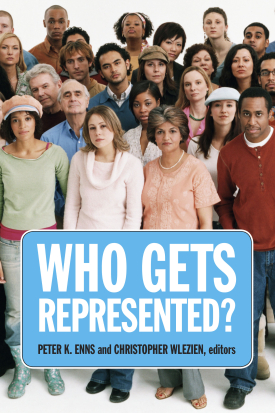
Who Gets Represented?
About This Book
An investigation of policy preferences in the U.S. and how group opinion affects political representation.
"The impressive array of social scientific studies in Who Gets Represented? should set the agenda for the next generation of research on public opinion and political inequality in the United States. This research ought to further untangle the mechanisms by which the rich and other identifiable constituencies have persistently benefitted more than others from government policies even as these policies have been responsive over time to the American public writ large."
-ROBERT Y. SHAPIRO, professor of political science, Columbia University
"This is a truly important book, containing cutting-edge scholarship on one of the most pressing questions of our era. The authors do not settle for easy answers, but instead collectively puzzle over the question of whether rising inequality in American society is in fact connected to the way democratic institutions link citizens to their government. The result is a complex yet critical debate that will reshape the way social scientists think about issues of political representation."
-JEFF MANZA, professor and chair, Department of Sociology, New York University
While it is often assumed that policymakers favor the interests of some citizens at the expense of others, it is not always evident when and how groups’ interests differ or what it means when they do. Who Gets Represented? challenges the usual assumption that the preferences of any one group—women, African Americans, or the middle class—are incompatible with the preferences of other groups. The book analyzes differences across income, education, racial, and partisan groups and investigates whether and how differences in group opinion matter with regard to political representation.
Part I examines opinions among social and racial groups. Relying on an innovative matching technique, contributors Marisa Abrajano and Keith Poole link respondents in different surveys to show that racial and ethnic groups do not, as previously thought, predictably embrace similar attitudes about social welfare. Katherine Cramer Walsh finds that, although preferences on health care policy and government intervention are often surprisingly similar across class lines, different income groups can maintain the same policy preferences for different reasons. Part II turns to how group interests translate into policy outcomes, with a focus on differences in representation between income groups. James Druckman and Lawrence Jacobs analyze Ronald Reagan’s response to private polling data during his presidency and show how different electorally significant groups—Republicans, the wealthy, religious conservatives—wielded disproportionate influence on Reagan’s policy positions. Christopher Wlezien and Stuart Soroka show that politicians’ responsiveness to the preferences of constituents within different income groups can be surprisingly even-handed. Analyzing data from 1876 to the present, Wesley Hussey and John Zaller focus on the important role of political parties, vis-à-vis constituents’ preferences, for legislators’ behavior.
Who Gets Represented? upends several long-held assumptions, among them the growing conventional wisdom that income plays in American politics and the assumption that certain groups will always—or will never—have common interests. Similarities among group opinions are as significant as differences for understanding political representation. Who Gets Represented? offers important and surprising answers
to the question it raises.
PETER K. ENNS is assistant professor of government at Cornell University.
CHRISTOPHER WLEZIEN is professor of political science at Temple University.
CONTRIBUTORS: Marisa Abrajano, Yosef Bhatti, James N. Druckman, Christopher Ellis, Robert S. Erikson, Martin Gilens, David A. Hopkins, Wesley Hussey, Lawrence R. Jacobs, Keith T. Poole, Elizabeth Rigby, Stuart N. Soroka, James A. Stimson, Laura Stoker, Joseph Daniel Ura, Katherine Cramer Walsh, Gerald C. Wright, John Zaller.
Related Events & Media
RSF Journal
View Book Series
Sign Up For Our Mailing List
Apply For Funding

Books
Social Contracts Under Stress
The Middle Classes of America, Europe, and Japan at the Turn of the Century
About This Book
"Bringing together a team of internationally known social scientists and historians, Social Contracts Under Stress exam ines the expansion of the middle classes in the United States, Western Europe, and Japan, as well as the problems that the universalist promise of the post-1945 'democratization of wealth' ran into in later decades. A truly outstanding anthology that convinces by virtue of its intellectual rigor and cohesion-and its timeliness-as the industrialized nations face the age-old social contract question, but this time on a global scale."
-Volker R. Berghahn, Columbia University
"It is rare that a single volume covers so important a theme across so wide a swath of nations at so high a level of analysis. This book explores the postwar social contract as it comes under increasing strain at the turn of our own century. The growth of the middle class-above all the turning of former proletarians into members of the bourgeoisie-was the social and political basis of postwar stability and democracy. This process, though similar across the industrialized world, took different inflections in various nations: from the the European focus on redistribution and social welfare, through the North American liberalist concern with consumer society, to the Japanese solution whereby exporting industries earned the wherewithal that allowed inefficient modes of production to continue, cushioning the hard social choices that would have been necessary in its absence. In our own day, however, this social contract has been challenged: by issues of race and gender and, above all, by globalization and the hard social choices it requires. It is such problems, at the core of contemporary political dilemmas, that these essays address with vision, rigor, and coherence."
-Peter Baldwin, University of California, Los Angeles
The years following World War II saw a huge expansion of the middle classes in the world's industrialized nations, with a significant part of the working class becoming absorbed into the middle class. Although never explicitly formalized, it was as though a new social contract called for government, business, and labor to work together to ensure greater political freedom and more broadly shared economic prosperity. For the most part, they succeeded. In Social Contracts Under Stress, eighteen experts from seven countries examine this historic transformation and look ahead to assess how the middle class might fare in the face of slowing economic growth and increasing globalization.
The first section of the book focuses on the differing experiences of Germany, Britain, France, the United States, and Japan as they became middle-class societies. The British working classes, for example, were slowest to consider themselves middle class, while in Japan by the 1960s, most workers had abandoned working-class identity. The French remain more fragmented among various middle classes and resist one homogenous entity. Part II presents compelling evidence that the rise of a huge middle class was far from inclusive or free of social friction. Some contributors discuss how the social contract reinforced long-standing prejudices toward minorities and women. In the United States, Ira Katznelson writes, Southern politicians used measures that should have promoted equality, such as the GI bill, to exclude blacks from full access to opportunity. In her review of gender and family models, Chiara Saraceno finds that Mediterranean countries have mobilized the power of the state to maintain a division of labor between men and women. The final section examines what effect globalization might have on the middle class. Leonard Schoppa's careful analysis of the relevant data shows how globalization has pushed "less skilled workers down and more skilled workers up out of a middle class that had for a few decades been home to both." Although Europe has resisted the rise of inequality more effectively than the United States or Japan, several contributors wonder how long that resistance can last.
Social Contracts Under Stress argues convincingly that keeping the middle class open and inclusive in the face of current economic pressures will require a collective will extending across countries. This book provides an invaluable guide for assessing the issues that must be considered in such an effort.
OLIVIER ZUNZ is Commonwealth Professor of History, University of Virginia.
LEONARD SCHOPPA is associate professor in the Woodrow Wilson Department of Government and Foreign Affairs, University of Virginia.
NOBUHIRO HIWATARI is professor of political science at the University of Tokyo.