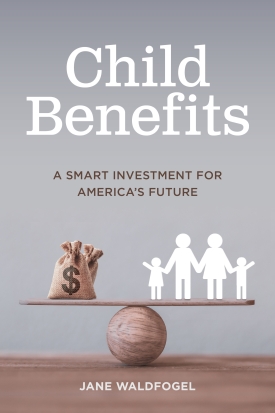
Cover image of the book Child Benefits
Books

Child Benefits

A Smart Investment for America's Future
Author
Jane Waldfogel
Paperback
$42.50
Add to Cart
Publication Date
6 in. × 9 in. 224 pages
ISBN
978-0-87154-871-9

About This Book

"Conservatives in other countries have long supported universal child benefits as an important tool for tackling child poverty while encouraging work and family stability. American conservatives have been more skeptical, but, as Jane Waldfogel demonstrates with wide-ranging evidence, child benefits are one pro-family policy that deserves support across the political spectrum."
-JOSH McCABE, director of social policy, Niskanen Center

"In this well-researched and informative book, Jane Waldfogel examines the case for child benefits in the United States. Woven with evidence and history, and tackling head-on the trade-offs embedded in the policy debate, Child Benefits is exactly what we need for this moment."
-HILARY HOYNES, Chancellor's Professor of Economics and Public Policy, Goldman School of Public Policy, University of California, Berkeley

"If you're interested in child poverty and in issues and challenges that government benefits and programs for children now face, do not miss Child Benefits. It is full of keen insights, thoughtful and deeply informative discussions, and wisdom about where we as a nation should go from here. And it's written in a clear, nontechnical, and highly readable manner that should appeal to a broad audience, which the book very much deserves."
-ROBERT GREENSTEIN, visiting fellow in economic studies, The Brookings Institution, and founder and president emeritus, Center on Budget and Policy Priorities

The United States has one of the highest child poverty rates among wealthy countries and stands out among its peers as the only country that does not offer a child benefit – regular payments from the government to most or all families with children, not conditioned on parental employment. During the temporary expansion of the Child Tax Credit (CTC) in 2021, the CTC functioned as a child benefit, and the child poverty rate fell to the lowest level ever recorded in the United States. Despite this decrease, the CTC expansion was not renewed. Concerns about enacting a child benefit include the cost, the possibility of misuse of money by parents, and how it might affect parental employment and fertility. In Child Benefits, social policy scholar Jane Waldfogel details the history and origins of child benefits around the world and comprehensively assesses how child benefits affect family spending, fertility, employment, child poverty, and child wellbeing to address such concerns and to determine the benefits of enacting such a policy permanently.

Drawing on research from peer countries in the Organization for Economic Cooperation and Development as well as the United States, Waldfogel shows that a child benefit would prevent poverty and hardship and protect children from deep poverty and income instability. The research is clear that families would spend the money from a child benefit on food, clothing, and other items for their children and that a child benefit would not have large negative impacts on parental employment or family decisions about fertility. It also shows that a child benefit would promote short- and longer-term child and family wellbeing. Child benefits have been shown to enhance opportunity and benefit society through healthier and better-educated young adults and stronger and more stable families. And rigorous benefit-cost analyses indicate that a child benefit, while costly, would more than pay for itself, yielding a large return on investment.

Waldfogel evaluates four current, major proposals for a child benefit and provides recommendations for a policy that would deliver the best outcomes for children and families and the best return on investment. She argues that such a policy would be more generous, not tied to parental employment or earnings, available to all parents but phased out for higher-income families, delivered in monthly payments through the tax system, and provided in addition to existing social programs.

Child Benefits provides fascinating insights on the history and impacts of child benefits and makes a clear and definitive argument for the establishment of a child benefit in the United States.

About the Author

JANE WALDFOGEL is the Compton Foundation Centennial Professor for the Prevention of Children’s and Youth Problems at the Columbia University School of Social Work and a visiting professor at the Centre for Analysis of Social Exclusion at the London School of Economics.

RSF Books by Jane Waldfogel

RSF Journal
View Book Series
Sign Up For Our Mailing List
Apply For Funding
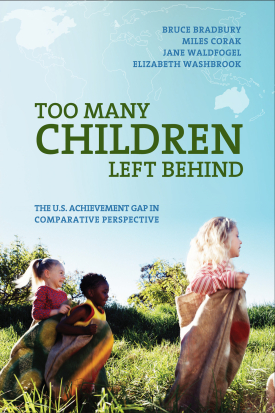
Cover image of the book Too Many Children Left Behind
Books

Too Many Children Left Behind

The U.S. Achievement Gap in Comparative Perspective
Authors
Bruce Bradbury
Miles Corak
Jane Waldfogel
Elizabeth Washbrook
Paperback
$45.00
Add to Cart
Publication Date
6 in. × 9 in. 224 pages
ISBN
978-0-87154-024-9
Also Available From

About This Book

“This carefully researched book documents that family background matters more in accounting for the academic success of children in the United States than for those in Canada, the United Kingdom, or Australia—all countries that have experienced similar economic shocks and have large immigrant populations. The authors make a compelling case that differences among the countries in social supports for families, labor market policies, and education policies all play roles in explaining this pattern. Too Many Children Left Behind will be sobering to readers in the United States, but it provides a source of hope that public policies matter in leveling the playing field and improving the life chances of children from low-income families.”

—RICHARD J. MURNANE, Thompson Research Professor, Harvard Graduate School of Education

“A devastating dismantling of the American Dream drawn from the most compelling data yet on children’s achievement during their early and formative years.”

—LEE ELLIOT MAJOR, chief executive, The Sutton Trust, and trustee, The Education Endowment Foundation

“It’s easy to think that the large achievement gap between rich and poor students in the United States is an immutable pattern, but the careful cross-national analysis in Too Many Children Left Behind suggests the opposite. The book’s detailed comparison of patterns of educational inequality in four countries demonstrates clearly that social and educational policies can help to equalize children’s opportunities for educational success.”

—SEAN F. REARDON, professor of poverty and inequality in education, Stanford University

The belief that with hard work and determination, all children have the opportunity to succeed in life is a cherished part of the American Dream. Yet, increased inequality in America has made that dream more difficult for many to obtain. In Too Many Children Left Behind, an international team of social scientists assesses how social mobility varies in the United States compared with Australia, Canada, and the United Kingdom. Bruce Bradbury, Miles Corak, Jane Waldfogel, and Elizabeth Washbrook show that the academic achievement gap between disadvantaged American children and their more advantaged peers is far greater than in other wealthy countries, with serious consequences for their future life outcomes. With education the key to expanding opportunities for those born into low socioeconomic status families, Too Many Children Left Behind helps us better understand educational disparities and how to reduce them.

Analyzing data on 8,000 school children in the United States, the authors demonstrate that disadvantages that begin early in life have long lasting effects on academic performance. The social inequalities that children experience before they start school contribute to a large gap in test scores between low- and high-SES students later in life. Many children from low-SES backgrounds lack critical resources, including books, high-quality child care, and other goods and services that foster the stimulating environment necessary for cognitive development. The authors find that not only is a child’s academic success deeply tied to his or her family background, but that this class-based achievement gap does not narrow as the child proceeds through school.

The authors compare test score gaps from the United States with those from three other countries and find smaller achievement gaps and greater social mobility in all three, particularly in Canada. The wider availability of public resources for disadvantaged children in those countries facilitates the early child development that is fundamental for academic success. All three countries provide stronger social services than the United States, including universal health insurance, universal preschool, paid parental leave, and other supports. The authors conclude that the United States could narrow its achievement gap by adopting public policies that expand support for children in the form of tax credits, parenting programs, and pre-K.

With economic inequalities limiting the futures of millions of children, Too Many Children Left Behind is a timely study that uses global evidence to show how the United States can do more to level the playing field.

BRUCE BRADBURY is associate professor at the Social Policy Research Centre at the University of New South Wales, Australia.

MILES CORAK is professor of economics at the Graduate School of Public and International Affairs at the University of Ottawa.

JANE WALDFOGEL is professor of social work and public affairs at the Columbia University School of Social Work and visiting professor at the Centre for Analysis of Social Exclusion at the London School of Economics and Political Science.

ELIZABETH WASHBROOK is lecturer in Quantitative Methods for Education at the Graduate School of Education and a member of the Centre for Multilevel Modelling at the University of Bristol, United Kingdom.

RSF Journal
View Book Series
Sign Up For Our Mailing List
Apply For Funding
Britain's War on Poverty
Books

Britain's War on Poverty

Author
Jane Waldfogel
Paperback
$39.95
Add to Cart
Publication Date
6 in. × 9 in. 280 pages
ISBN
978-0-87154-898-6
Also Available From

About This Book

“[Waldfogel’s] carefully researched and balanced account demonstrates that committed governments can indeed implement social policies that improve the well-being of their citizens. Her very readable assessment of the British experiment also has relevance for other countries, especially the United States, and her excellent book deserves to be widely consulted.”
—POLITICAL SCIENCE QUARTERLY 

“A developed country declaring a major war on poverty comes around once in a generation. People will want to know why they did it, how they went about it, but, even more crucially what the impact was on children. This book is the only one to cover all these dimensions and to do it with style. Britain’s War on Poverty isn’t about Britain—it’s about declaring war on poverty.”
—PAUL GREGG, University of Bristol 

“America had a war on poverty and poverty won; the United Kingdom has waged the same war and is winning it by making steady progress against child poverty. Their child poverty rate is down by half from its starting point, and children are demonstrably better off based on polices they adopted and consistently financed and delivered. Why did the Brits do so much better than the Americans? This splendid book convincingly shows why and how a ‘true to its aims,’ well-financed, and persistent war on poverty can work in an Anglo- Saxon democracy. Jane Waldfogel shows how and why policy can make a difference against poverty if it is a high priority for a nation. Britain’s War on Poverty should be widely and carefully read by social policy analysts and advocates who seek a better future for America’s young children.”
—TIMOTHY M. SMEEDING, University of Wisconsin–Madison 

“This timely volume tells the remarkable story of the British government’s attempt to end child poverty. Professor Waldfogel, who resides in the United Kingdom for several months every year, tells the story with color and passion, emphasizing the similarities and differences between anti-poverty policy in the United States and Britain. Perhaps most interesting and provocative are the lessons she draws from the British experience for a more sweeping commitment by America to greatly reduce the nation’s child poverty rate, which is now higher than it was in the 1970s. Scholars, advocates, and policymakers committed to reducing child poverty will find Britain’s War on Poverty packed with insights about how we should proceed.”
—RON HASKINS, Brookings Institution

In 1999, one in four British children lived in poverty—the third highest child poverty rate among industrialized countries. Five years later, the child poverty rate in Britain had fallen by more than half in absolute terms. How did the British government accomplish this and what can the United States learn from the British experience? Jane Waldfogel offers a sharp analysis of the New Labour government’s anti-poverty agenda, its dramatic early success and eventual stalled progress. Comparing Britain’s anti-poverty initiative to U.S. welfare reform, the book shows how the policies of both countries have affected child poverty, living standards, and well-being in low-income families and suggests next steps for future reforms.

Britain’s War on Poverty evaluates the three-pronged anti-poverty strategy employed by the British government and what these efforts accomplished. British reforms sought to promote work and make work pay, to increase financial support for families with children, and to invest in the health, early-life development, and education of children. The latter two features set the British reforms apart from the work-oriented U.S. welfare reforms, which did not specifically target income or program supports for children. Plagued by premature initiatives and what some experts called an overly ambitious agenda, the British reforms fell short of their intended goal but nevertheless significantly increased single-parent employment, raised incomes for low-income families, and improved child outcomes. Poverty has fallen, and the pattern of low-income family expenditures on child enrichment and healthy food has begun to converge with higher-income families.

As Waldfogel sees it, further success in reducing child poverty in Britain will rely on understanding who is poor and who is at highest risk. More than half of poor children live in families where at least one parent is working, followed by unemployed single- and two-parent homes, respectively. Poverty rates are also notably higher for children with disabled parents, large families, and for Pakistani and Bangladeshi children. Based on these demographics, Waldfogel argues that future reforms must, among other goals, raise working-family incomes, provide more work for single parents, and better engage high-risk racial and ethnic minority groups.

What can the United States learn from the British example? Britain’s War on Poverty is a primer in the triumphs and pitfalls of protracted policy. Notable differences distinguish the British and U.S. models, but Waldfogel asserts that a future U.S. poverty agenda must specifically address child poverty and the income inequality that helps create it. By any measurement and despite obstacles, Britain has significantly reduced child poverty. The book’s key lesson is that it can be done.

JANE WALDFOGEL is professor of social work and public affairs at the Columbia University School of Social Work and visiting professor at the Centre for Analysis of Social Exclusion at the London School of Economics and Political Science.

RSF Journal
View Book Series
Sign Up For Our Mailing List
Apply For Funding
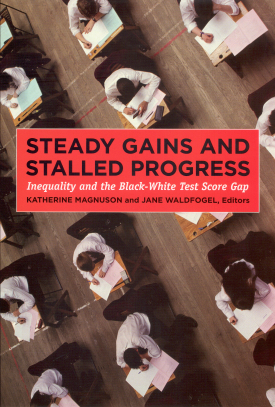
Cover image of the book Steady Gains and Stalled Progress
Books

Steady Gains and Stalled Progress

Inequality and the Black-White Test Score Gap
Editors
Katherine Magnuson
Jane Waldfogel
Paperback
$45.00
Add to Cart
Publication Date
6 in. × 9 in. 368 pages
ISBN
978-0-87154-473-5
Also Available From

About This Book

"Steady Gains and Stalled Progress is an important collection and a worthy successor to Christopher Jencks and Meredith Phillips' classic The Black-White Test-Score Gap. It offers new evidence that highlights the complexities of racial inequality and provides a basis for cautious optimism for the future."
-ADAM GAMORAN, professor of sociology and educational policy studies and director, Wisconsin Center for Education Research, University of Wisconsin, Madison

"The black-white gap in test scores is one of the most stubborn and mystifying challenges facing the United States. And while it is hard to separate fact from statistical artifact and personal belief, Katherine Magnuson and Jane Waldfogel have produced a thorough and insightful volume that accomplishes just that. Even experts in education policy will come away having learned something new."
-CECILIA E. ROUSE, Theodore A. Wells '29 Professor of Economics and Public Affairs, Princeton University

"Few trends have tested the optimism of the Civil Rights era more than the stubborn persistence of the black-white achievement gap. Steady Gains and Stalled Progress assembles a major league team of social scientists to examine possible explanations for the puzzling career of this gap. Their penetrating analysis will be essential reading for anyone interested in education, social equity, or the future of the American workforce."
-CHARLES T. CLOTFELTER, professor of public policy studies, economics, and law, Duke University

Addressing the disparity in test scores between black and white children remains one of the greatest social challenges of our time. Between the 1960s and 1980s, tremendous strides were made in closing the achievement gap, but that remarkable progress halted abruptly in the mid 1980s, and stagnated throughout the 1990s. How can we understand these shifting trends and their relation to escalating economic inequality? In Steady Gains and Stalled Progress, interdisciplinary experts present a groundbreaking analysis of the multifaceted reasons behind the test score gap—and the policies that hold the greatest promise for renewed progress in the future.

Steady Gains and Stalled Progress shows that while income inequality does not directly lead to racial differences in test scores, it creates and exacerbates disparities in schools, families, and communities—which do affect test scores. Jens Ludwig and Jacob Vigdor demonstrate that the period of greatest progress in closing the gap coincided with the historic push for school desegregation in the 1960s and 1970s. Stagnation came after efforts to integrate schools slowed down. Today, the test score gap is nearly 50 percent larger in states with the highest levels of school segregation.  Katherine Magnuson, Dan Rosenbaum, and Jane Waldfogel show how parents’ level of education affects children’s academic performance: as educational attainment for black parents increased in the 1970s and 1980s, the gap in children’s test scores narrowed. Sean Corcoran and William Evans present evidence that teachers of black students have less experience and are less satisfied in their careers than teachers of white students. David Grissmer and Elizabeth Eiseman find that the effects of economic deprivation on cognitive and emotional development in early childhood lead to a racial divide in school readiness on the very first day of kindergarten. Looking ahead, Helen Ladd stresses that the task of narrowing the divide is not one that can or should be left to schools alone. Progress will resume only when policymakers address the larger social and economic forces behind the problem. Ronald Ferguson masterfully interweaves the volume’s chief findings to highlight the fact that the achievement gap is the cumulative effect of many different processes operating in different contexts.

The gap in black and white test scores is one of the most salient features of racial inequality today. Steady Gains and Stalled Progress provides the detailed information and powerful insight we need to understand a complicated past and design a better future.

KATHERINE MAGNUSON is assistant professor of social work and a faculty affiliate at the Institute for Research on Poverty at the University of Wisconsin, Madison.

JANE WALDFOGEL is professor of social work and public affairs at Columbia University.

CONTRIBUTORS: Mark Berends, Mary E. Campbell, Sean P. Corcoran, Elizabeth Eiseman, William N. Evans, Ronald F. Ferguson,  David Grissmer,  Robert Haveman,  Helen F. Ladd,  Jens Ludwig, Roberto V. Penaloza,  Meredith Phillips,  Dan T. Rosenbaum,  Jacob L. Vigdor, Tina Wildhagen, Barbara L. Wolfe.

An Institute for Research on Poverty Affiliated Book on Poverty and Public Policy


RSF Journal
View Book Series
Sign Up For Our Mailing List
Apply For Funding
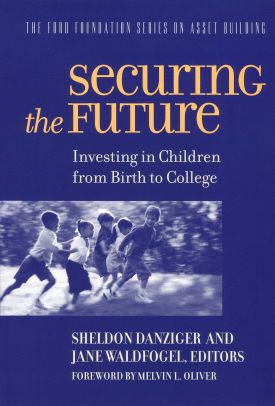
Cover image of the book Securing the Future
Books

Securing the Future

Investing in Children from Birth to College
Editors
Sheldon Danziger
Jane Waldfogel
Paperback
$34.95
Add to Cart
Publication Date
6.63 in. × 9.25 in. 348 pages
ISBN
978-0-87154-280-9
Also Available From

About This Book

"One of the best collections of papers to come my way in a long time on improving programs aimed at cultivating opportunities for children. It is a treasure trove for academics and policy makers."
-Frank Furstenberg Jr., University of Pennsylvania

"Sheldon Danziger and Jane Waldfogel have given us an exciting new framework for thinking about the reproduction of poverty and have brought together some of the most insightful minds in economics, sociology, and developmental psychology to tell us what to do."
-Sara S. McLanahan, Princeton University

More than ever, the economic health of a country depends upon the skills, knowledge, and capacities of its people. How does a person acquire these human assets and how can we promote their development? Securing the Future assembles an interdisciplinary team of scholars to investigate the full range of factors—pediatric, psychological, social, and economic—that bear on a child's development into a well-adjusted, economically productive member of society. A central purpose of the volume is to identify sound interventions that will boost human assets, particularly among the disadvantaged. The book provides a comprehensive evaluation of current initiatives and offers a wealth of new suggestions for effective public and private investments in child development.

While children from affluent, highly educated families have good quality child care and an expensive education provided for them, children from poor families make do with informal child care and a public school system that does not always meet their needs. How might we best redress this growing imbalance? The contributors to this volume recommend policies that treat academic attainment together with psychological development and social adjustment. Mentoring programs, for example, promote better school performance by first fostering a young person's motivation to learn. Investments made early in life, such as preschool education, are shown to have the greatest impact on later learning for the least cost.

In their focus upon children, however, the authors do not neglect the important links between generations. Poverty and inequality harm the development of parents and children alike. Interventions that empower parents to fight for better services and better schools are also of great benefit to their children.

Securing the Future shows how investments in child development are both a means to an end and an end in themselves. They benefit the child directly and they also help that child contribute to the well-being of society. This book points us toward more effective strategies for promoting the economic success and the social cohesion of future generations.

SHELDON DANZIGER is Distinguished University Professor of Public Policy and co-director of the National Poverty Center at the University of Michigan.
 
JANE WALDFOGEL is professor of social work and public affairs at the Columbia University School of Social Work and research associate at the Centre for Analysis of Social Exclusion at the London School of Economics.

CONTRIBUTORS: Debra Donahoe, Jacquelynne S. Eccles,  James J. Jeckman,  Robert S. Kahn,  Thomas J. Kane,  Lance Lochner,  Lisa M. Lynch,  Melvin L. Oliver,  Hillard Pouncy,  Craig T. Ramey,  Sharon Landesman Ramey,  Robert J. Sampson,  Margaret Beale Spencer, Dena Phillips Swanson,  Marta Tienda,  Allan Wigfield,  Barry Zuckerman, M.D.

A Volume in the Ford Foundation Series on Asset Building

RSF Journal
View Book Series
Sign Up For Our Mailing List
Apply For Funding