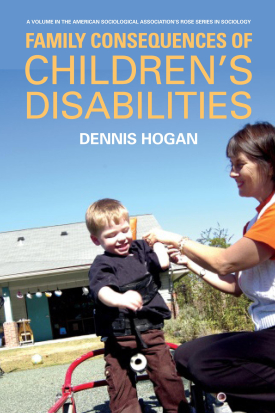
Cover image of the book Family Consequences of Children's Disabilities
Books

Family Consequences of Children's Disabilities

Author
Dennis Hogan
Paperback
$37.50
Add to Cart
Publication Date
132 pages
ISBN
978-0-87154-457-5
Also Available From

About This Book

A Volume in the American Sociological Association’s Rose Series in Sociology

Winner of the 2012 Otis Dudley Duncan Award for Outstanding Scholarship in Social Demography

The Americans with Disabilities Act (ADA) and other national policies are designed to ensure the greatest possible inclusion of people with disabilities in all aspects of American life. But as a matter of national policy we still place the lion's share of responsibility for raising children with disabilities on their families. While this strategy largely works, sociologist Dennis Hogan maintains, the reality is that family financial security, the parents' relationship, and the needs of other children in the home all can be stretched to the limit. In Family Consequences of Children's Disabilities Hogan delves inside the experiences of these families and examines the financial and emotional costs of raising a child with a disability. The book examines the challenges families of children with disabilities encounter and how these challenges impact family life.

The first comprehensive account of the families of children with disabilities, Family Consequences of Children's Disabilities employs data culled from seven national surveys and interviews with twenty-four mothers of children with disabilities, asking them questions about their family life, social supports, and how other children in the home were faring. Not surprisingly, Hogan finds that couples who are together when their child is born have a higher likelihood of divorcing than other parents do. The potential for financial insecurity contributes to this anxiety, especially as many parents must strike a careful balance between employment and caregiving. Mothers are less likely to have paid employment, and the financial burden on single parents can be devastating. One-third of children with disabilities live in single-parent households, and nearly 30 percent of families raising a child with a disability live in poverty.

Because of the high levels of stress these families incur, support networks are crucial. Grandparents are often a source of support. Siblings can also assist with personal care and, consequently, tend to develop more helpful attitudes, be more inclusive of others, and be more tolerant. But these siblings are at risk for their own health problems: they are three times more likely to experience poor health than children in homes where there is no child with a disability. Yet this book also shows that raising a child with a disability includes unexpected rewards—the families tend to be closer, and they engage in more shared activities such as games, television, and meals.

Family Consequences of Children's Disabilities offers access to a world many never see or prefer to ignore. The book provides vital information on effective treatment, rehabilitation, and enablement to medical professionals, educators, social workers, and lawmakers. This compelling book demonstrates that every mirror has two faces: raising a child with a disability can be difficult, but it can also offer expanded understanding.

DENNIS HOGAN is Robert E. Turner Distinguished Professor of Population Studies at Brown University.

RSF Journal
View Book Series
Sign Up For Our Mailing List
Apply For Funding
Cover image of the book From Parents to Children
Books

From Parents to Children

The Intergenerational Transmission of Advantage
Editors
John Ermisch
Markus Jäntti
Timothy M. Smeeding
Paperback
$69.95
Add to Cart
Publication Date
524 pages
ISBN
978-0-87154-045-4
Also Available From

About This Book

Does economic inequality in one generation lead to inequality of opportunity in the next? In From Parents to Children, an esteemed international group of scholars investigates this question using data from ten countries with differing levels of inequality. The book compares whether and how parents' resources transmit advantage to their children at different stages of development and sheds light on the structural differences among countries that may influence intergenerational mobility.

How and why is economic mobility higher in some countries than in others? The contributors find that inequality in mobility-relevant skills emerges early in childhood in all of the countries studied. Bruce Bradbury and his coauthors focus on learning readiness among young children and show that as early as age five, large disparities in cognitive and other mobility-relevant skills develop between low- and high-income kids, particularly in the United States and the United Kingdom. Such disparities may be mitigated by investments in early childhood education, as Christelle Dumas and Arnaud Lefranc demonstrate. They find that universal pre-school education in France lessens the negative effect of low parental SES and gives low-income children a greater shot at social mobility. Katherine Magnuson, Jane Waldfogel, and Elizabeth Washbrook find that income-based gaps in cognitive achievement in the United States and the United Kingdom widen as children reach adolescence. Robert Haveman and his coauthors show that the effect of parental income on test scores increases as children age; and in both the United States and Canada, having parents with a higher income betters the chances that a child will enroll in college.

As economic inequality in the United States continues to rise, the national policy conversation will not only need to address the devastating effects of rising inequality in this generation but also the potential consequences of the decline in mobility from one generation to the next. Drawing on unparalleled international datasets, From Parents to Children provides an important first step.

JOHN ERMISCH is professor of family demography at Oxford University.

MARKUS JäNTTI is professor of economics at the Swedish Institute for Social Research, Stockholm University.

TIMOTHY M. SMEEDING is director of the Institute for Research on Poverty, University of Wisconsin-Madison.

CONTRIBUTORS: Silke Anger, Lars Bergman, Erik Bihagen, Paul Bingley, Anders Bjorklund, Jo Blanden, Bruce Bradbury, Massimiliano Bratti, Lorenzo Cappellari, Miles Corak, Emilia Del Bono, Kathryn Duckworth, Christelle Dumas, Greg J. Duncan, Olaf Groh-Samberg, Robert Haveman, John Jerrim, Jan O. Jonsson, Ilan Katz, Katja Kokko, Arnaud Lefranc, Henning Lohmann, Anna-Liisa Lyyra, Katherine Magnuson, Molly Metzger, John Micklewright, Carina Mood, Martin Nybom, Frauke H. Peter, Patrizio Piraino, Lea Pulkkinen, Gerry Redmond, John Roemer, Sharon Simonton, C. Katharina Spiess, Jane Waldfogel, Eizabeth Washbrook, Niels Westergard-Nielsen, James A. Wilson, Kathryn Wilson.


RSF Journal
View Book Series
Sign Up For Our Mailing List
Apply For Funding
Cover image of the book Invisible Men
Books

Invisible Men

Mass Incarceration and the Myth of Black Progress
Author
Becky Pettit
Paperback
$39.95
Add to Cart
Publication Date
156 pages
ISBN
978-0-87154-667-8
Also Available From

About This Book

For African American men without a high school diploma, being in prison or jail is more common than being employed—a sobering reality that calls into question post-Civil Rights era social gains. Nearly 70 percent of young black men will be imprisoned at some point in their lives, and poor black men with low levels of education make up a disproportionate share of incarcerated Americans. In Invisible Men, sociologist Becky Pettit demonstrates another vexing fact of mass incarceration: most national surveys do not account for prison inmates, a fact that results in a misrepresentation of U.S. political, economic, and social conditions in general and black progress in particular. Invisible Men provides an eye-opening examination of how mass incarceration has concealed decades of racial inequality.

Pettit marshals a wealth of evidence correlating the explosion in prison growth with the disappearance of millions of black men into the American penal system. She shows that, because prison inmates are not included in most survey data, statistics that seemed to indicate a narrowing black-white racial gap—on educational attainment, work force participation, and earnings—instead fail to capture persistent racial, economic, and social disadvantage among African Americans. Federal statistical agencies, including the U.S. Census Bureau, collect surprisingly little information about the incarcerated, and inmates are not included in household samples in national surveys. As a result, these men are invisible to most mainstream social institutions, lawmakers, and nearly all social science research that isn't directly related to crime or criminal justice. Since merely being counted poses such a challenge, inmates' lives—including their family background, the communities they come from, or what happens to them after incarceration—are even more rarely examined. And since correctional budgets provide primarily for housing and monitoring inmates, with little left over for job training or rehabilitation, a large population of young men are not only invisible to society while in prison but also ill-equipped to participate upon release.

Invisible Men provides a vital reality check for social researchers, lawmakers, and anyone who cares about racial equality. The book shows that more than a half century after the first civil rights legislation, the dismal fact of mass incarceration inflicts widespread and enduring damage by undermining the fair allocation of public resources and political representation, by depriving the children of inmates of their parents' economic and emotional participation, and, ultimately, by concealing African American disadvantage from public view.

BECKY PETTIT is professor of sociology at the University of Washington.

RSF Journal
View Book Series
Sign Up For Our Mailing List
Apply For Funding
Cover image of the book Nurturing Dads
Books

Nurturing Dads

Social Initiatives for Contemporary Fatherhood
Authors
William Marsiglio
Kevin Roy
Paperback
$45.00
Add to Cart
Publication Date
6 in. × 9 in. 312 pages
ISBN
978-0-87154-566-4
Also Available From

About This Book

A Volume in the American Sociological Association’s Rose Series in Sociology

American fathers are a highly diverse group, but the breadwinning, live-in, biological dad prevails as the fatherhood ideal. Consequently, policymakers continue to emphasize marriage and residency over initiatives that might help foster healthy father-child relationships and creative co-parenting regardless of marital or residential status. In Nurturing Dads, William Marsiglio and Kevin Roy explore the ways new initiatives can address the social, cultural, and economic challenges men face in contemporary families and foster more meaningful engagement between many different kinds of fathers and their children.

What makes a good father? The firsthand accounts in Nurturing Dads show that the answer to this question varies widely and in ways that counter the mainstream "provide and reside" model of fatherhood. Marsiglio and Roy document the personal experiences of more than three hundred men from a wide range of socioeconomic backgrounds and diverse settings, including fathers-to-be, young adult fathers, middle-class dads, stepfathers, men with multiple children in separate families, and fathers in correctional facilities. They find that most dads express the desire to have strong, close relationships with their children and to develop the nurturing skills to maintain these bonds. But they also find that disadvantaged fathers, including young dads and those in constrained financial and personal circumstances, confront myriad structural obstacles, such as poverty, inadequate education, and poor job opportunities.

Nurturing Dads asserts that society should help fathers become more committed and attentive caregivers and that federal and state agencies, work sites, grassroots advocacy groups, and the media all have roles to play. Recent efforts to introduce state-initiated paternity leave should be coupled with social programs that encourage fathers to develop unconditional commitments to children, to co-parent with mothers, to establish partnerships with their children's other caregivers, and to develop parenting skills and resources before becoming fathers via activities like volunteering and mentoring kids. Ultimately, Marsiglio and Roy argue, such combined strategies would not only change the policy landscape to promote engaged fathering but also change the cultural landscape to view nurturance as a fundamental aspect of good fathering.

Care is a human experience—not just a woman's responsibility—and this core idea behind Nurturing Dads holds important implications for how society supports its families and defines manhood. The book promotes the progressive notion that fathers should provide more than financial support and, in the process, bring about a better start in life for their children.

WILLIAM MARSIGLIO is professor in the Department of Sociology and Criminology & Law at the University of Florida.

KEVIN ROY is associate professor of family science at the University of Maryland

RSF Journal
View Book Series
Sign Up For Our Mailing List
Apply For Funding

Data tabulated by the U.S. Census shows that poverty rates have jumped by 2.6 percentage points since the onset of the recession, rising from 12.5 percent in 2007 to 15.1 percent in 2010. Although the annual rate of 15.1 percent is the highest rate since 1983, growth in the U.S. population means that the 46 million people in poverty at the end of 2010 is the highest number in poverty since the official poverty line was first established in the early 1960s. Poverty has also been changing in ways other than the simple increases in numbers and rates.

As of 2009, 15.8% of the U.S. population was Latino, and this number is expected to rise in the coming years. Despite the increasing presence and importance of Latinos in the U.S., our education system still largely fails Latino students. In 2008, Latino students in the fourth grade scored an average of 21 points lower than non-Hispanic white students on both reading and math National Assessment of Educational Progress (NAEP 2009). In addition, the dropout rate for Latino students is 18.3%, compared to 4.8 for whites.

Cover image of the book Good Jobs America
Books

Good Jobs America

Making Work Better for Everyone
Authors
Paul Osterman
Beth Shulman
Paperback
$34.95
Add to Cart
Publication Date
6 in. × 9 in. 200 pages
ISBN
978-0-87154-663-0
Also Available From

About This Book

America confronts a jobs crisis that has two faces. The first is obvious when we read the newspapers or talk with our friends and neighbors: there are simply not enough jobs to go around. The second jobs crisis is more subtle but no less serious: far too many jobs fall below the standard that most Americans would consider decent work. A quarter of working adults are trapped in jobs that do not provide living wages, health insurance, or much hope of upward mobility. The problem spans all races and ethnic groups and includes both native-born Americans and immigrants. But Good Jobs America provides examples from industries ranging from food services and retail to manufacturing and hospitals to demonstrate that bad jobs can be made into good ones. Paul Osterman and Beth Shulman make a rigorous argument that by enacting policies to help employers improve job quality we can create better jobs, and futures, for all workers.

Good Jobs America dispels several myths about low-wage work and job quality. The book demonstrates that mobility out of the low-wage market is a chimera—far too many adults remain trapped in poor-quality jobs. Osterman and Shulman show that while education and training are important, policies aimed at improving earnings equality are essential to lifting workers out of poverty. The book also demolishes the myth that such policies would slow economic growth. The experiences of countries such as France, Germany, and the Netherlands, show that it is possible to mandate higher job standards while remaining competitive in international markets. Good Jobs America shows that both government and the firms that hire low-wage workers have important roles to play in improving the quality of low-wage jobs. Enforcement agencies might bolster the effectiveness of existing regulations by exerting pressure on parent companies, enabling effects to trickle down to the subsidiaries and sub-contractors where low-wage jobs are located. States like New York have already demonstrated that involving community and advocacy groups—such as immigrant rights organizations, social services agencies, and unions—in the enforcement process helps decrease workplace violations. And since better jobs reduce turnover and improve performance, career ladder programs within firms help create positions employees can aspire to. But in order for ladder programs to work, firms must also provide higher rungs—the career advancement opportunities workers need to get ahead.

Low-wage employment occupies a significant share of the American labor market, but most of these jobs offer little and lead nowhere. Good Jobs America reappraises what we know about job quality and low-wage employment and makes a powerful argument for our obligation to help the most vulnerable workers. A core principle of U.S. society is that good jobs be made accessible to all. This book proposes that such a goal is possible if we are committed to realizing it.

PAUL OSTERMAN is NTU Professor at the MIT Sloan School of Management as well as a member of the Department of Urban Planning at MIT.

BETH SHULMAN was senior fellow at Demos, chair of the Board of the National Employment Law Project, and co-chair of the Fairness Initiative on Low-Wage Work.


RSF Journal
View Book Series
Sign Up For Our Mailing List
Apply For Funding
Cover image of the book Persistence, Privilege, and Parenting
Books

Persistence, Privilege, and Parenting

The Comparative Study of Intergenerational Mobility
Editors
Timothy M. Smeeding
Robert Erikson
Markus Jäntti
Paperback
$59.95
Add to Cart
Publication Date
392 pages
ISBN
978-0-87154-031-7
Also Available From

About This Book

Americans like to believe that theirs is the land of opportunity, but the hard facts are that children born into poor families in the United States tend to stay poor and children born into wealthy families generally stay rich. Other countries have shown more success at lessening the effects of inequality on mobility—possibly by making public investments in education, health, and family well-being that offset the private advantages of the wealthy. What can the United States learn from these other countries about how to provide children from disadvantaged backgrounds an equal chance in life? Making comparisons across ten countries, Persistence, Privilege, and Parenting brings together a team of eminent international scholars to examine why advantage and disadvantage persist across generations. The book sheds light on how the social and economic mobility of children differs within and across countries and the impact private family resources, public policies, and social institutions may have on mobility.

In what ways do parents pass advantage or disadvantage on to their children? Persistence, Privilege, and Parenting is an expansive exploration of the relationship between parental socioeconomic status and background and the outcomes of their grown children. The authors also address the impact of education and parental financial assistance on mobility. Contributors Miles Corak, Lori Curtis, and Shelley Phipps look at how family economic background influences the outcomes of adult children in the United States and Canada. They find that, despite many cultural similarities between the two countries, Canada has three times the rate of intergenerational mobility as the United States—possibly because Canada makes more public investments in its labor market, health care, and family programs. Jo Blanden and her colleagues explore a number of factors affecting how advantage is transmitted between parents and children in the United States and the United Kingdom, including education, occupation, marriage, and health. They find that despite the two nations having similar rates of intergenerational mobility and social inequality, lack of educational opportunity plays a greater role in limiting U.S. mobility, while the United Kingdom’s deeply rooted social class structure makes it difficult for the disadvantaged to transcend their circumstances. Jane Waldfogel and Elizabeth Washbrook examine cognitive and behavioral school readiness across income groups and find that pre-school age children in both the United States and Britain show substantial income-related gaps in school readiness—driven in part by poorly developed parenting skills among overburdened, low-income families. The authors suggest that the most encouraging policies focus on both school and home interventions, including such measures as increases in federal funding for Head Start programs in the United States, raising pre-school staff qualifications in Britain, and parenting programs in both countries.

A significant step forward in the study of intergenerational mobility, Persistence, Privilege, and Parenting demonstrates that the transmission of advantage or disadvantage from one generation to the next varies widely from country to country. This striking finding is a particular cause for concern in the United States, where the persistence of disadvantage remains stubbornly high. But, it provides a reason to hope that by better understanding mobility across the generations abroad, we can find ways to do better at home.

TIMOTHY M. SMEEDING is director of the Institute for Research on Poverty and Distinguished Professor of Public Affairs at the University of Wisconsin–Madison.

ROBERT ERIKSON is professor of sociology at the Swedish Institute for Social Research, Stockholm University.

MARKUS JANTTI is professor of economics at the Swedish Institute for Social Research, Stockholm University.

CONTRIBUTORS: Jo Blanden, Miles Corak, Lori J. Curtis, Matthew Di Carlo, Greg J. Duncan, Robert Erikson, John Ermisch, Gøsta Epsing-Andersen, David B. Grusky, Robert Haveman, Markus Jäntti, John Jerrim, Jan O. Jonsson, Ariel Kalil, Bertrand Maître, John Micklewright, Carina Mood, Brian Nolan, Fabian T. Pfeffer, Shelley Phipps, Reinhard Pollak, Chiara Pronzato, Timothy M. Smeeding, James P. Smith, Kjetil Telle, Sander Wagner, Jane Waldfogel, Elizabeth Washbrook, Christopher T. Whelan, Kathryn Wilson, Kathleen M. Ziol-Guest, Julie M. Zissimopoulos

RSF Journal
View Book Series
Sign Up For Our Mailing List
Apply For Funding
Cover image of the book Just Neighbors?
Books

Just Neighbors?

Research on African American and Latino Relations in the United States
Editors
Edward Telles
Mark Sawyer
Gaspar Rivera-Salgado
Paperback
$49.95
Add to Cart
Publication Date
388 pages
ISBN
978-0-87154-828-3
Also Available From

About This Book

Blacks and Latinos have transformed the American city—together these groups now constitute the majority in seven of the ten largest cities. Large-scale immigration from Latin America has been changing U.S. racial dynamics for decades, and Latino migration to new destinations is changing the face of the American south. Yet most of what social science has helped us to understand about these groups has been observed primarily in relation to whites—not each other. Just Neighbors? challenges the traditional black/white paradigm of American race relations by examining African Americans and Latinos as they relate to each other in the labor market, the public sphere, neighborhoods, and schools. The book shows the influence of race, class, and received stereotypes on black-Latino social interactions and offers insight on how finding common ground may benefit both groups.

From the labor market and political coalitions to community organizing, street culture, and interpersonal encounters, Just Neighbors? analyzes a spectrum of Latino-African American social relations to understand when and how these groups cooperate or compete. Contributor Frank Bean and his co-authors show how the widely held belief that Mexican immigration weakens job prospects for native-born black workers is largely unfounded—especially as these groups are rarely in direct competition for jobs. Michael Jones-Correa finds that Latino integration beyond the traditional gateway cities promotes seemingly contradictory feelings: a sense of connectedness between the native minority and the newcomers but also perceptions of competition. Mark Sawyer explores the possibilities for social and political cooperation between the two groups in Los Angeles and finds that lingering stereotypes among both groups, as well as negative attitudes among blacks about immigration, remain powerful but potentially surmountable forces in group relations. Regina Freer and Claudia Sandoval examine how racial and ethnic identity impacts coalition building between Latino and black youth and find that racial pride and a sense of linked fate encourages openness to working across racial lines.

Black and Latino populations have become a majority in the largest U.S. cities, yet their combined demographic dominance has not abated both groups’ social and economic disadvantage in comparison to whites. Just Neighbors? lays a much-needed foundation for studying social relations between minority groups. This trailblazing book shows that, neither natural allies nor natural adversaries, Latinos and African Americans have a profound potential for coalition-building and mutual cooperation. They may well be stronger together rather than apart.

EDWARD TELLES is professor of sociology at Princeton University and vice president of the American Sociological Association.

MARK Q. SAWYER is associate professor of African American studies and political science at the University of California, Los Angeles, and is also director of the Center for the Study of Race, Ethnicity and Politics.

GASPAR RIVERA-SALGADO is project director at the UCLA Center for Labor Research and Education.

CONTRIBUTORS: James D. Bachmeier, Matt A. Barreto, Frand D. Bean, Susan K. Brown, Jessica Johnson Carew, Niambi Carter, Regina M. Freer, Michael Jones-Correa, Gerald F. Lackey, Claudia Sandoval Lopez, Monique L. Lyle, Cid Martinez, Paula D. McClain, Monica McDermott, Tatcho Mindiola Jr., Jason L. Morin, Tatishe M. Nteta, Shayla C. Nunnally, Efren O. Perez, Victor M. Rios, Nestor Rodriquez, Gabriel R. Sanchez, Candis Watts, Rosaura Tafoya-Estrada, James Diego Vgil, Kevin Wallsten, Eugene Walton Jr., Sylvia Zamora.

RSF Journal
View Book Series
Sign Up For Our Mailing List
Apply For Funding