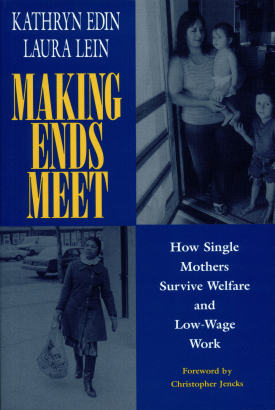
Cover image of the book Making Ends Meet
Books

Making Ends Meet

How Single Mothers Survive Welfare and Low-Wage Work
Authors
Kathryn Edin
Laura Lein
Paperback
$32.00
Add to Cart
Publication Date
6 in. × 9 in. 340 pages
ISBN
978-0-87154-234-2
Also Available From

About This Book

Welfare mothers are popularly viewed as passively dependent on their checks and averse to work. Reformers across the political spectrum advocate moving these women off the welfare rolls and into the labor force as the solution to their problems. Making Ends Meet offers dramatic evidence toward a different conclusion: In the present labor market, unskilled single mothers who hold jobs are frequently worse off than those on welfare, and neither welfare nor low-wage employment alone will support a family at subsistence levels.

Kathryn Edin and Laura Lein interviewed nearly four hundred welfare and low-income single mothers from cities in Massachusetts, Texas, Illinois, and South Carolina over a six year period. They learned the reality of these mothers' struggles to provide for their families: where their money comes from, what they spend it on, how they cope with their children's needs, and what hardships they suffer. Edin and Lein's careful budgetary analyses reveal that even a full range of welfare benefits—AFDC payments, food stamps, Medicaid, and housing subsidies—typically meet only three-fifths of a family's needs, and that funds for adequate food, clothing and other necessities are often lacking. Leaving welfare for work offers little hope for improvement, and in many cases threatens even greater hardship. Jobs for unskilled and semi-skilled women provide meager salaries, irregular or uncertain hours, frequent layoffs, and no promise of advancement. Mothers who work not only assume extra child care, medical, and transportation expenses but are also deprived of many of the housing and educational subsidies available to those on welfare. Regardless of whether they are on welfare or employed, virtually all these single mothers need to supplement their income with menial, off-the-books work and intermittent contributions from family, live-in boyfriends, their children's fathers, and local charities. In doing so, they pay a heavy price. Welfare mothers must work covertly to avoid losing benefits, while working mothers are forced to sacrifice even more time with their children.

Making Ends Meet demonstrates compellingly why the choice between welfare and work is more complex and risky than is commonly recognized by politicians, the media, or the public. Almost all the welfare-reliant women interviewed by Edin and Lein made repeated efforts to leave welfare for work, only to be forced to return when they lost their jobs, a child became ill, or they could not cover their bills with their wages. Mothers who managed more stable employment usually benefited from a variety of mitigating circumstances such as having a relative willing to watch their children for free, regular child support payments, or very low housing, medical, or commuting costs.

With first hand accounts and detailed financial data, Making Ends Meet tells the real story of the challenges, hardships, and survival strategies of America's poorest families. If this country's efforts to improve the self-sufficiency of female-headed families is to succeed, reformers will need to move beyond the myths of welfare dependency and deal with the hard realities of an unrewarding American labor market, the lack of affordable health insurance and child care for single mothers who work, and the true cost of subsistence living. Making Ends Meet is a realistic look at a world that so many would change and so few understand.

KATHRYN EDIN is assistant professor, department of sociology and Center for Urban Policy Research at Rutgers University.

LAURA LEIN is senior lecturer, department of anthropology, and senior lecturer and research scientist, the School of Social Work, the University of Texas at Austin.

RSF Journal
View Book Series
Sign Up For Our Mailing List
Apply For Funding
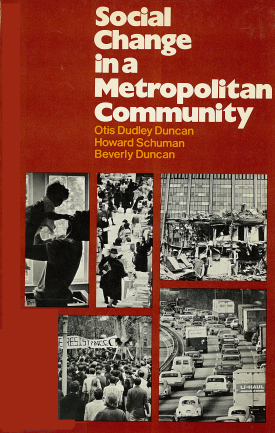
Cover image of the book Social Change in a Metropolitan Community
Books

Social Change in a Metropolitan Community

Authors
Otis Dudley Duncan
Howard Schuman
Beverly Duncan
Paperback
$26.95
Add to Cart
Publication Date
6 in. × 9 in. 136 pages
ISBN
978-0-87154-216-8
Also Available From

About This Book

How has American society changed over the last fifteen years? Do we raise our children differently now than in 1953? Has women's liberation produced a shift in attitudes toward marriage or altered our idea about appropriate activities for women? Have our attitudes toward race undergone a significant revision?

In this challenging volume, three eminent sociologists examine questions like these in the light of hard data which have become available, year by year, over the last two decades. The major purpose of the book is to demonstrate how measures of social change can be developed, capitalizing on past efforts in survey research. An omnibus survey, carried out in 1971, was designed almost entirely as a selective repitition of questions originally asked in the 1950s. It provides precise and reliable measures of change in such areas as marital and sex roles, social participation, child rearing, religious behavior, political orientations, and racial attitudes.

Lucid and authoritative, Social Change in a Metropolitan Community presents a unique body of information on changes in public opinion, social norms, and institutional behavior. Its large number of statistical measurements are presented in an extremely accessible form—almost always as simple percentage comparisons. The research findings included here are unduplicated by any other study, and as a source of information on current social trends they provide fascinating reading for anyone who wishes to enlarge his understanding of the temper of our times.

OTIS DUDLEY DUNCAN, HOWARD SCHUMAN, and BEVERLY DUNCAN are all professors of sociology at the University of Michigan.

RSF Journal
View Book Series
Sign Up For Our Mailing List
Apply For Funding
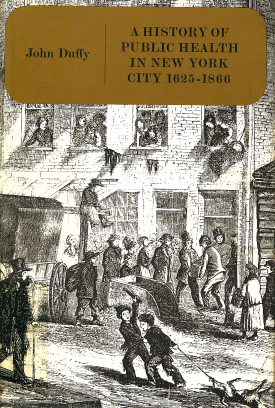
Cover image of the book A History of Public Health in New York City, 1625–1866
Books

A History of Public Health in New York City, 1625–1866

Author
John Duffy
Publication Date
6 in. × 9 in. 640 pages
ISBN
978-0-87154-212-0
Also Available From

About This Book

Traces the development of the sanitary and health problems of New York City from earliest Dutch times to the culmination of a nineteenth-century reform movement that produced the Metropolitan Health Act of 1866, the forerunner of the present New York City Department of Health. Professor Duffy shows the city's transition from a clean and healthy colonial settlement to an epidemic-ridden community in the eighteenth century, as the city outgrew its health and sanitation facilities. He describes the slow growth of a demand for adequate health laws in the mid-nineteenth century, leading to the establishment of the first permanent health agency in 1866.

JOHN DUFFY is professor of history of medicine in the history department and School of Medicine at Tulane University.

RSF Journal
View Book Series
Sign Up For Our Mailing List
Apply For Funding
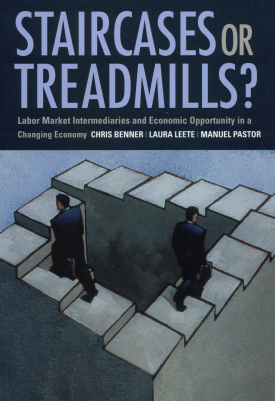
Cover image of the book Staircases or Treadmills?
Books

Staircases or Treadmills?

Labor Market Intermediaries and Economic Opportunity in a Changing Economy
Authors
Chris Benner
Laura Leete
Manuel Pastor
Hardcover
$42.50
Add to Cart
Publication Date
6 in. × 9 in. 312 pages
ISBN
978-0-87154-169-7
Also Available From

About This Book

Globalization, technological change, and deregulation have made the American marketplace increasingly competitive in recent decades, but for many workers this “new economy” has entailed heightened job insecurity, lower wages, and scarcer benefits. As the job market has grown more volatile, a variety of labor market intermediaries—organizations that help job seekers find employment—have sprung up, from private temporary agencies to government “One-Stop Career Centers.” In Staircases or Treadmills? Chris Benner, Laura Leete, and Manuel Pastor investigate what approaches are most effective in helping workers to secure jobs with decent wages and benefits, and they provide specific policy recommendations for how job-matching organizations can better serve disadvantaged workers.

Staircases or Treadmills? is the first comprehensive study documenting the prevalence of all types of labor market intermediaries and investigating how these intermediaries affect workers’ employment opportunities. Benner, Leete, and Pastor draw on years of research in two distinct regional labor markets—“old economy” Milwaukee and “new economy” Silicon Valley—including a first-of-its-kind random survey of the prevalence and impacts of intermediaries, and a wide range of interviews with intermediary agencies’ staff and clients. One of the main obstacles that disadvantaged workers face is that social networks of families and friends are less effective in connecting job-seekers to stable, quality employment. Intermediaries often serve as a substitute method for finding a job.  Which substitute is chosen, however, matters: The authors find that the most effective organizations—including many unions, community colleges, and local non-profits—actively foster contacts between workers and employers, tend to make long-term investments in training for career development, and seek to transform as well as satisfy market demands. But without effective social networks to help workers locate the best intermediaries, most rely on private temporary agencies and other organizations that offer fewer services and, statistical analysis shows, often channel their participants into jobs with low wages and few benefits. Staircases or Treadmills? suggests that, to become more effective, intermediary organizations of all types need to focus more on training workers, teaching networking skills, and fostering contact between workers and employers in the same industries.

A generation ago, rising living standards were broadly distributed and coupled with relatively secure employment. Today, many Americans fear that heightened job insecurity is overshadowing the benefits of dynamic economic growth. Staircases or Treadmills? is a stimulating guide to how private and public job-matching institutions can empower disadvantaged workers to share in economic progress.

CHRIS BENNER is assistant professor of urban and economic geography at Pennsylvania State University.

LAURA LEETE is the Fred H. Paulus Director of Public Policy Research and associate professor of economics and public policy at Willamette University.

MANUEL PASTOR is a professor of geography and American Studies and ethnicity at the University of Southern California.

RSF Journal
View Book Series
Sign Up For Our Mailing List
Apply For Funding
Cover image of the book The Two New Yorks
Books

The Two New Yorks

State-City Relations in the Changing Federal System
Editors
Gerald Benjamin
Charles Brecher
Hardcover
Add to Cart
Publication Date
6 in. × 9 in. 576 pages
ISBN
978-0-87154-107-9
Also Available From

About This Book

Over the past eight years, a marked shift in the national political mood has substantially reduced the federal government's involvement in ameliorating urban problems and enhanced the prominence of state and local governments in the domestic policy arena. Many states and big cities have been forced to reassess their traditionally vexed relationships.

Nowhere has this drama been played out more stormily than in New York. In The Two New Yorks, experts from government, the academy, and the non-profit sector examine aspects of an interaction that has a major impact on the performance of state and city institutions. The analyses presented here explore current state-city strategies for handling such troubling policy areas as education, health care, and housing. Attention is also given to important contextual factors such as economic and demographic trends, and to structural features such as the political framework, relationships with the national government, and the system of public finance.

Despite its uniquely large scope, the drama of the new New Yorks parallels or presages issues faced by virtually all large cities and their states. This unprecedented study makes a vital contribution in an era of declining federal aid and pressing urban need.

GERALD BENJAMIN is at SUNY New Paltz.

CHARLES BRECHER is at New York University.

CONTRIBUTORS: Richard D. Alba, Mary Jo Bane, Gerald Benjamin, Robert Berne, Susan Blamk, Barbara B. Blum, Matthew Drennan, Barbara Gordon Espejo, Ester Fuchs, Cynthia B. Green, James M. Hartman, Raymond D. Horton, Sarah F. Liebschutz, David Lewin, Irene Lurie, Paul D. Moore, James C. Musselwhite Jr., Martin Shefter, Kenneth E. Thorpe, Emanuel Tobier, Katherine Trent, 

RSF Journal
View Book Series
Sign Up For Our Mailing List
Apply For Funding
Cover image of the book Budapest and New York
Books

Budapest and New York

Studies in Metropolitan Transformation, 1870-1930
Editors
Thomas Bender
Carl E. Schorske
Hardcover
Add to Cart
Publication Date
6 in. × 9 in. 416 pages
ISBN
978-0-87154-113-0
Also Available From

About This Book

Little over a century ago, New York and Budapest were both flourishing cities engaging in spectacular modernization. By 1930, New York had emerged as an innovating cosmopolitan metropolis, while Budapest languished under the conditions that would foster fascism. Budapest and New York explores the increasingly divergent trajectories of these once-similar cities through the perspectives of both Hungarian and American experts in the fields of political, cultural, social and art history. Their original essays illuminate key aspects of urban life that most reveal the turn-of-the-century evolution of New York and Budapest: democratic participation, use of public space, neighborhood ethnicity, and culture high and low.

What comes across most strikingly in these essays is New York's cultivation of social and political pluralism, a trend not found in Budapest. Nationalist ideology exerted tremendous pressure on Budapest's ethnic groups to assimilate to a single Hungarian language and culture. In contrast, New York's ethnic diversity was transmitted through a mass culture that celebrated ethnicity while muting distinct ethnic traditions, making them accessible to a national audience. While Budapest succumbed to the patriotic imperatives of a nation threatened by war, revolution, and fascism, New York, free from such pressures, embraced the variety of its people and transformed its urban ethos into a paradigm for America.

Budapest and New York is the lively story of the making of metropolitan culture in Europe and America, and of the influential relationship between city and nation. In unifying essays, the editors observe comparisons not only between the cities, but in the scholarly outlooks and methodologies of Hungarian and American histories. This volume is a unique urban history. Begun under the unfavorable conditions of a divided world, it represents a breakthrough in cross-cultural, transnational, and interdisciplinary historical work.

THOMAS BENDER is University Professor of the Humanities and professor of history at New York University.

CARL E. SCHORSKE is professor emeritus at Princeton University, and the Pulitzer Prize winning author of Fin-de-Siecle Vienna: Politics and Culture.

CONTRIBUTORS: Thomas Bender, Elizabeth Blackmar, Geza Buzinkay, Wanda M. Corn, Deborah Dash Moore, Philip Fisher, Eva Forgacs, Gabor Gyani, David C. Hammack, Peter Hanak, Neil Harris, Miklos Lacko, Zsuzsa L. Nagy, Roy Rosenzweig, Carl E. Schorske, Robert W. Snyder, and Istvan Teplan.

RSF Journal
View Book Series
Sign Up For Our Mailing List
Apply For Funding
Cover image of the book The Free List
Books

The Free List

Property without Taxes
Author
Alfred Balk
Hardcover
Add to Cart
Publication Date
6 in. × 9 in. 284 pages
ISBN
978-0-87154-083-6
Also Available From

About This Book

A recent Supreme Court decision confirmed the churches' right to tax exemption for religious property. In this highly relevant book, Alfred Balk places this question in social perspective and demonstrates how tax exemption and immunity affect the fiscal load of local communities and the well-being of our whole society. Among the "free list" or tax-free properties which the author examines are churches, hospitals, schools, and government buildings. Seven specific proposals for reform are set forth.

ALFRED BALK is visiting editor of the Columbia Journalism Review and an Editor-at-Large of Saturday Review. He has written more than a hundred articles for national magazines, including Harper’s, Saturday Review, Saturday Evening Post, New York Times Magazine, Reader’s Digest, This Week, The Nation, McCall’s, and The Reporter. He also is the author of The Religion Business (John Knox, 1968), and a contributor to a number of anthologies.

RSF Journal
View Book Series
Sign Up For Our Mailing List
Apply For Funding

In 1998 and 1999, the Foundation issued an open-ended request for proposals to conduct case studies of low-wage jobs in the United States. The twelve best proposals were funded, yielding rich studies of 25 industries that employ workers at low pay. Yet none of these studies covered work in the retail sector, where 14% of the labor force is employed, many of them at low wages.