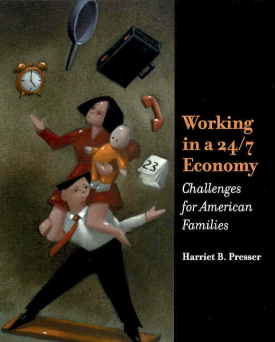
Working in a 24/7 Economy
About This Book
"Harriet Presser has provided us with an extraordinary, well-written, important piece of research that greatly reduces our ignorance about shiftwork. The book deserves a wide audience among academics and policy-makers."
-INDUSTRIAL AND LABOR RELATIONS REVIEW
"An impressive analysis of the impact of working time on the American family. Working in a 24/7 Economy should be required reading for everyone engaged in work scheduling policy, practice, or research!"
-DONALD I. TEPAS, PROFESSOR EMERITUS, UNIVERSITY OF CONNECTICUT AND SECRETARY, SHIFTWORK COMMITTEE, INTERNATIONAL COMMISSION ON OCCUPATIONAL HEALTH
"Noted demographer Harriet Presser has spent much of the last two decades investigating the implications of shift work for families. Her masterful synthesis of the literature reveals that nonstandard hours are not only here to stay, but also that they pose important, often unrecognized challenges for families, especially for couples and single parents raising young children. This book is must reading, not only for scholars who are interested specifically in the work-family interface but for researchers in the fields of business and management, work and occupations, labor economics, industrial-organizational psychology, family studies, and child development. Presser's conclusions provide important insights not only for the research community, but for corporate management, policy makers, and community leaders. An important take-home message is that we can no longer ignore the timing of work hours and how those hours dovetail-or wreak havoc-with family life."
-NAN CROUTER, PROFESSOR OF HUMAN DEVELOPMENT AND DIRECTOR, CENTER FOR WORK AND FAMILY RESEARCH, PENN STATE UNIVERSITY
"Few studies have even touched on this topic, yet Harriet Presser covers it thoroughly, deliberately, and even-handedly. In other words, while some explorers are content to proclaim that they have discovered new land, Presser sends back a surprisingly complete map, filled with the main rivers, mountains, plains, and more than a few hidden valleys. I cannot remember the last time I read a book containing so much thoroughly original work. This is the place to learn about night, evening, and weekend work and how it impacts family life."
-JERRY A. JACOBS, MERRIAM TERM PROFESSOR, UNIVERSITY OF PENNSYLVANIA
"The complicated and difficult lives of workers forced to work at times others sleep, play, and have normal family time together is documented in this meticulous study. Harriet Presser describes the severe problems of broken marriages and problematic child care arrangements that two-fifths of our work force confronts in an economy in which there are no time boundaries. This is must reading for scholars, policy-makers, and the public."
-CYNTHIA FUCHS EPSTEIN, DISTINGUISHED PROFESSOR, GRADUATE CENTER, CITY UNIVERSITY OF NEW YORK
An economy that operates 24/7—as ours now does—imposes extraordinary burdens on workers. Two-fifths of all employed Americans work mostly during evenings, nights, weekends, or on rotating shifts outside the traditional 9-to-5 work day. The pervasiveness of nonstandard work schedules has become a significant social phenomenon, with important implications for the health and well-being of workers and their families. In Working in a 24/7 Economy, Harriet Presser looks at the effects of nonstandard work schedules on family functioning and shows how these schedules disrupt marriages and force families to cobble together complex child-care arrangements that should concern us all.
The number of hours Americans work has received ample attention, but the issue of which hours—or days—Americans work has received much less scrutiny. Working in a 24/7 Economy provides a comprehensive overview of who works nonstandard schedules and why. Presser argues that the growth in women's employment, technological change, and other demographic changes over the past thirty years gave rise to the growing demand for late-shift and weekend employment in the service sector. She also demonstrates that most people who work these hours do so primarily because it is a job requirement, rather than a choice based on personal considerations. Presser shows that the consequences of working nonstandard schedules often differ for men and women since housework and child-rearing remain assigned primarily to women even when both spouses are employed. As with many other social problems, the burden of these schedules disproportionately affects the working poor, reflecting their lack of options in the workplace and adding to their disadvantage. Presser also documents how such work arrangements have created a new rhythm of daily life within many American families, including those with two earners and absent fathers. With spouses often not at home together in the evenings or nights, and parents often not at home with their children at such times, the relatively new concept of "home-time" has emerged as primary concern for families across the nation.
Employing a wealth of empirical data, Working in a 24/7 Economy shows that nonstandard work schedules are both highly prevalent among American families and generate a level of complexity in family functioning that demands greater public attention. Presser makes a convincing case for expanded research and meaningful policy initiatives to address this growing social phenomenon.
HARRIET B. PRESSER is Distinguished University Professor in the Department of Sociology at the University of Maryland.