Cover image of the book Stories Employers Tell
Books

Stories Employers Tell

Race, Skill, and Hiring in America
Authors
Philip Moss
Chris Tilly
Paperback
$25.95
Add to Cart
Publication Date
6.63 in. × 9.25 in. 332 pages
ISBN
978-0-87154-632-6
Also Available From

About This Book

Is the United States justified in seeing itself as a meritocracy, where stark inequalities in pay and employment reflect differences in skills, education,and effort? Or does racial discrimination still permeate the labor market, resulting in the systematic under hiring and underpaying of racial minorities, regardless of merit? Throughout the 1980s and early 1990s African Americans have lost ground to whites in the labor market, but this widening racial inequality is most often attributed to economic restructuring, not the racial attitudes of employers. It is argued that the educational gap between blacks and whites, though narrowing, carries greater penalties now that we are living in an era of global trade and technological change that favors highly educated workers and displaces the low-skilled.

Stories Employers Tell demonstrates that this conventional wisdom is incomplete. Racial discrimination is still a fundamental part of the explanation of labor market disadvantage. Drawing upon a wide-ranging survey of employers in Atlanta, Boston, Detroit, and Los Angeles, Moss and Tilly investigate the types of jobs employers offer, the skills required, and the recruitment, screening and hiring procedures used to fill them. The authors then follow up in greater depth on selected employers to explore the attitudes, motivations, and rationale underlying their hiring decisions, as well as decisions about where to locate a business.

Moss and Tilly show how an employer's perception of the merit or suitability of a candidate is often colored by racial stereotypes and culture-bound expectations. The rising demand for soft skills, such as communication skills and people skills, opens the door to discrimination that is rarely overt, or even conscious, but is nonetheless damaging to the prospects of minority candidates and particularly difficult to police. Some employers expressed a concern to race-match employees with the customers they are likely to be dealing with. As more jobs require direct interaction with the public, race has become increasingly important in determining labor market fortunes. Frequently, employers also take into account the racial make-up of neighborhoods when deciding where to locate their businesses.

Ultimately, it is the hiring decisions of employers that determine whether today's labor market reflects merit or prejudice. This book, the result of years of careful research, offers us a rare opportunity to view the issue of discrimination through the employers' eyes.

PHILIP MOSS is professor in the Department of Regional Economic and Social Development at the University of Massachusetts, Lowell.

CHRIS TILLY is University Professor of Regional Economics and Social Development at the University of Massachusetts, Lowell.

A Volume in the Multi-City Study of Urban Inequality

RSF Journal
View Book Series
Sign Up For Our Mailing List
Apply For Funding
Cover image of the book Inspectors-General, Junkyard Dogs, or Man's Best Friend
Books

Inspectors-General, Junkyard Dogs, or Man's Best Friend

Authors
Mark H. Moore
Margaret Jane Gates
Paperback
$21.95
Add to Cart
Publication Date
6 in. × 9 in. 132 pages
ISBN
978-0-87154-605-0
Also Available From

About This Book

In 1978, determined to combat fraud, waste, and abuse in government programs, Congress overwhelmingly approved the creation of special Offices of Inspectors-General (OIGs) in many federal departments. Moore and Gates here provide the first evaluation of this important institutional innovation. Clearly and objectively, they examine the powerful but often imprecisely defined concepts—wastefulness, accountability, performance—that underlie the OIG mandate. Their study conveys a realistic sense of how these offices operate and how their impact is affected by the changing dynamics of politics and personality.

A Volume in the the Russell Sage Foundation's Social Science Perspectives Series


MARK H. MOORE is Hauser Professor of Nonprofit Organizations at the Harvard Kennedy School of Government.

MARGARET JANE GATES was Deputy Inspector General, U.S. Department of Agriculture.

RSF Journal
View Book Series
Sign Up For Our Mailing List
Apply For Funding
Cover image of the book The Professions
Books

The Professions

Roles and Rules
Author
Wilbert E. Moore
Hardcover
Add to Cart
Publication Date
6 in. × 9 in. 336 pages
ISBN
978-0-87154-604-3
Also Available From

About This Book

Discusses the place and position of the professional in society today. Wilbert E. Moore attempts to define the characteristics of the professional and to describe the attributes that give professionals the basis for status and esteem. Dr. Moore maintains that the modern scale of professionalism demands a full-time occupation, commitment to a calling, authenticated membership in a formalized organization, advanced education, service orientation, and autonomy restrained by responsibility. The author discusses the professional's interaction on various levels—with his clients, his peers, his employers, his fellows in complementary occupations, and society at large.

WILBERT E. MOORE was past president of the American Sociological Association, a sociologist at Russell Sage Foundation, and visiting professor at Princeton University.

RSF Journal
View Book Series
Sign Up For Our Mailing List
Apply For Funding
Cover image of the book West Indian Immigrants
Books

West Indian Immigrants

A Black Success Story?
Author
Suzanne Model
Paperback
$34.95
Add to Cart
Publication Date
6 in. × 9 in. 256 pages
ISBN
978-0-87154-675-3
Also Available From

About This Book

West Indian immigrants to the United States fare better than native-born African Americans on a wide array of economic measures, including labor force participation, earnings, and occupational prestige. Some researchers argue that the root of this difference lies in differing cultural attitudes toward work, while others maintain that white Americans favor West Indian blacks over African Americans, giving them an edge in the workforce. Still others hold that West Indians who emigrate to this country are more ambitious and talented than those they left behind. In West Indian Immigrants,  sociologist Suzanne Model subjects these theories to close historical and empirical scrutiny to unravel the mystery of West Indian success.

West Indian Immigrants draws on four decades of national census data, surveys of Caribbean emigrants around the world, and historical records dating back to the emergence of the slave trade. Model debunks the notion that growing up in an all-black society is an advantage by showing that immigrants from racially homogeneous and racially heterogeneous areas have identical economic outcomes. Weighing the evidence for white American favoritism, Model compares West Indian immigrants in New York, Toronto, London, and Amsterdam, and finds that, despite variation in the labor markets and ethnic composition of these cities, Caribbean immigrants in these four cities attain similar levels of economic success. Model also looks at “movers” and “stayers” from Barbados, Jamaica, Trinidad, and Guyana, and finds that emigrants leaving all four countries have more education and hold higher status jobs than those who remain. In this sense, West Indians immigrants are not so different from successful native-born African Americans who have moved within the U.S. to further their careers. Both West Indian immigrants and native-born African-American movers are the “best and the brightest”—they are more literate and hold better jobs than those who stay put. While political debates about the nature of black disadvantage in America have long fixated on West Indians’ relatively favorable economic position, this crucial finding reveals a fundamental flaw in the argument that West Indian success is proof of native-born blacks’ behavioral shortcomings. Proponents of this viewpoint have overlooked the critical role of immigrant self-selection.

West Indian Immigrants is a sweeping historical narrative and definitive empirical analysis that promises to change the way we think about what it means to be a black American. Ultimately, Model shows that West Indians aren’t a black success story at all—rather, they are an immigrant success story.

SUZANNE MODEL is professor of sociology at the University of Massachusetts, Amherst.

RSF Journal
View Book Series
Sign Up For Our Mailing List
Apply For Funding
Cover image of the book Ethnic Solidarity for Economic Survival
Books

Ethnic Solidarity for Economic Survival

Korean Greengrocers in New York City
Author
Pyong Gap Min
Paperback
$34.95
Add to Cart
Publication Date
6 in. × 9 in. 216 pages
ISBN
978-0-87154-641-8
Also Available From

About This Book

Generations of immigrants have relied on small family businesses in their pursuit of the American dream. This entrepreneurial tradition remains highly visible among Korean immigrants in New York City, who have carved out a thriving business niche for themselves operating many of the city’s small grocery stores and produce markets. But this success has come at a price, leading to dramatic, highly publicized conflicts between Koreans and other ethnic groups. In Ethnic Solidarity for Economic Survival, Pyong Gap Min takes Korean produce retailers as a case study to explore how involvement in ethnic businesses—especially where it collides with the economic interests of other ethnic groups—powerfully shapes the social, cultural, and economic unity of immigrant groups.

Korean produce merchants, caught between white distributors, black customers, Hispanic employees, and assertive labor unions, provide a unique opportunity to study the formation of group solidarity in the face of inter-group conflicts. Ethnic Solidarity for Economic Survival draws on census and survey data, interviews with community leaders and merchants, and a review of ethnic newspaper articles to trace the growth and evolution of Korean collective action in response to challenges produce merchants received from both white suppliers and black customers.

When Korean produce merchants first attempted to gain a foothold in the city’s economy, they encountered pervasive discrimination from white wholesale suppliers at Hunts Point Market in the Bronx. In response, Korean merchants formed the Korean Produce Association (KPA), a business organization that gradually evolved into a powerful engine for promoting Korean interests. The KPA used boycotts, pickets, and group purchasing to effect enduring improvements in supplier-merchant relations.

Pyong Gap Min returns to the racially charged events surrounding black boycotts of Korean stores in the 1990s, which were fueled by frustration among African Americans at a perceived economic invasion of their neighborhoods. The Korean community responded with rallies, political negotiations, and publicity campaigns of their own. The disappearance of such disputes in recent years has been accompanied by a corresponding reduction in Korean collective action, suggesting that ethnic unity is not inevitable but rather emerges, often as a form of self-defense, under certain contentious conditions. Solidarity, Min argues, is situational.

This important new book charts a novel course in immigrant research by demonstrating how business conflicts can give rise to demonstrations of group solidarity. Ethnic Solidarity for Economic Survival is at once a sophisticated empirical analysis and a riveting collection of stories—about immigration, race, work, and the American dream.

PYONG GAP MIN is professor of sociology at Queens College and the Graduate Center of the City University of New York.
RSF Journal
View Book Series
Sign Up For Our Mailing List
Apply For Funding
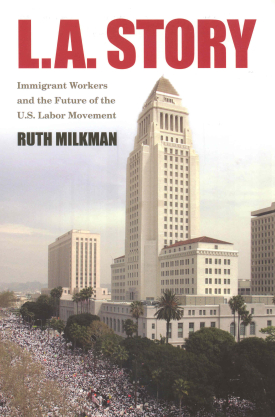
Cover image of the book L.A. Story
Books

L.A. Story

Immigrant Workers and the Future of the U.S. Labor Movement
Author
Ruth Milkman
Paperback
$34.95
Add to Cart
Publication Date
6 in. × 9 in. 264 pages
ISBN
978-0-87154-635-7
Also Available From

About This Book

Sharp decreases in union membership over the last fifty years have caused many to dismiss organized labor as irrelevant in today’s labor market. In the private sector, only 8 percent of workers today are union members, down from 24 percent as recently as 1973. Yet developments in Southern California—including the successful Justice for Janitors campaign—suggest that reports of organized labor’s demise may have been exaggerated. In L.A. Story, sociologist and labor expert Ruth Milkman explains how Los Angeles, once known as a company town hostile to labor, became a hotbed for unionism, and how immigrant service workers emerged as the unlikely leaders in the battle for workers’ rights.

L.A. Story shatters many of the myths of modern labor with a close look at workers in four industries in Los Angeles: building maintenance, trucking, construction, and garment production. Though many blame deunionization and deteriorating working conditions on immigrants, Milkman shows that this conventional wisdom is wrong. Her analysis reveals that worsening work environments preceded the influx of foreign-born workers, who filled the positions only after native-born workers fled these suddenly undesirable jobs. Ironically, L.A. Story shows that immigrant workers, who many union leaders feared were incapable of being organized because of language constraints and fear of deportation, instead proved highly responsive to organizing efforts. As Milkman demonstrates, these mostly Latino workers came to their service jobs in the United States with a more group-oriented mentality than the American workers they replaced. Some also drew on experience in their native countries with labor and political struggles. This stock of fresh minds and new ideas, along with a physical distance from the east-coast centers of labor’s old guard, made Los Angeles the center of a burgeoning workers’ rights movement.

Los Angeles’ recent labor history highlights some of the key ingredients of the labor movement’s resurgence—new leadership, latitude to experiment with organizing techniques, and a willingness to embrace both top-down and bottom-up strategies. L.A. Story’s clear and thorough assessment of these developments points to an alternative, high-road national economic agenda that could provide workers with a way out of poverty and into the middle class.


RUTH MILKMAN is professor of sociology and director of the Institute of Industrial Relations at the University of California, Los Angeles.

RSF Journal
View Book Series
Sign Up For Our Mailing List
Apply For Funding
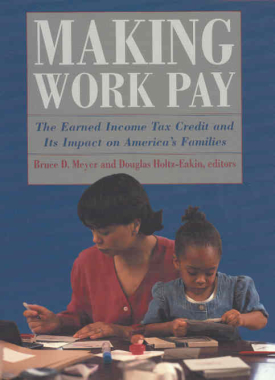
Cover image of the book Making Work Pay
Books

Making Work Pay

The Earned Income Tax Credit and Its Impact on America's Families
Editors
Bruce D. Meyer
Douglas Holtz-Eakin
Hardcover
Add to Cart
Publication Date
6 in. × 9 in. 412 pages
ISBN
978-0-87154-599-2
Also Available From

About This Book

 Since its inception under President Ford in 1975, the Earned Income Tax Credit (EITC) has become the largest antipoverty program for the non-elderly in the United States. In 1998, more than nineteen million families received EITC payments, and the program lifted over four million Americans above the poverty line. Despite the rapid growth of the EITC throughout the 1990s, little has been written about how the program works or how it affects low-income families. Making Work Pay provides the first full-scale examination of the EITC, exploring its effects on income distribution, poverty, work, and marriage.

Making Work Pay opens with a history of the EITC -- its emergence in the 1970s as a pro-work, low-cost antipoverty program and its expansion through the 1980s and 1990s. The central chapters in the volume look at the substantial impact of the EITC on work incentives in recent years and show that the program, in combination with welfare reform and a strong economy, has led to an unprecedented increase in the employment of single mothers. In one study, researchers conclude that the EITC—with its stipulation that one family member be a wage earner—was the most important change in work incentives for single mothers between 1984 and 1996, a period when the employment rate of single mothers rose sharply. Several chapters outline proposals for reforming the program, addressing the concerns by policymakers about the work disincentives that rise as benefits fall with increasing income. Finally, Making Work Pay examines how EITC recipients view the credit and what they do with it once they get it. The contributors find that not only does EITC's lump-sum payment increase consumption but it also allows recipients to make changes in economic status. Many families use the end-of-the-year payment as a form of forced savings, enabling them to save for home improvement, a new car, or other purchases to improve their lives, and providing the extra economic cushion needed to move beyond mere day-to-day survival.

Comprehensive in scope, Making Work Pay is an indispensable resource for policymakers, administrators, and researchers seeking to understand the ramifications of the country's largest programs for aiding the working poor.

BRUCE D. MEYER is professor of economics at Northwestern University.

DOUGLAS HOLTZ-EAKIN is at the Center for Policy Research, Syracuse University.

CONTRIBUTORS:  Lisa Barrow, David T. Ellwood, Janet Holtzblatt, Jeffrey B. Liebman, Janet McCubbin, Leslie McGranahan, Michael O'Connor, Katherin Ross Phillips, Robert Rebelein, Jennifer L. Romich, Dan T. Rosenbaum, Timothy M. Smeeding, Dennis J. Ventry Jr., Thomas S. Weisner.

RSF Journal
View Book Series
Sign Up For Our Mailing List
Apply For Funding
Cover image of the book Codes of Conduct
Books

Codes of Conduct

Behavioral Research into Business Ethics
Editors
David M. Messick
Ann E. Tenbrunsel
Hardcover
$65.00
Add to Cart
Publication Date
6 in. × 9 in. 420 pages
ISBN
978-0-87154-594-7
Also Available From

About This Book

Despite ongoing efforts to maintain ethical standards, highly publicized episodes of corporate misconduct occur with disturbing frequency. Firms produce defective products, release toxic substances into the environment, or permit dangerous conditions to existin their workplaces. The propensity for irresponsible acts is not confined to rogue companies, but crops up in even the most respectable firms. Codes of Conduct is the first comprehensive attempt to understand these problems by applying the principles of modern behavioral science to the study of organizational behavior.

Codes of Conduct probes the psychological and social processes through which companies and their managers respond to a wide array of ethical dilemmas, from risk and safety management to the treatment of employees. The contributors employ a wide range of case studies to illustrate the effects of social influence and group persuasion, organizational authority and communication, fragmented responsibility, and the process of rationalization. John Darley investigates how unethical acts are unintentionally assembled within organizations as a result of cascading pressures and social processes. Essays by Roderick Kramer and David Messick and by George Loewenstein focus on irrational decision making among managers. Willem Wagenaar examines how worker safety is endangered by management decisions that focus too narrowly on cost cutting and short time horizons. Essays by Baruch Fischhoff and by Robyn Dawes review the role of the expert in assessing environmental risk.

Robert Bies reviews evidence that employees are more willing to provide personal information and to accept affirmative action programs if they are consulted on the intended procedures and goals. Stephanie Goodwin and Susan Fiske discuss how employees can be educated to base office judgments on personal qualities rather than on generalizations of gender, race, and ethnicity. Codes of Conduct makes an important scientific contribution to the understanding of decisionmaking and social processes in business, and offers clear insights into the design of effective policies to improve ethical conduct.

DAVID M. MESSICK is at the Kellogg School at Northwestern University.

ANN E. TENBRUNSEL is at the College of Business Administration, University of Notre Dame.

CONTRIBUTORS: Jonathan Baron, Max H. Bazerman, Maura A. Belliveau, Francisco J. Benzoni, Robert J. Bies, Marilynn B. Brewer, Robert B. Cialdini, John M. Darley, Robyn M. Dawes, Thomas Donaldson, Baruch Fischhoff, Susan T. Fiske, Robert H. Frank, Stephanie A. Goodwin, Russell Hardin, Helmut Jungermann, Joshua Klayman, Roderick M. Kramer, George Loewenstein, Robert Mauro, Ann L. McGill, David M. Messick, Myron Rothbart, Ann E. Tenbrunsel, Tom R. Tyler, Kimberly A. Wade-Benzoni, Willem A. Wagenaar, and Patricia H. Werhane.

RSF Journal
View Book Series
Sign Up For Our Mailing List
Apply For Funding
Cover image of the book Welfare Reform and Political Theory
Books

Welfare Reform and Political Theory

Editors
Lawrence M. Mead
Christopher Beem
Paperback
Add to Cart
Publication Date
6 in. × 9 in. 296 pages
ISBN
978-0-87154-588-6
Also Available From

About This Book

During the 1990s, both the United States and Britain shifted from entitlement to work-based systems for supporting their poor citizens. Much research has examined the implications of welfare reform for the economic well-being of the poor, but the new legislation also affects our view of democracy—and how it ought to function. By eliminating entitlement and setting behavioral conditions on aid, welfare reform challenges our understanding of citizenship, political equality, and the role of the state. In Welfare Reform and Political Theory, editors Lawrence Mead and Christopher Beem have assembled an accomplished list of political theorists, social policy experts, and legal scholars to address how welfare reform has affected core concepts of political theory and our understanding of democracy itself.

Welfare Reform and Political Theory is unified by a common set of questions. The contributors come from across the political spectrum, each bringing different perspectives to bear. Carole Pateman argues that welfare reform has compromised the very tenets of democracy by tying the idea of citizenship to participation in the marketplace. But William Galston writes that American citizenship has in some respects always been conditioned on good behavior; work requirements continue that tradition by promoting individual responsibility and self-reliance—values essential to a well-functioning democracy. Desmond King suggests that work requirements draw invidious distinctions among citizens and therefore destroy political equality. Amy Wax, on the other hand, contends that ending entitlement does not harm notions of equality, but promotes them, by ensuring that no one is rewarded for idleness. Christopher Beem argues that entitlement welfare served a social function—acknowledging the social value of care—that has been lost in the movement towards conditional benefits. Stuart White writes that work requirements can be accepted only subject to certain conditions, while Lawrence Mead argues that concerns about justice must be addressed only after recipients are working. Alan Deacon is well to the left of Joel Schartz, but both say government may actively promote virtue through social policy—a stance some other contributors reject.

The move to work-centered welfare in the 1990s represented not just a change in government policy, but a philosophical change in the way people perceived government, its functions, and its relationship with citizens. Welfare Reform and Political Theory offers a long overdue theoretical reexamination of democracy and citizenship in a workfare society.

LAWRENCE M. MEAD is professor of politics at New York University.

CHRISTOPHER BEEM is a program officer at The Johnson Foundation.

CONTRIBUTORS:  Alan Deacon, William A. Galston,  Desmond King,  Carole Pateman, Joel Schwartz, Amy L. Wax,  Stuart White.  

RSF Journal
View Book Series
Sign Up For Our Mailing List
Apply For Funding
Cover image of the book Pious Property
Books

Pious Property

Islamic Mortgages in the United States
Author
Bill Maurer
Hardcover
$34.95
Add to Cart
Publication Date
6 in. × 9 in. 144 pages
ISBN
978-0-87154-581-7
Also Available From

About This Book

Owning a home has always been central to the American dream. For the more than one million Muslims in the United States, this is no exception. However, the Qur'an forbids the payment of interest, which places conventional home financing out of reach for observant Muslims. To meet the growing Muslim demand for home purchases, a market for home financing that would be halal, or permissible under Islamic law, has emerged. In Pious Property, anthropologist William Maurer profiles the emergence of this new religiously based financial service and explores the ways it reflects the influence of Muslim practices on American economic life and vice versa.

Pious Property charts the development of Islamic mortgages in America, starting with Islamic interpretations of the prohibition against riba—literally translated as "increase" but interpreted as "usury" or "interest." Maurer then explores the different practices that have emerged as permissible options for Islamic homebuyers—such as lease-to-own arrangements, profit-loss sharing, and cost-plus contracts—and explains how they have gained acceptance in the Islamic community by relying on payment schemes that avoid standard interest rate payments. Using interviews with Muslim homebuyers and financiers, and in-depth analysis of two companies that provide mortgage alternatives to Muslims, Maurer discovers an interesting paradox: progressive Muslims tend to use financial contracts that seemingly comply better with the prohibition against interest, while traditional Muslims seem more inclined to take on financing very similar to interest-based mortgages. Maurer finds that Muslims make their decisions about using Islamic mortgage alternatives based not only on the views of religious scholars, but also on their conceptions of how business is supposed to be conducted in America. While one form of Islamic financing is seemingly more congruent with the prohibition against riba, the other exhibits more of the qualities of American mortgages—anonymity and standardized forms. The appearance that an Islamic financing instrument is legal and professional leaves many Muslim homebuyers with the impression that it is halal, revealing the influence of American capitalism on Muslim Americans’ understanding of their religious rules.

The market for halal financial products exists at the intersection of American and Islamic culture and is emblematic of the way that, for centuries, America's newcomers have adapted to and changed the fabric of American life. In Pious Property, William Maurer explores this rapidly growing economic phenomenon with historical perspective and scholarly insight.

BILL MAURER is associate professor of anthropology at the University of California, Irvine.
 

RSF Journal
View Book Series
Sign Up For Our Mailing List
Apply For Funding