Cover image of the book The Social Organization of Schooling
Books

The Social Organization of Schooling

Editors
Larry V. Hedges
Barbara Schneider
Hardcover
Add to Cart
Publication Date
6.63 in. × 9.25 in. 384 pages
ISBN
978-0-87154-340-0
Also Available From

About This Book

“The Social Organization of Schooling should be required reading for current researchers and policy makers struggling to understand and improve public school performance. The book makes a significant contribution to contemporary educational scholarship by reasserting the primacy of organizational analysis in the examination of both the strengths and limitations of schools as institutions.”
—RICHARD ARUM, professor of sociology and director of educational research, New York University 

“The Social Organization of Schooling takes seriously the claim that schools are best understood as operating within a social context. Whether focusing on the dynamics of the classroom or how educational institutions change, the contributors to this book highlight important contextual conditions. The result is a theoretically rich way of thinking about current and changing conditions of schools.”
—DOUGLAS B. DOWNEY, associate professor of sociology, Ohio State University

Schools are complex social settings where students, teachers, administrators, and parents interact to shape a child’s educational experience. Any effort to improve educational outcomes for America’s children requires a dynamic understanding of the environments in which children learn. In The Social Organization of Schooling, editors Larry Hedges and Barbara Schneider assemble researchers from the fields of education, organizational theory, and sociology to provide a new framework for understanding and analyzing America’s schools and the many challenges they face.

The Social Organization of Schooling closely examines the varied components that make up a school’s social environment. Contributors Adam Gamoran, Ramona Gunter, and Tona Williams focus on the social organization of teaching. Using intensive case studies, they show how positive professional relations among teachers contribute to greater collaboration, the dissemination of effective teaching practices, and ultimately, a better learning environment for children. Children learn more from better teachers, but those best equipped to teach often opt for professions with higher social stature, such as law or medicine. In his chapter, Robert Dreeben calls for the establishment of universal principles and practices to define good teaching, arguing that such standards are necessary to legitimize teaching as a high status profession. The Social Organization of Schooling also looks at how social norms in schools are shaped and reinforced by interactions among teachers and students. Sociologist Maureen Hallinan shows that students who are challenged intellectually and accepted socially are more likely to embrace school norms and accept responsibility for their own actions. Using classroom observations, surveys, and school records, Daniel McFarland finds that group-based classroom activities are effective tools in promoting both social and scholastic development in adolescents. The Social Organization of Schooling also addresses educational reforms and the way they affect a school’s social structures. Examining how testing policies affect children’s opportunities to learn, Chandra Muller and Kathryn Schiller find that policies which increased school accountability boosted student enrollment in math courses, reflecting a shift in the school culture towards higher standards.

Employing a variety of analytical methods, The Social Organization of Schooling provides a sound understanding of the social mechanisms at work in our educational system. This important volume brings a fresh perspective to the many ongoing debates in education policy and is essential reading for anyone concerned with the future of America’s children.

LARRY V. HEDGES is Stella M. Rowley Professor of Education, Psychology, and Sociology in the Harris School at the University of Chicago.

BARBARA SCHNEIDER is professor of sociology and human development and codirector of the Alfred P. Sloan Center on Parents, Children, and Work at the University of Chicago.

CONTRIBUTORS: Charles E. Bidwell, Robert Dreeban,  Kenneth A. Frank,  Adam Gamoran,  Ramona Gunter,   Maureen T. Hallinan, Lori Diane Hill, Richard M. Ingersoll,  Susan Moore Johnson,  Daniel A. McFarland,  Chandra Muller,  Robert A. Petrin,  Catherine Riegle-Crumb, Kathryn S. Schiller, W. Richard Scott,  Christopher B. Swanson,  Tona Williams, Yong Zhao.

RSF Journal
View Book Series
Sign Up For Our Mailing List
Apply For Funding
Cover image of the book Succeeding Generations
Books

Succeeding Generations

On the Effects of Investments in Children
Authors
Robert Haveman
Barbara Wolfe
Paperback
Add to Cart
Publication Date
6 in. × 9 in. 344 pages
ISBN
978-0-87154-380-6
Also Available From

About This Book

Drawn from an extensive two-decade longitudinal survey of American families, Succeeding Generations traces a representative group of America's children from their early years through young adulthood. It evaluates the many background factors that are most influential in determining how much education children will obtain, whether or not they will become teen parents, and how economically active they will be when they reach their twenties. Succeeding Generations demonstrates how our children's future has been placed at risk by social and economic conditions such as fractured families, a troubled economy, rising poverty rates, and neighborhood erosion. The authors also pinpoint some significant causes of children's later success, emphasizing the importance of parents' education and, despite the apparent loss of time spent with children, the generally positive influence of maternal employment. Haveman and Wolfe supplement their research with a comprehensive review of the many debates among economists, sociologists, developmental psychologists, and other experts on how best to improve the lot of America's children.

"A state-of-the-art investigation of the determinants of children's success in the United States....Clearly written, highly readable, and compelling."—Contemporary Sociology

"Haveman and Wolfe are professors of economics who bring sophisticated statistical and econometric techniques to the analysis of the economic and educational success of children as they progress into young adulthood."—Choice

"This study is one of the most comprehensive of its kind, in part because the researchers collected detailed information about a wide range of children each year for more than two decades." —Wisconsin State Journal

"The research at the core of this book addresses critically important questions in social science...an important contribution to the literature." —Robert Plotnick, University of Washington

ROBERT H. HAVEMAN is John Bascom Professor in the department of economics and at the La Follette Institute of Public Affairs at the University of Wisconsin, Madison.

BARBARA L. WOLFE is professor of economics and preventative medicine, and professor at La Follette Institute of Public Affairs, University of Wisconsin, Madison.

RSF Journal
View Book Series
Sign Up For Our Mailing List
Apply For Funding
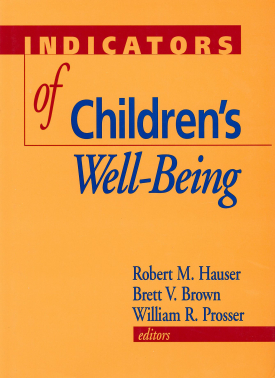
Cover image of the book Indicators of Children's Well-Being
Books

Indicators of Children's Well-Being

Editors
Brett V. Brown
William R. Prosser
Robert M. Hauser
Hardcover
Add to Cart
Publication Date
6.63 in. × 9.25 in. 532 pages
ISBN
978-0-87154-386-8
Also Available From

About This Book

The search for reliable information on the well-being of America's young is vital to designing programs to improve their lives. Yet social scientists are concerned that many measurements of children's physical and emotional health are inadequate, misleading, or outdated, leaving policymakers ill-informed. Indicators of Children's Well-Being is an ambitious inquiry into current efforts to monitor children from the prenatal period through adolescence. Working with the most up-to-date statistical sources, experts from multiple disciplines assess how data on physical development, education, economic security, family and neighborhood conditions, and social behavior are collected and analyzed, what findings they reveal, and what improvements are needed to create a more comprehensive and policy-relevant system of measurement.

Today's climate of welfare reform has opened new possibilities for program innovation and experimentation, but it has also intensified the need for a clearly defined and wide-ranging empirical framework to pinpoint where help is needed and what interventions will succeed. Indicators of Children's Well-Being emphasizes the importance of accurate studies that address real problems. Essays on children's material well-being show why income data must be supplemented with assessments of housing, medical care, household expenditure, food consumption, and education. Other contributors urge refinements to existing survey instruments such as the Census and the Current Population Survey. The usefulness of records from human service agencies, child welfare records, and juvenile court statistics is also evaluated.

ROBERT M. HAUSER is Vilas Research Professor of Sociology and affiliate at the Institute for Research on Poverty, University of Wisconsin, Madison.

BRETT V. BROWN is research associate at Child Trends, Inc., Washington, D.C.

WILLIAM R. PROSSER is senior policy analyst who is retired from the Office of the Assistant Secretary for Planning and Evaluation, U.S. Department of Health and Human Services, Washington, D.C.

CONTRIBUTORS: J. Lawrence Aber, Jeanne Brooks-Gunn, Thomas J. Corbett, Claudia J. Coulton, Greg J. Duncan, David J. Eggebeen, Arthur B. Elster, Frank F. Furstenberg Jr., Robert M. Goerge, Dennis P. Hogan, Mary Elizabeth Hughes, Aurora Jackson, Stephanie M. Jones, Thomas J. Kane, Bruce P. Kennedy, Daniel Koretz, Paula Lantz, John M. Love, Susan E. Mayer, Timothy J. McGourthy, Marc L. Miringoff, Marque-Luisa Miringoff, Kristin A. Moore, Allyn M. Mortimer, Leslie Moscow, Jane Mosley, Melissa Partin, Deborah A. Phillips, Deborah Prothrow-Stith, Gary D. Sandefur, James Sears, Judith R. Smith, Matthew Stagner, Barbara Starfield, Ruby Takanishi, Barbara L. Wolfe.

An Institute for Research on Poverty Affiliated Book on Poverty and Public Policy


RSF Journal
View Book Series
Sign Up For Our Mailing List
Apply For Funding
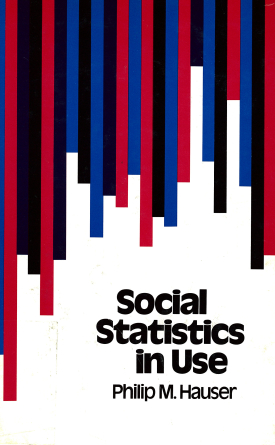
Cover image of the book Social Statistics in Use
Books

Social Statistics in Use

Author
Philip M. Hauser
Hardcover
Add to Cart
Publication Date
6 in. × 9 in. 400 pages
ISBN
978-0-87154-375-2
Also Available From

About This Book

Shows why social statistics are important and how they are put to use in the interest of the public. Written by a sociologist who serves as Director of the Population Research Center at the University of Chicago, the book illustrates the many applications social statistics have for governmental agencies at the federal, state, and local levels; for the business community; for labor unions; for educators and researchers; and for the general public. The author provides a description of the major bodies of social statistical information, including population; births, deaths, and health; marriage, divorce, and the family; education; the labor force; crime; consumption and the consumer; recreation; governments; and public opinion polls.

PHILIP M. HAUSER is Lucy Flower Professor of Urban Sociology and director of the Population Research Center at the University of Chicago.

RSF Journal
View Book Series
Sign Up For Our Mailing List
Apply For Funding
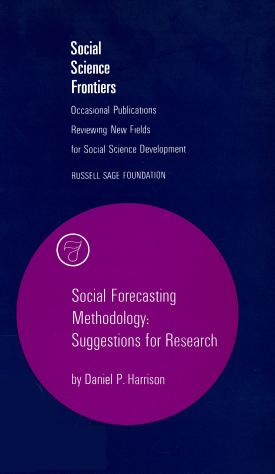
Cover image of the book Social Forecasting Methodology
Books

Social Forecasting Methodology

Suggestions for Research
Author
Daniel P. Harrison
Paperback
Add to Cart
Publication Date
6 in. × 9 in. 104 pages
ISBN
978-0-87154-376-9
Also Available From

About This Book

A volume in the Social Science Frontiers series, which are occasional publications reviewing new fields for social science development.

These occasional publications seek to summarize recent work being done in particular areas of social research, to review new developments in the field, and to indicate issues needing further investigation. The publications are intended to help orient those concerned with developing current research programs and broadening the use of social science in the policy-making process.

A Volume in the the Russell Sage Foundation's Social Science Frontiers Series

RSF Journal
View Book Series
Sign Up For Our Mailing List
Apply For Funding
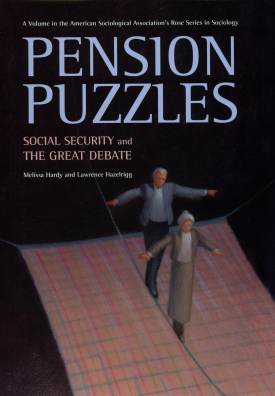
Cover image of the book Pension Puzzles
Books

Pension Puzzles

Social Security and the Great Debate
Authors
Melissa Hardy
Lawrence Hazelrigg
Paperback
$33.95
Add to Cart
Publication Date
6 in. × 9 in. 304 pages
ISBN
978-0-87154-334-9
Also Available From

About This Book

A Volume in the American Sociological Association’s Rose Series in Sociology

"This volume is distinguished by immense scholarship in economics and political science extending beyond the Social Security issue to the proper role of government in the economy. An important addition to the literature."
-CHOICE

"Melissa Hardy and Lawrence Hazelrigg clear the air on the Social Security debate. They set their sociological sights on the econometric battle over rescue strategies versus privatization, showing that arguments about efficiency are invariably colored by politics. In reviewing arguments and evidence for each side, they call for an open debate in which politicians and policy wonks put all their cards on the table. This lucid and even-handed book offers the non-expert an introduction to the issues that is engaging, yet never dumbed down. It challenges the expert to overcome partisan politics."
-FRANK DOBBIN, professor of sociology, Harvard University

"Melissa Hardy and Lawrence Hazelrigg bring an insightful and nuanced sociological perspective to the history and recent controversies surrounding Social Security and proposed changes in the system with an impressively broad (and deep) intellectual orientation that transcends sociology to include economics, history, philosophy, political science, and literature. They evaluate the 'toxic' political-economic climate surrounding Social Security in a clear-eyed fashion by distinguishing 'technical' from 'political' arguments. And, they make courageous public judgments about the political motives, voracity, and behaviors of public figures embroiled in these policy debates."
-ANGELA M. O'RAND, professor of sociology, Duke University

The rancorous debate over the future of Social Security reached a fever pitch in 2005 when President Bush unsuccessfully proposed a plan for private retirement accounts. Although efforts to reform Social Security seem to have reached an impasse, the long-term problem—the projected Social Security deficit—remains. In Pension Puzzles, sociologists Melissa Hardy and Lawrence Hazelrigg explain for a general audience the fiscal challenges facing Social Security and explore the larger political context of the Social Security debate.

Pension Puzzles cuts through the sloganeering of politicians in both parties, presenting Social Security’s technical problems evenhandedly and showing how the Social Security debate is one piece of a larger political struggle. Hardy and Hazelrigg strip away the ideological baggage to explicate the basic terms and concepts needed to understand the predicament of Social Security. They compare the cases for privatizing Social Security and for preserving the program in its current form with adjustments to taxes and benefits, and they examine the different economic projections assumed by proponents of each approach. In pursuit of its privatization agenda, Hardy and Hazelrigg argue, the Bush administration has misled the public on an issue that was already widely misunderstood. The authors show how privatization proponents have relied on dubious assumptions about future rates of return to stock market investments and about the average citizen’s ability to make informed investment decisions. In addition, the administration has painted the real but manageable shortfalls in Social Security revenue as a fiscal crisis. Projections of Social Security revenues and benefits by the Social Security Administration have treated revenues as fixed, when in fact they are determined by choices made by Congress. Ultimately, as Hardy and Hazelrigg point out, the clash over Social Security is about more than technical fiscal issues: it is part of the larger culture wars and the ideological struggle over what kind of social responsibilities and rights American citizens should have. This rancorous partisan wrangling, the alarmist talk about a “crisis” in Social Security, and the outright deception employed in this debate have all undermined the trust between citizens and government that is needed to restore the solvency of Social Security for future generations of retirees.

Drawing together economic analyses, public opinion data, and historical narratives, Pension Puzzles is a lucid and engaging guide to the major proposals for Social Security reform. It is also an insightful exploration of what that debate reveals about American political culture in the twenty-first century.

MELISSA HARDY is Distinguished Professor of Human Development and Family Studies in Sociology and Demography and director of the Gerontology Center at the Pennsylvania State University.

LAWRENCE HAZELRIGG is professor emeritus at Florida State University and adjunct professor of sociology at the Pennsylvania State University.

RSF Journal
View Book Series
Sign Up For Our Mailing List
Apply For Funding
Cover image of the book The Conditions of Discretion
Books

The Conditions of Discretion

Autonomy, Community, Bureaucracy
Author
Joel F. Handler
Hardcover
Add to Cart
Publication Date
6 in. × 9 in. 344 pages
ISBN
978-0-87154-349-3
Also Available From

About This Book

This timely book is concerned with interactions between ordinary people and large public bureaucracies—interactions that typically are characterized by mutual frustration and antagonism. In fact, as Joel Handler points out, the procedural guidelines intended to ensure fairness and due process fail to take account of an initial imbalance of power and tend to create adversarial rather than cooperative relationships.

When the special education needs of a handicapped child must be determined, parents and school administrators often face an especially painful confrontation. The Conditions of Discretion focuses on one successful approach to educational decision making (developed by the school district of Madison, Wisconsin) in order to illustrate how such interactions can be restructured and enhanced. Madison’s creative plan regards parents as part of the solution, not the problem, and uses “lay advocates” to turn conflict into an opportunity for communication. Arrangements such as these, in Handler’s analysis, exemplify the theoretical conditions under which discretionary decisions can be made fairly and with the informed participation of all concerned.

The Conditions of Discretion offers not only a detailed case study, sympathetically described, but also persuasive assessments of major themes in contemporary legal and social policy—informed consent, bureaucratic change, social movement activity, the relationship of the individual to the state. From these strands, Handler weaves a significant new theory of cooperative decision making that integrates the public and the private, recognizes the importance of values, and preserves autonomy within community.

"A masterful blend of social criticism, social sciences, and humane, constructive thought about the future of the welfare state." —Duncan Kennedy, Harvard Law School

JOEL F. HANDLER is professor of law at the University of California, Los Angeles.

RSF Journal
View Book Series
Sign Up For Our Mailing List
Apply For Funding
Cover image of the book Social Science in the Making
Books

Social Science in the Making

Essays on the Russell Sage Foundation, 1907–1972
Authors
David C. Hammack
Stanton Wheeler
Hardcover
Add to Cart
Publication Date
6 in. × 9 in. 176 pages
ISBN
978-0-87154-347-9
Also Available From

About This Book

"Together, the historical essays in this volume provide the best account of how the Foundation moved away from its roots as a policy think tank.... This book of essays is the only extended treatment of the Foundation's history that includes both its distinguished early years and its emergence after World War II as the principal private foundation devoted to strengthening basic research in the social sciences." —ERIC WANNER, president of the Russell Sage Foundation, in his foreword to the volume

DANIEL HAMMACK is Hiram C. Haydn Professor of History at Case Western Reserve University.

STANTON WHEELER was Ford Foundation Professor Emeritus of Law and the Social Sciences and professorial lecturer in law at Yale University.

RSF Journal
View Book Series
Sign Up For Our Mailing List
Apply For Funding
Cover image of the book Power and Society in Greater New York
Books

Power and Society in Greater New York

Author
David C. Hammack
Hardcover
$56.95
Add to Cart
Publication Date
6 in. × 9 in. 448 pages
ISBN
978-0-87154-348-6
Also Available From

About This Book

Who has ruled New York? Has power become more concentrated—or more widely and democratically dispersed—in American cities over the past one hundred years? How did New York come to have its modern physical and institutional shape? Focusing on the period when New York City was transformed from a nineteenth-century mercantile center to a modern metropolis, David C. Hammack offers an entirely new view of the history of power and public policy in the nation's largest urban community.

Opening with a fresh and original interpretation of the metropolitan region's economic and social history between 1890 and 1910, Hammack goes on to show how various population groups used their economic, social, cultural, and political resources to shape the decisions that created the modern city. As New York grew in size and complexity, its economic and social interests were forced to compete and form alliances. No single group—not even the wealthy—was able to exercise continuing control of urban policy. Building on his account of this interplay among numerous elites, Hammack concludes with a new interpretation of the history of power in New York and other American cities between 1890 and 1950.

This book makes a major contribution to the study of community power, of urban and regional history, and of public policy. And by taking the meaning and distribution of power as his theme, Hammack is able to reintegrate economic, social, and political history in a rich and comprehensive work.

"Lucid, instructive, and discerning....The most commanding analysis of its subject that I know." —John M. Blum, professor of history, Yale University

"A powerful and persuasive treatment of a marvelous subject." —Nelson W. Polsby, professor of political science, University of California, Berkeley

DAVID C. HAMMACK is professor of history at Case Western Reserve University.

RSF Journal
View Book Series
Sign Up For Our Mailing List
Apply For Funding
Cover image of the book Help or Hindrance?
Books

Help or Hindrance?

The Economic Implications of Immigration for African Americans
Editors
Daniel S. Hamermesh
Frank D. Bean
Hardcover
$59.95
Add to Cart
Publication Date
6 in. × 9 in. 404 pages
ISBN
978-0-87154-387-5
Also Available From

About This Book

With recent immigration at a near record high, many observers fear that African Americans, particularly those in low skill jobs, are increasingly losing out to immigrants in the American labor market. Because today's immigrants are largely non-European and non-white, there is also speculation that their presence will intensify the competition for housing and educational opportunities among minority groups. Help or Hindrance? probes the foundation of these concerns with the first comprehensive investigation into the effects of immigration on African Americans.

With detailed economic analysis of African American job prospects, benefits, and working conditions, Help or Hindrance? demonstrates that although immigration does not appear to have affected the actual employment rate of blacks, it has contributed slightly to the widening gap between the annual earnings of black and white males. Those near the lowest skills level appear most affected, suggesting that the most likely losers are workers with abilities similar to those of immigrants. With many employers moving away from cities, access to housing and problems of segregation have also become integral to success in the job market. And within black neighborhoods themselves, the establishment of small immigrant businesses has raised concerns that these may hinder local residents from starting up similar ventures. Help or Hindrance? also examines how immigration has affected the educational attainment of African Americans. Increased competition for college affirmative action and remedial programs has noticeably reduced African Americans' access to college places and scholarships.

Help or Hindrance? offers compelling evidence that although immigration has in many ways benefited parts of American society, it has had a cumulatively negative effect on the economic prospects of African Americans. In concluding chapters, this volume provides an overview of possible policy interventions and evaluates them within the current social and political climate. Because the long-term impact of current immigration on social welfare remains unknown solutions are far from clear. Help or Hindrance? provides a valuable benchmark for discussion of immigration and racial equity in a time of rapid population change.

FRANK D. BEAN is the Ashbel Smith Professor of Sociology and professor of public affairs at the University of Texas at Austin.

DANIEL S. HAMERMESH is Edward Everett Hall Centennial Professor of Economics at the University of Texas at Austin. He is also research associate of the National Bureau of Economic Research.

CONTRIBUTORS: Frank D. Bean, Daniel S. Hamermesh, Julian R. Betts, George J. Borjas, Kristin F. Butcher, Robert W. Fairlie, Richard B. Freeman, Jeffrey T. Grogger, Caroline M. Hoxby, George E. Johnson, Linda Datcher Loury, Bruce D. Meyer, Cordelia W. Reimers, Peter H. Schuck, Marta Tienda, and Jeffrey S. Zax.

RSF Journal
View Book Series
Sign Up For Our Mailing List
Apply For Funding