Cover image of the book Neighborhood Poverty, Volume 2
Books

Neighborhood Poverty, Volume 2

Policy Implications in Studying Neighborhoods
Editors
Greg J. Duncan
Jeanne Brooks-Gunn
J. Lawrence Aber
Paperback
$26.95
Add to Cart
Publication Date
1 in. × 1 in. 260 pages
ISBN
978-0-87154-189-5
Also Available From

About This Book

"This work addresses an area of great interest in recent social policy discussions about the underclass. These two volumes report new and innovative research, and should be of interest to people in child development, social psychology, sociology, and economics. An important work."
-LEE RAINWATER, Harvard University

"Neighborhood Poverty is a monumental work, reporting the results of a massive interdisciplinary effort to understand the role of neighborhood contexts on the development of children. These volumes combine some of the strongest empirical work to date with thoughtful conceptual and methodological critiques of neighborhood effects research, which move beyond merely looking for neighborhood effects to understanding the mechanisms through which these effects are manifested. The research effort chronicled here is a model of how social science research ought to be conducted on complex social issues."
-PAUL JARGOWSKY, University of Texas at Dallas

Perhaps the most alarming phenomenon in American cities has been the transformation of many neighborhoods into isolated ghettos where poverty is the norm and violent crime, drug use, out-of-wedlock births, and soaring school dropout rates are rampant. Public concern over these destitute areas has focused on their most vulnerable inhabitants—children and adolescents. How profoundly does neighborhood poverty endanger their well-being and development? Is the influence of neighborhood more powerful than that of the family? Neighborhood Poverty approaches these questions with an insightful and wide-ranging investigation into the effect of community poverty on children's physical health, cognitive and verbal abilities, educational attainment, and social adjustment.

This two-volume set offers the most current research and analysis from experts in the fields of child development, social psychology, sociology and economics. Drawing from national and city-based sources, Volume I reports the empirical evidence concerning the relationship between children and community. As the essays demonstrate, poverty entails a host of problems that affects the quality of educational, recreational, and child care services.Poor neighborhoods usually share other negative features—particularly racial segregation and a preponderance of single mother families—that may adversely affect children. Yet children are not equally susceptible to the pitfalls of deprived communities. Neighborhood has different effects depending on a child's age, race, and gender, while parenting techniques and a family's degree of community involvement also serve as mitigating factors.

Volume II incorporates empirical data on neighborhood poverty into discussions of policy and program development. The contributors point to promising community initiatives and suggest methods to strengthen neighborhood-based service programs for children. Several essays analyze the conceptual and methodological issues surrounding the measurement of neighborhood characteristics. These essays focus on the need to expand scientific insight into urban poverty by drawing on broader pools of ethnographic, epidemiological, and quantitative data. Volume II explores the possibilities for a richer and more well-rounded understanding of neighborhood and poverty issues.

To grasp the human cost of poverty, we must clearly understand how living in distressed neighborhoods impairs children's ability to function at every level. Neighborhood Poverty explores the multiple and complex paths between community, family, and childhood development. These two volumes provide and indispensable guide for social policy and demonstrate the power of interdisciplinary social science to probe complex social issues.

JEANNE BROOKS-GUNN is Virginia and Leonard Marx Professor of Child Development at Teachers College, Columbia University. She is also director of the Center for Children and Families and founder of the Adolescent Study Program at Teachers College.

GREG J. DUNCAN is professor of education and social policy and a faculty associate in the Institute for Policy Research at Northwestern University. He is also faculty affiliate of the Northwestern University/University of Chicago Joint Center for Poverty Research.

J. LAWRENCE ABER is director of the National Center for Children in Poverty at the Columbia School of Public Health, Columbia University.

CONTRIBUTORS:Daniel Aaronson, Prudence Brown, Linda M. Burton, Thomas D. Cook, Claudia J. Coulton, Nancy Darling, Serdar M. Degirmencioglu, Frank M. Furstenberg Jr., Martha A. Gephart, Mary Elizabeth Hughes, Robin L. Jarrett, Sheila B. Kamerman, Tedd Jay Kochman, Jill E. Korbin, Tama Leventhal, Paul A. McDermott, Jeffrey D. Morenoff, Townsand Price-Spratlen, Harold A. Richman, Robert J. Sampson,  Margaret Beale Spencer, Shobha C. Shagle, Laurence Steinberg.

RSF Journal
View Book Series
Sign Up For Our Mailing List
Apply For Funding
Cover image of the book Neighborhood Poverty, Volume 1
Books

Neighborhood Poverty, Volume 1

Context and Consequences for Children
Editors
Greg J. Duncan
Jeanne Brooks-Gunn
J. Lawrence Aber
Paperback
$26.95
Add to Cart
Publication Date
1 in. × 1 in. 356 pages
ISBN
978-0-87154-188-8
Also Available From

About This Book

"This work addresses an area of great interest in recent social policy discussions about the underclass. These two volumes report new and innovative research, and should be of interest to people in child development, social psychology, sociology, and economics. An important work."
-LEE RAINWATER, Harvard University

"Neighborhood Poverty is a monumental work, reporting the results of a massive interdisciplinary effort to understand the role of neighborhood contexts on the development of children. These volumes combine some of the strongest empirical work to date with thoughtful conceptual and methodological critiques of neighborhood effects research, which move beyond merely looking for neighborhood effects to understanding the mechanisms through which these effects are manifested. The research effort chronicled here is a model of how social science research ought to be conducted on complex social issues."
PAUL JARGOWSKY, University of Texas at Dallas

Perhaps the most alarming phenomenon in American cities has been the transformation of many neighborhoods into isolated ghettos where poverty is the norm and violent crime, drug use, out-of-wedlock births, and soaring school dropout rates are rampant. Public concern over these destitute areas has focused on their most vulnerable inhabitants—children and adolescents. How profoundly does neighborhood poverty endanger their well-being and development? Is the influence of neighborhood more powerful than that of the family? Neighborhood Poverty: Context and Consequences for Children approaches these questions with an insightful and wide-ranging investigation into the effect of community poverty on children's physical health, cognitive and verbal abilities, educational attainment, and social adjustment.

This two-volume set offers the most current research and analysis from experts in the fields of child development, social psychology, sociology and economics. Drawing from national and city-based sources, Volume I reports the empirical evidence concerning the relationship between children and community. As the essays demonstrate, poverty entails a host of problems that affects the quality of educational, recreational, and child care services. Poor neighborhoods usually share other negative features—particularly racial segregation and a preponderance of single mother families—that may adversely affect children. Yet children are not equally susceptible to the pitfalls of deprived communities. Neighborhood has different effects depending on a child's age, race, and gender, while parenting techniques and a family's degree of community involvement also serve as mitigating factors.

Volume II incorporates empirical data on neighborhood poverty into discussions of policy and program development. The contributors point to promising community initiatives and suggest methods to strengthen neighborhood-based service programs for children. Several essays analyze the conceptual and methodological issues surrounding the measurement of neighborhood characteristics. These essays focus on the need to expand scientific insight into urban poverty by drawing on broader pools of ethnographic, epidemiological, and quantitative data. Volume II explores the possibilities for a richer and more well-rounded understanding of neighborhood and poverty issues.

To grasp the human cost of poverty, we must clearly understand how living in distressed neighborhoods impairs children's ability to function at every level. Neighborhood Poverty explores the multiple and complex paths between community, family, and childhood development. These two volumes provide and indispensible guide for social policy and demonstrate the power of interdisciplinary social science to probe complex social issues.

JEANNE BROOKS-GUNN is Virginia and Leonard Marx Professor of Child Development at Teachers College, Columbia University. She is also director of the Center for Children and Families and founder of the Adolescent Study Program at Teachers College.

GREG J. DUNCAN is professor of education and social policy and a faculty associate in the Institute for Policy Research at Northwestern University. He is also faculty affiliate of the Northwestern University/University of Chicago Joint Center for Poverty Research.

J. LAWRENCE ABER is director of the National Center for Children in Poverty at the Columbia School of Public Health, Columbia University.

CONTRIBUTORS: Daniel Aaronson, LaRue Allen, Prudence Brown, Linda M. Burton, P. Lindsay Chase-Lansdale, Elizabeth Clifford, Steven P. Cole, James P. Connell, Thomas D. Cook, Claudia J. Coulton, Warren E. Crichlow, Nancy Darling, Serdar M. Degirmencioglu, Frank M. Furstenberg Jr., Martha A. Gephart, Rachel A Gordon, Bonnie L. Halpern-Felsher, Mary Elizabeth Hughes, Robin L. Jarrett, Stephanie M. Jones, Sheila B. Kamerman, Pamela K. Klebanov, Tedd Jay Kochman, Jill E. Korbin, Jeffrey S. Lehman, Tama Leventhal, Paul A. McDermott, Jeffrey D. Morenoff, Townsand Price-Spratlen, Harold A. Richman, Robert J. Sampson, Edward Seidman, Shobha C. Shagle, Timothy M. Smeeding, Margaret Beale Spencer, Laurence Steinberg, Dena Phillips Swanson, Peter A. Usinger.

 

RSF Journal
View Book Series
Sign Up For Our Mailing List
Apply For Funding
Cover image of the book Trust and Governance
Books

Trust and Governance

Editors
Valerie Braithwaite
Margaret Levi
Paperback
$34.95
Add to Cart
Publication Date
1 in. × 1 in. 400 pages
ISBN
978-0-87154-135-2
Also Available From

About This Book

"A significant contribution to the issue of trust in the state. The value of this book is that it presents a true dialogue, with all the major conflicting perspectives represented. It will certainly attract the attention of social scientists in a variety of disciplines who are working on some aspect of 'institutional theory."
GARY MILLER, Washington University in St. Louis

"Interest in the issue of trust has grown substantially in recent years, so this is a timely book that should receive a lot of attention across the social sciences. A very important collection of well-crafted essays."
-ELINOR OSTROM, Indiana University

An effective democratic society depends on the confidence citizens place in their government. Payment of taxes, acceptance of legislative and judicial decisions, compliance with social service programs, and support of military objectives are but some examples of the need for public cooperation with state demands. At the same time, voters expect their officials to behave ethically and responsibly. To those seeking to understand—and to improve—this mutual responsiveness, Trust and Governance provides a wide-ranging inquiry into the role of trust in civic life.

Trust and Governance asks several important questions: Is trust really essential to good governance, or are strong laws more important? What leads people either to trust or to distrust government, and what makes officials decide to be trustworthy? Can too much trust render the public vulnerable to government corruption, and if so what safeguards are necessary? In approaching these questions, the contributors draw upon an abundance of historical and current resources to offer a variety of perspectives on the role of trust in government. For some, trust between citizens and government is a rational compact based on a fair exchange of information and the public's ability to evaluate government performance. Levi and Daunton each examine how the establishment of clear goals and accountability procedures within government agencies facilitates greater public commitment, evidence that a strong government can itself be a source of trust. Conversely, Jennings and Peel offer two cases in which loss of citizen confidence resulted from the administration of seemingly unresponsive, punitive social service programs.

Other contributors to Trust and Governance view trust as a social bonding, wherein the public's emotional investment in government becomes more important than their ability to measure its performance. The sense of being trusted by voters can itself be a powerful incentive for elected officials to behave ethically, as Blackburn, Brennan, and Pettit each demonstrate. Other authors explore how a sense of communal identity and shared values make citizens more likely to eschew their own self-interest and favor the government as a source of collective good. Underlying many of these essays is the assumption that regulatory institutions are necessary to protect citizens from the worst effects of misplaced trust. Trust and Governance offers evidence that the jurisdictional level at which people and government interact—be it federal, state, or local—is fundamental to whether trust is rationally or socially based. Although social trust is more prevalent at the local level, both forms of trust may be essential to a healthy society.

Enriched by perspectives from political science, sociology, psychology, economics, history, and philosophy, Trust and Governance opens a new dialogue on the role of trust in the vital relationship between citizenry and government.

VALERIE BRAITHWAITE is associate director of the Research School of Social Sciences at the Australian National University, Canberra, Australia. She is also coordinator of the Trust Strand of the Reshaping Australian Institutions Project in the Research School of Social Sciences.

MARGARET LEVI is professor of political science and Harry Bridges Chair in Labor Studies, University of Washington, Seattle. She is also director of the University of Washington Center for Labor Studies.

CONTRIBUTORS: William T. Bianco,  Simon Blackburn,  John Braithwaite, Geofrrey Brennan, Martin Daunton, Russell Hardin,  M. Kent Jennings,  Mark Peel, Philip Pettit, John T. Scholz, Tom R. Tyler, Susan H. Whiting.


A Volume in the Russell Sage Foundation's Series on Trust

RSF Journal
View Book Series
Sign Up For Our Mailing List
Apply For Funding
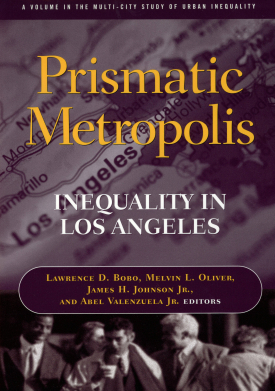
Cover image of the book Prismatic Metropolis
Books

Prismatic Metropolis

Inequality in Los Angeles
Editors
Lawrence D. Bobo
Melvin L. Oliver
James H. Johnson, Jr.
Abel Valenzuela, Jr.
Paperback
$29.95
Add to Cart
Publication Date
1 in. × 1 in. 628 pages
ISBN
978-0-87154-130-7
Also Available From

About This Book

"Prismatic Metropolis is destined to become a standard reference for students of urban inequality. Based on thoughtful analysis of very rich and original data sets, this authoritative volume demonstrates the important interplay of structural conditions and cultural-psychological factors in generating and sustaining inequality in one of the nation's most important metropolises."
-WILLIAM JULIUS WILSON, Harvard University

"Far too much of what we think we know about urban poverty stems from studies of blacks and whites in older industrial cities, yet the urban future will increasingly unfold in dynamic, post-industrial agglomerations inhabited by a diverse array of racial and ethnic groups. In their comprehensive analysis of inequality in Los Angeles, the contributors paint a startling picture of the urban future, one increasingly segmented by race, place, ethnicity, and class. Prismatic Metropolis points the way to a new urban sociology for a new century."
-DOUGLAS S. MASSEY, University of Pennsylvania

"In documenting the dynamics of race, ethnicity, and gender in access to housing, jobs, and advancement at work, Prismatic Metropolis maps the contours of social and economic inequality in the nation's foremost "global city." Chapters provide wide-ranging coverage, from a pathbreaking analysis of the reproduction of housing segregation patterns, to detailed accounts of the ways that racial attitudes, social networks, childcare obligations, transportation systems, and ethnic economic enclaves link race and gender to economic success. This extraordinary volume, while based on analyses of one city, has lessons for all U.S. cities. Prismatic Metropolis is the essential starting place for understanding how race, ethnic, and gender inequality play out in contemporary cities and for discovering pathways toward economic and social justice."
-BARBARA RESKIN, Harvard University

This book cuts through the powerful mythology surrounding Los Angeles to reveal the causes of inequality in a city that has weathered rapid population change, economic restructuring, and fractious ethnic relations. The sources of disadvantage and the means of getting ahead differ greatly among the city's myriad ethnic groups. The demand for unskilled labor is stronger here than in other cities, allowing Los Angeles's large population of immigrant workers with little education to find work in light manufacturing and low-paid service jobs.

A less beneficial result of this trend is the increased marginalization of the city's low-skilled black workers, who do not enjoy the extended ethnic networks of many of the new immigrant groups and who must contend with persistent negative racial stereotypes.

Patterns of residential segregation are also more diffuse in Los Angeles, with many once-black neighborhoods now split evenly between blacks, Hispanics, Asians, and other minorities. Inequality in Los Angeles cannot be reduced to a simple black-white divide. Nonetheless, in this thoroughly multicultural city, race remains a crucial factor shaping economic fortunes.

LAWRENCE D. BOBO is professor of sociology and Afro-American studies at Harvard University.

MELVIN L. OLIVER is vice president of the Ford Foundation. He is responsible for overseeing the Asset Building and Community Development Program.

JAMES H. JOHNSON JR. is William Rand Kenan Jr. Distinguished Professor of Management, Sociology, and Public Policy and director of the  Urban Investment Strategies Center in the Kenan Institute in the Kenan-Flager Business School at the University of North Carolina at Chapel Hill.

ABEL VALENZUELA JR. is assistant professor of urban planning and Chicana/o studies at the University of California, Los Angeles. He is also associate director of the Center for the Study of Urban Poverty, Institute for Social Science Research.

CONTRIBUTORS:  Elisa Jayne Bienenstock, Camille Zubrinksi Charles, Walter C. Farrell Jr.,  Jennifer L. Glanville,  Elizabeth Gonzalez,  David M. Grant,  Tarry Hum, Devon Johnson,  Michael I. Lichter,  Julie E. Press,  Michael A. Stoll, Susan A. Suh,  Jennifer A. Stoloff.  

A Volume in the Multi-City Study of Urban Inequality

RSF Journal
View Book Series
Sign Up For Our Mailing List
Apply For Funding
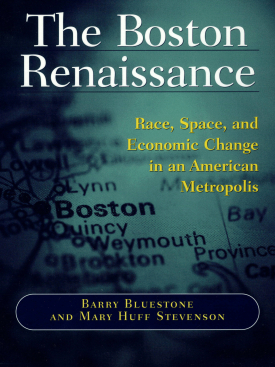
Cover image of the book The Boston Renaissance
Books

The Boston Renaissance

Race, Space, and Economic Change in an American Metropolis
Authors
Barry Bluestone
Mary Huff Stevenson
Paperback
Add to Cart
Publication Date
1 in. × 1 in. 476 pages
ISBN
978-0-87154-126-0
Also Available From

About This Book

"The Boston Renaissance is a tour de force. Drawing upon a rich array of new data, Barry Bluestone and Mary Huff Stevenson provide an original and insightful analysis of Boston's remarkable triple revolution. This book is replete with information and should be read by scholars and policymakers alike."
-WILLIAM JULIUS WILSON, Harvard University

"How an old and declining northeast city transformed itself into one of the most successful urban communities in American is a story the must be told, and it is told effectively in The Boston Renaissance."
-MICHAEL S. DUKAKIS, professor of political science and former governor of Massachusetts

"Dubbed an urban disaster case only twenty years ago, Boston today is a high-tech boom town, a marvel of tight labor markets and sky rocketing real estate. How did this transformation come about and who has reaped the bounty? We learn how different ethnic groups reshaped the social landscape of the metropolitan region and how the tracks of that upheaval shaped race relations. The Boston Renaissance is essential reading for scholars, policy makers, and citizens concerned with urban change in the twenty-first century."
-KATHERINE S. NEWMAN, Kennedy School of Government

"As the authors point out, Boston was considered an economic basket case as recently as 1982. In terms of the poverty rate, violent crime, and other indexes of urban decline, Boston was at the bottom. Two decades later, employment has climbed to an all time high. The city's neighborhoods are making remarkable comebacks, and Boston's crime prevention strategy has become the model for cities across the nation. The Boston Renaissance is the story of how a struggling city grew into America's urban success story."
-THOMAS M. MENINO, Mayor of Boston

This volume documents metropolitan Boston's metamorphosis from a casualty of manufacturing decline in the 1970s to a paragon of the high-tech and service industries in the 1990s. The city's rebound has been part of a wider regional renaissance, as new commercial centers have sprung up outside the city limits. A stream of immigrants have flowed into the area, redrawing the map of ethnic relations in the city. While Boston's vaunted mind-based economy rewards the highly educated, many unskilled workers have also found opportunities servicing the city's growing health and education industries.

Boston's renaissance remains uneven, and the authors identify a variety of handicaps (low education, unstable employment, single parenthood) that still hold minorities back. Nonetheless this book presents Boston as a hopeful example of how America's older cities can reinvent themselves in the wake of suburbanization and deindustrialization.

BARRY BLUESTONE is the Russell B. and Andr`ee B. Stearns Trustee Professor of Political Economy and director of the Center for Urban and Regional Policy at Northeastern University.

MARY HUFF STEVENSON is associate professor of economics at the University of Massachusetts, Boston, and senior fellow at its McCormack Institute of Public Affairs.

A Volume in the Multi-City Study of Urban Inequality

RSF Journal
View Book Series
Sign Up For Our Mailing List
Apply For Funding
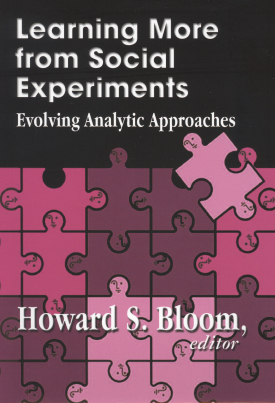
Cover image of the book Learning More From Social Experiments
Books

Learning More From Social Experiments

Evolving Analytic Approaches
Editor
Howard S. Bloom
Paperback
$29.95
Add to Cart
Publication Date
1 in. × 1 in. 264 pages
ISBN
978-0-87154-133-8
Also Available From

About This Book

"The authors of this important new book show how to open up the 'black box' of randomized experimental designs, yielding critical insights and linking the experimental findings to behavioral theories. Each of the chapters in Learning More from Social Experiments offers state-of-the-art lessons for practitioners and analysts alike."
-DAVID CARD, Class of 1950 Professor of Economics and head of the Center for Labor Economics, University of California, Berkeley

"Learning More from Social Experiments is an important addition to the library of any program evaluator or field researcher. Building on their decades of real-world experience designing, conducting, and analyzing social experiments, Howard Bloom and his MDRC colleagues provide an array of stimulating examples demonstrating how the marriage of careful research design and modern statistical methodology can dramatically improve the explanatory power of field studies."
-JUDITH D. SINGER, James Bryant Conant Professor of Education, Harvard Graduate School of Education

Policy analysis has grown increasingly reliant on the random assignment experiment—a research method whereby participants are sorted by chance into either a program group that is subject to a government policy or program, or a control group that is not. Because the groups are randomly selected, they do not differ from one another systematically. Therefore any differences between the groups at the end of the study can be attributed solely to the influence of the program or policy. But there are many questions that randomized experiments have not been able to address. What component of a social policy made it successful? Did a given program fail because it was designed poorly or because it suffered from low participation rates? In Learning More from Social Experiments, editor Howard Bloom and a team of innovative social researchers profile advancements in the scientific underpinnings of social policy research that can improve randomized experimental studies.

Using evaluations of actual social programs as examples, Learning More from Social Experiments makes the case that many of the limitations of random assignment studies can be overcome by combining data from these studies with statistical methods from other research designs. Carolyn Hill, James Riccio, and Bloom profile a new statistical model that allows researchers to pool data from multiple randomized-experiments in order to determine what characteristics of a program made it successful. Lisa Gennetian, Pamela Morris, Johannes Bos, and Bloom discuss how a statistical estimation procedure can be used with experimental data to single out the effects of a program’s intermediate outcomes (e.g., how closely patients in a drug study adhere to the prescribed dosage) on its ultimate outcomes (the health effects of the drug). Sometimes, a social policy has its true effect on communities and not individuals, such as in neighborhood watch programs or public health initiatives. In these cases, researchers must randomly assign treatment to groups or clusters of individuals, but this technique raises different issues than do experiments that randomly assign individuals. Bloom evaluates the properties of cluster randomization, its relevance to different kinds of social programs, and the complications that arise from its use. He pays particular attention to the way in which the movement of individuals into and out of clusters over time complicates the design, execution, and interpretation of a study.

Learning More from Social Experiments represents a substantial leap forward in the analysis of social policies. By supplementing theory with applied research examples, this important new book makes the case for enhancing the scope and relevance of social research by combining randomized experiments with non-experimental statistical methods, and it serves as a useful guide for researchers who wish to do so.

HOWARD S. BLOOM is chief social scientist at MDRC.

CONTRIBUTORS: Johannes M. Bos, Lisa A. Gennetian, Carolyn J. Hill, Charles Michalopoulos, Pamela A. Morris, James A. Riccio.

RSF Journal
View Book Series
Sign Up For Our Mailing List
Apply For Funding
Cover image of the book Gender and Family Issues in the Workplace
Books

Gender and Family Issues in the Workplace

Editors
Francine D. Blau
Ronald G. Ehrenberg
Paperback
$24.95
Add to Cart
Publication Date
1 in. × 1 in. 316 pages
ISBN
978-0-87154-122-2
Also Available From

About This Book

"A high-quality collection of articles that should be of interest to scholars concerned with gender issues and labor markets."
-Industrial and Labor Relations Review

"Valuable reading ... conveys a sophistication and sense of perspective that should be constructive for many policy and personal debates on the subject of women and the workplace."
-Journal of Economic Literature

"The book is a useful addition to the library of family and consumer economists. Educators and researchers will find thoughtful, comprehensive studies that include challenging theoretical frameworks and empirical analyses."
-Journal of Consumer Affairs

Today, as married women commonly pursue careers outside the home, concerns about their ability to achieve equal footing with men without sacrificing the needs of their families trouble policymakers and economists alike. In 1993 federal legislation was passed that required most firms to provide unpaid maternity leave for up to twelve weeks. Yet, as Gender and Family Issues in the Workplace reveals, motherhood remains a primary obstacle to women's economic success. This volume offers fascinating and provocative new analyses of women's status in the labor market, as it explores the debate surrounding parental leave: Do policies that mandate extended leave protect jobs and promote child welfare, or do they sidetrack women's careers and make them less desirable employees?

An examination of the disadvantages that women—particularly young mothers—face in today's workplace sets the stage for the debate. Claudia Goldin presents evidence that female college graduates are rarely able to balance motherhood with career track employment, and Jane Waldfogel demonstrates that having children results in substantially lower wages for women. The long hours demanded by managerial and other high powered professions further penalize women who in many cases still bear primary responsibility for their homes and children. Do parental leave policies improve the situation for women? Gender and Family Issues in the Workplace offers a variety of perspectives on this important question. Some propose that mandated leave improves women's wages by allowing them to preserve their job tenure. Other economists express concern that federal leave policies prevent firms and their workers from acting on their own particular needs and constraints, while others argue that because such policies improve the well-being of children they are necessary to society as a whole. Olivia Mitchell finds that although the availability of unpaid parental leave has sharply increased, only a tiny percentage of workers have access to paid leave or child care assistance. Others caution that the current design of family-friendly policies may promote gender inequality by reinforcing the traditional division of labor within families.

Parental leave policy is a complex issue embedded in a tangle of economic and social institutions. Gender and Family Issues in the Workplace offers an innovative and up-to-date investigation into women's chances for success and equality in the modern economy.

FRANCINE D. BLAU is Frances Perkins Professor of Industrial and Labor Relations at Cornell University and research associate of the National Bureau of Economic Research in Cambridge, Massachusetts. At Cornell University, she is also research director of the School of Industrial and Labor Relations, director of the Institute for Labor Market Policy, faculty associate of the Cornell Employment and Family Careers Institute, and affiliate of the Women's Studies Program.

RONALD G. EHRENBERG is Irving M. Ives Professor of Industrial and Labor Relations and Economics and director of the Cornell Higher Education Research Institute. He is also research associate at the National Bureau of Economic Research and is president-elect of the Society of Labor Economists.

CONTRIBUTORS: Francine D. Blau, Ronald G. Ehrenberg, Barbara R. Bergmann, Rebecca M. Blank, Ileen A. DeVault, Paula England, Marianne A. Ferber, Claudia Goldin, Jonathan Gruber, Marjorie Honig, Lawrence F. Katz, Jacob Alex Klerman, Renee M. Landers, Arleen Leibowitz, Janice Fanning Madden, Olivia S. Mitchell, H. Elizabeth Peters, Solomon W. Polachek, James B. Rebitzer, Cordelia W. Reimers, Donna S. Rothstein, Christopher J. Ruhm, Myra H. Strober, Lowell J. Taylor, Jackqueline L. Teague, Jane Waldfogel, and Michael Waldman.

RSF Journal
View Book Series
Sign Up For Our Mailing List
Apply For Funding
Cover image of the book The Declining Significance of Gender?
Books

The Declining Significance of Gender?

Editors
Francine D. Blau
Mary C. Brinton
David Grusky
Paperback
$34.95
Add to Cart
Publication Date
1 in. × 1 in. 312 pages
ISBN
97808971543707
Also Available From

About This Book

"This book is full of interesting information on the long-run trends in women's work and family life, exploring the evidence behind key theories about why women's jobs have improved and why there are still large gender gaps in many areas. A major appeal is its multi-disciplinary approach, including economic, political, and organizational perspectives on gender and work. The Declining Significance of Gender? is a book that anyone interested in research on women in the labor market will want to read."
-REBECCA M. BLANK, University of Michigan

"An impressive list of sociologists and economists confront the evidence of women's progress and setbacks in work and beyond. Their authoritative treatments show how American women's common destiny of disadvantage gave way to a world in which some women have come a long way while others are being left behind."
-MICHAEL HOUT, University of California, Berkeley

"The Declining Significance of Gender? is an up-to-date collection of some of the best analyses of the causes and outcomes of gender differentiation in the paid labor force that one can find. WIth outstanding contributions by the top sociologically informed economists and economically informed sociologists working today on issues such as pay equity, glass ceilings, and culturally imposed social structures, the volume should be on the desk of scholars and policy makers, journalists, and activists alike. The work of the scholars brought together in Francine D. Blau, Mary C. Brinton, and David B. Grusky's carefully selected collection of essays brings a lucid and dispassionate perspective to a topic usually informed more by sentiment than by data."
-CYNTHIA FUCHS EPSTEIN, Graduate Center, City University of New York

The last half-century has witnessed substantial change in the opportunities and rewards available to men and women in the workplace. While the gender pay gap narrowed and female labor force participation rose dramatically in recent decades, some dimensions of gender inequality—most notably the division of labor in the family—have been more resistant to change, or have changed more slowly in recent years than in the past. These trends suggest that one of two possible futures could lie ahead: an optimistic scenario in which gender inequalities continue to erode, or a pessimistic scenario where contemporary institutional arrangements persevere and the gender revolution stalls.

In The Declining Significance of Gender?, editors Francine Blau, Mary Brinton, and David Grusky bring together top gender scholars in sociology and economics to make sense of the recent changes in gender inequality, and to judge whether the optimistic or pessimistic view better depicts the prospects and bottlenecks that lie ahead. It examines the economic, organizational, political, and cultural forces that have changed the status of women and men in the labor market. The contributors examine the economic assumption that discrimination in hiring is economically inefficient and will be weeded out eventually by market competition. They explore the effect that family-family organizational policies have had in drawing women into the workplace and giving them even footing in the organizational hierarchy. Several chapters ask whether political interventions might reduce or increase gender inequality, and others discuss whether a social ethos favoring egalitarianism is working to overcome generations of discriminatory treatment against women.

Although there is much rhetoric about the future of gender inequality, The Declining Significance of Gender? provides a sustained attempt to consider analytically the forces that are shaping the gender revolution. Its wide-ranging analysis of contemporary gender disparities will stimulate readers to think more deeply and in new ways about the extent to which gender remains a major fault line of inequality.

FRANCINE D. BLAU is Frances Perkins Professor of Industrial and Labor Relations and Labor Economics at Cornell University.

MARY C. BRINTON is Reischauer Institute Professor of Sociology at Harvard University.

DAVID B. GRUSKY is professor of sociology at Stanford University.

CONTRIBUTORS: Francine D. Blau, Mary C. Brinton, Paula England, Claudia Goldin, David B. Grusky, Heidi Hartmann, Robert Max Jackson, Lawrence M. Kahn, Vicky Lovell, Eva M. Meyersson Milgrom, Trond Petersen, Solomon W. Polachek, Cecilia L. Ridgeway, and Stephen J. Rose.

RSF Journal
View Book Series
Sign Up For Our Mailing List
Apply For Funding
Cover image of the book The Child Care Problem
Books

The Child Care Problem

An Economic Analysis
Author
David M. Blau
Paperback
$27.50
Add to Cart
Publication Date
1 in. × 1 in. 280 pages
ISBN
978-0-87154-101-7
Also Available From

About This Book

"This book goes beyond the rhetoric that characterizes most child care debates, and relies on data to describe the market for child care and on the results of serious evaluations to describe the effect of child care policies. David Blau has done more research on the economics of child care than anyone else and this book distills his findings. It is balanced and comprehensive. The Child Care Problem should be required reading for everyone who wants to understand what does and does not work in the market for child care."
-Rebecca M. Blank, University of Michigan

"Simply the best treatment of the economics of child care. Before blaming the 'system' (or politicians), see how market forces shape the nature and quality of contemporary child care. Only in that way is true reform possible."
-Douglas J. Besharov, American Enterprise Institute

The child care system in the United States is widely criticized, yet the underlying structural problems are difficult to pin down. In The Child Care Problem, David M. Blau sets aside the often emotional terms of the debate and applies a rigorous economic analysis to the state of the child care system in this country, arriving at a surprising diagnosis of the root of the problem.

Blau approaches child care as a service that is bought and sold in markets, addressing such questions as: What kinds of child care are available? Is good care really hard to find? How do costs affect the services families choose? Why are child care workers underpaid relative to other professions? He finds that the child care market functions much better than is commonly believed. The supply of providers has kept pace with the number of mothers entering the workforce, and costs remain relatively modest. Yet most families place a relatively low value on high-quality child care, and are unwilling to pay more for better care. Blau sees this lack of demand—rather than the market's inadequate supply—as the cause of the nation's child care dilemma. The Child Care Problem also faults government welfare policies—which treat child care subsidies mainly as a means to increase employment of mothers, but set no standards regarding the quality of child care their subsidies can purchase.

Blau trains an economic lens on research by child psychologists, evaluating the evidence that the day care environment has a genuine impact on early development. The failure of families and government to place a priority on improving such critical conditions for their children provides a compelling reason to advocate change. The Child Care Problem concludes with a balanced proposal for reform. Blau outlines a systematic effort to provide families of all incomes with the information they need to make more prudent decisions. And he suggests specific revisions to welfare policy, including both an allowance to defray the expenses of families with children, and a child care voucher that is worth more when used for higher quality care.

The Child Care Problem provides a straightforward evaluation of the many contradictory claims about the problems with child care, and lays out a reasoned blueprint for reform which will help guide both social scientists and non-academics alike toward improving the quality of child care in this country.

DAVID M. BLAU is professor economics at the University of North Carolina, Chapel Hill.

RSF Journal
View Book Series
Sign Up For Our Mailing List
Apply For Funding
Cover image of the book At Home and Abroad
Books

At Home and Abroad

U.S. Labor Market Performance in International Perspective
Authors
Francine D. Blau
Lawrence M. Kahn
Paperback
$33.95
Add to Cart
Publication Date
1 in. × 1 in. 328 pages
ISBN
978-0-87154-082-9
Also Available From

About This Book

Winner of the 2002 Richard A. Lester Prize for Outstanding Book in Labor Economics and Industrial Relations

"At Home and Abroad is an admirable work of analysis and exposition-a clear, highly informative, and solidly grounded study of how labor market institutions affect employment and relative wages."
-STEVEN DAVIS, University of Chicago

"Francine Blau and Lawrence Kahn have produced a thoughtful and compelling analysis of how market forces and institutions shape national differences in wage inequality, unemployment, and gender pay gaps. For those seeking to understand the benefits, as well as the costs, of the deregulated and flexible U.S. labor market, this is a must-read book."
-LAWRENCE KATZ, Harvard University

"Francine Blau and Lawrence Kahn have produced a masterful synthesis of available evidence on how labor market institutions affect wages and employment. As their review makes clear, the experiences of other countries contain important lessons for U.S. labor market policy. This book should be required reading for anyone with an interest in realistic options for improving the lot of American workers."
-KATHARINE G. ABRAHAM, University of Maryland

"The United States has led the industrialized world in rising income inequality and declining unemployment in the past two decades. Francine Blau and Lawrence Kahn present the definitive analysis that sorts out the evidence on these and related phenomena, isolating the roles of institutions and macroeconomic forces. At Home and Abroad is must reading for macroeconomists, labor economists, and any non- specialist who is interested in these central economic and social outcomes."
-DANIEL S. HAMERMESH, University of Texas at Austin

Throughout the latter part of the 20th century, the U.S. labor market performed differently than the labor markets of the world's other advanced industrialized societies. In the early 1970s, the United States had higher unemployment rates than its Western European counterparts. But after two oil crises, rapid technological change, and globalization rocked the world's economies, unemployment fell in the United States, while increasing dramatically in other nations. At the same time, wage inequality widened more in the United States than in Europe. In At Home and Abroad, Cornell University economists Francine D. Blau and Lawrence M. Kahn examine the reasons for these striking dissimilarities between the United States and its economic allies.

Comparing countries, the authors find that governments and unions play a far greater role in the labor market in Europe than they do in the United States. It is much more difficult to lay off workers in Europe than in the United States, unemployment insurance is more generous in Europe, and many fewer Americans than Europeans are covered by collective bargaining agreements. Interventionist labor market institutions in Europe compress wages, thus contributing to the lower levels of wage inequality in the European Union than in the United States.

Using a unique blend of microeconomic and microeconomic analyses, the authors assess how these differences affect wage and unemployment levels. In a lucid narrative, they present ample evidence that, as upheavals shook the global economy, the flexible U.S. market let wages adjust so that jobs could be maintained, while more rigid European economies maintained wages at the cost of losing jobs.

By helping readers understand the relationship between different economic responses and outcomes, At Home and Abroad makes an invaluable contribution to the continuing debate about the role institutions can and should play in creating jobs and maintaining living standards.


FRANCINE D. BLAU is Frances Perkins Professor of Industrial and Labor Relations, and LAWRENCE M. KAHN is Professor of Labor Economics and Collective Bargaining, School of Industrial and Labor Relations, Cornell University.


RSF Journal
View Book Series
Sign Up For Our Mailing List
Apply For Funding